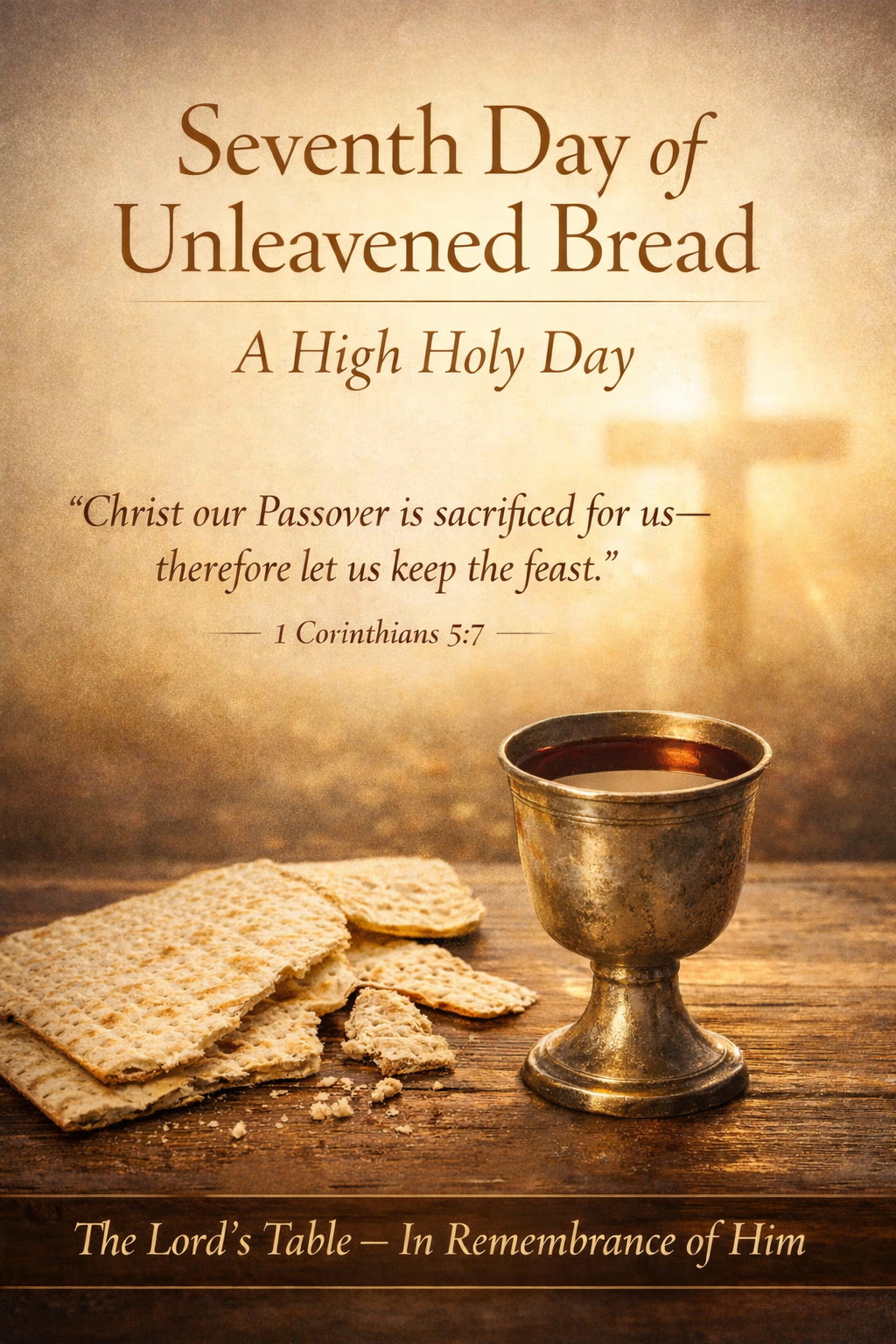
As we come to the Seventh Day of the Feast of Unleavened Bread—a High Holy Day, it is fitting that we pause in thanksgiving and reflection on the fullness of what has been accomplished in Christ, and what continues in Him.
This is not merely a remembrance of something past, but a participation in something present and ongoing.
The Fulfillment of the Offerings in Christ
There is a deep and continuous thread of fulfillment in how we “do this in remembrance”—not as a replacement of the offerings, but as participation in their fulfillment.
As it is written:
“In every place incense shall be offered unto My Name, and a pure offering” (Malachi 1:11).
This points beyond the earthly altar to its heavenly reality.
Christ, as our High Priest—
“passed into the heavens” (Hebrews 4:14),
och
“now to appear in the presence of God for us” (Hebrews 9:24)—
offers perfectly and continually before the Father at the true altar in heaven.
👉 The altar on earth was given as a pattern; the heavenly is the substance.
And so, when we come to the Lord’s Table, we are not instituting something new—we are entering into His perfect and ongoing offering.
The Testimony of Scripture
1. His Offering Was Complete and Without Delay
Hebrews 9:12 — “By His own blood He entered in once…”
Hebrews 10:12 — “After He had offered… sat down…”
👉 The pattern is clear: offering → entering → completion.
Not delay, but fulfillment.
2. He Overcame Death Without Corruption
Acts 2:27 — “Thou wilt not suffer Thine Holy One to see corruption”
👉 Death did not defile Him—He conquered it.
3. His Resurrection Aligns with the Appointed Time
Luke 24:1 — “On the first day of the week…”
👉 Rising immediately following the Sabbath within the feast pattern—
as the Firstfruits.
4. He Was Revealed in the Breaking of Bread
On that very day:
- He sat with them
- He broke bread
- Their eyes were opened
👉 Even in His risen presence, He is made known in this act.
5. The Lord’s Supper as the Gathered Practice
Acts 2:42 — “They continued steadfastly in the apostles’ doctrine and fellowship, in the breaking of bread…”
1 Corinthians 11:20 — “When you come together… this is to eat the Lord’s Supper”
👉 This is not merely a household observance, but something done when the assembly is gathered.
6. “Do This in Remembrance” — An Ongoing Participation
Christ did not limit this to a single yearly moment.
👉 Each time we partake, we proclaim His sacrifice and participate in its fulfillment.
The Seventh Day — A High Holy Day
The Feast of Unleavened Bread is not one day, but seven—
och den Seventh Day is itself a holy convocation.
👉 This final day completes the pattern:
- Deliverance
- Separation
- Purification
- Completion
And even now, we are called to keep the feast:
“Christ our Passover is sacrificed for us: therefore let us keep the feast” (1 Corinthians 5:7–8)
👉 Not merely in symbol—but in truth, in sincerity, and in Christ.
The Apostolic and Early Church Practice
This pattern was not lost after the apostles—it was preserved.
Men such as Polycarp of Smyrna och Polycrates of Ephesus testified strongly to the continued observance of the full Paschal cycle, including the Feast of Unleavened Bread.
Polycrates, in particular, defended this tradition as having been received from:
- the Apostle John
- and the bishops of Asia
👉 maintaining the full pattern of the feast.
This faithful adherence led to conflict with Rome, and ultimately excommunication for those who refused to abandon the apostolic tradition.
The Celtic and Ephesian Continuity
This same tradition—rooted in the Apostle John and the churches of Asia—
was preserved in what is often referred to as the Ephesian tradition.
👉 It is this stream that continued:
- the full Paschal observance
- the keeping of the Feast of Unleavened Bread
- and the recognition of its spiritual and liturgical fulfillment in Christ
This continuity is also reflected in the Celtic Church, which maintained strong adherence to these older apostolic patterns.
The Ongoing Count Toward Pentecost
From Firstfruits, the command is given:
“Ye shall count unto you… from the morrow after the sabbath… seven sabbaths shall be complete” (Leviticus 23:15)
👉 A sacred counting begins.
This count moves:
- from the first day of the week
- to the first day of the week
- until Pentecost
The Church’s Liturgical Witness
This pattern is preserved in the life of the Church.
In the Book of Common Prayer, we see:
- The First Sunday after Easter
- followed by numbered Sundays
- leading to Pentecost
👉 This is not accidental—it reflects the biblical pattern of counting.
And as noted in the 1928 Book of Common Prayer Preface, provision is made that:
👉 additional observances and festivals may be kept
👉 according to pastoral care and availability of ministers
Christ Himself taught that His people would both:
- fast
- and feast
A Living Pattern of Worship
Thus, as we stand on this Seventh Day of Unleavened Bread, we do not stand at the end—but in the midst of a living pattern:
- From Passover
- To Firstfruits
- Through the counted weeks
- Unto Pentecost
👉 A continuous unfolding of the work of Christ.
A Call to the Table
Christ fulfills all things:
- The Lamb
- The Offering
- The High Priest
And even now:
👉 He appears before the Father for us
👉 He gathers His people
👉 He is made known in the breaking of bread
Therefore:
Let us keep the feast.
Let us gather in unity.
Let us partake of the Lord’s Table.
👉 Not only in remembrance—
but in participation in His perfect and ongoing offering.
Closing
On this High Holy Day, we give thanks:
- for what has been accomplished
- for what has been revealed
- and for what continues in Christ
👉 until the fullness of all things is complete.
 Swedish
  English
  German
  Dutch
Dutch  Polish
  French
  Ukrainian