
Pascha, Not Paganism: A Direct Answer to the Claim That “Easter Is Pagan”
A biblical, historical, and practical defense of the Resurrection feast rooted in Passover—not paganism
Quick Overview (Key Points at a Glance)
1. Pascha = Passover fulfilled in Christ — not a pagan feast — The Resurrection celebration comes directly from the biblical Passover fulfilled in Christ.
2. No Church document ever says “adopt a pagan holiday” — There is no historical evidence of intentional pagan alignment.
3. Early Church debates were about timing—and preserving Passover alignment — Pascha was kept according to the equinox, the moon, and the biblical Passover framework, not pagan observance.
4. “Easter” is a local English month-name, not the origin of the feast — A linguistic carryover, not theology.
5. Most of the world calls it Pascha, not Easter — The global Church preserves the Passover meaning.
6. No Easter Bunny in Rome, Italy, or the Orthodox world — A later Western cultural addition.
(Local folklore: Osterhas exclusive to German / Saxon myths, not church theology)
7. Eggs come from Lent fasting and Passover symbolism — Practical and biblical roots.
8. Folk customs are not Church doctrine — Cultural layers developed later.
9. “Fertility and Increase” / A Biblical pattern of worship and reason of celebration — Not inherently pagan.
10. Babylonian-origin claims lack historical continuity — No real transmission chain exists.
11. Calendar differences do not equal pagan compromise — They reflect calculation methods.
12. Scripture: “the substance is Christ” (Col. 2:16–17) — The meaning is anchored in Him.
13. Scripture: days are regarded “unto the Lord” (Rom. 14:5–6) — Observance of many days through the year is directed toward God. (Passover / Pascha is commanded for all our generations, and all our dwellings, for ever.)
14. Conclusion: A Clarification, a Return, and a Call to Faithful Assembly
Introduction: Where This Claim Actually Circulates
Not all Christians around the world have ever heard—or cared about—the claim that “Easter is pagan.”
In fact:
- Багато Eastern Christians have always known the feast simply as Pascha
- Багато European Christians have never associated it with bunnies or modern commercial imagery
This argument tends to circulate most heavily in:
- American Christianity
- Certain parts of Western Protestant culture
- Online communities that position themselves as “rediscovering truth”
It is often presented as a kind of awakening:
“You’ve been celebrating a pagan holiday without realizing it.”
Because of this framing, it can be persuasive—especially to those sincerely seeking a deeper, more biblical faith.
But the argument relies on a confusion of categories, and once those are separated, it begins to fall apart.
The Core Reality: The Feast Is Pascha (Passover Fulfilled)
At its foundation, the Christian celebration of the Resurrection is not derived from paganism—it is rooted in Passover.
The Apostle Paul states:
“Christ our Passover is sacrificed for us.” (1 Corinthians 5:7)
This reflects how the earliest Christians understood the event:
- Christ is the Passover Lamb
- His death fulfills the sacrifice
- His Resurrection completes the victory
Both major expressions of the Church agree:
- The Catholic Church teaches Christ fulfills Passover
- The Eastern Orthodox Church continues to call the feast Pascha
For much of the Christian world, this has never even been a question—the feast is simply the Christian Passover.
What the Early Church Debated—and How They Kept Pascha Aligned with Passover
When we examine the early Church, we do not find debates about adopting pagan practices. Instead, we find careful discussions about how to determine the proper time of Pascha in continuity with the biblical Passover.
Early sources show that the central question was not what the feast meant—it was already understood as Christ’s Passover—but when it should be observed.
Church historians such as Eusebius of Caesarea record disputes over questions like:
- Should the feast follow the 14th day (Passover timing) directly?
- Or should it always be celebrated on a Sunday?
These were questions of calculation and unity, not theology or pagan influence.
At the same time, early Church instructions make clear that Pascha remained anchored to the Passover framework, guided by both Scripture and the observable signs in creation.
The Apostolic Constitutions instruct believers:
“Keep your Passover… after the equinox.”
This reflects the biblical pattern—Passover determined in relation to the spring season and the lunar cycle, not by arbitrary or external festivals.
The same text acknowledges the difficulty of calculation and adds:
“Do not you yourselves compute, but keep it when your brethren of the circumcision do so… lest you fall into error.”
This does not indicate blind dependence, but it shows that the early Church remained aware of the established Passover reckoning, and at times looked to it to avoid miscalculation. The concern was accuracy—not separation.
Taken together, these instructions demonstrate that the early Church was guided by:
- The equinox and the moon
- The Passover pattern of Scripture
- And, when needed, reference to those already observing it
In other words, Pascha was understood as the fulfillment of Passover—not a departure from it.
It is also important to recognize that later developments in certain Western regions—particularly efforts to standardize the date independently of Jewish reckoning—did not represent the entirety of Christian practice. The broader Church, especially in the East, continued to preserve a Paschal understanding closely tied to the traditional cycle connected to Passover.
This is the opposite of what is often claimed: rather than moving toward paganism, the early Church was carefully guarding its alignment with the biblical Passover.
No Evidence of a Pagan Conspiracy
Despite frequent claims, there is:
- No papal decree
- No council decision
- No early Christian writing
that says the Church chose a pagan festival and rebranded it.
Instead, the discussions we actually find involve:
- The spring equinox
- The full moon
- The proper Sunday observance
Even when some Western authorities later avoided aligning with Jewish calendars, this reflects a shift in calculation method, not a turn toward paganism.
The Word “Easter” — A Regional Linguistic Carryover
The only commonly cited “pagan connection” comes from Bede, an 8th-century English monk and historian who documented early Anglo-Saxon customs.
He explains that the month called Eosturmonath had an older name associated with a local tradition, and that Christians continued using that familiar name when referring to the Paschal season.
This is important:
- Bede is describing a local month name
- Not the origin of the feast itself
In other words:
👉 The name carried over
👉 The meaning did not
And globally:
- Greek: Pascha
- Latin: Pascha
- Italian: Pasqua
The English word is the exception, not the rule.
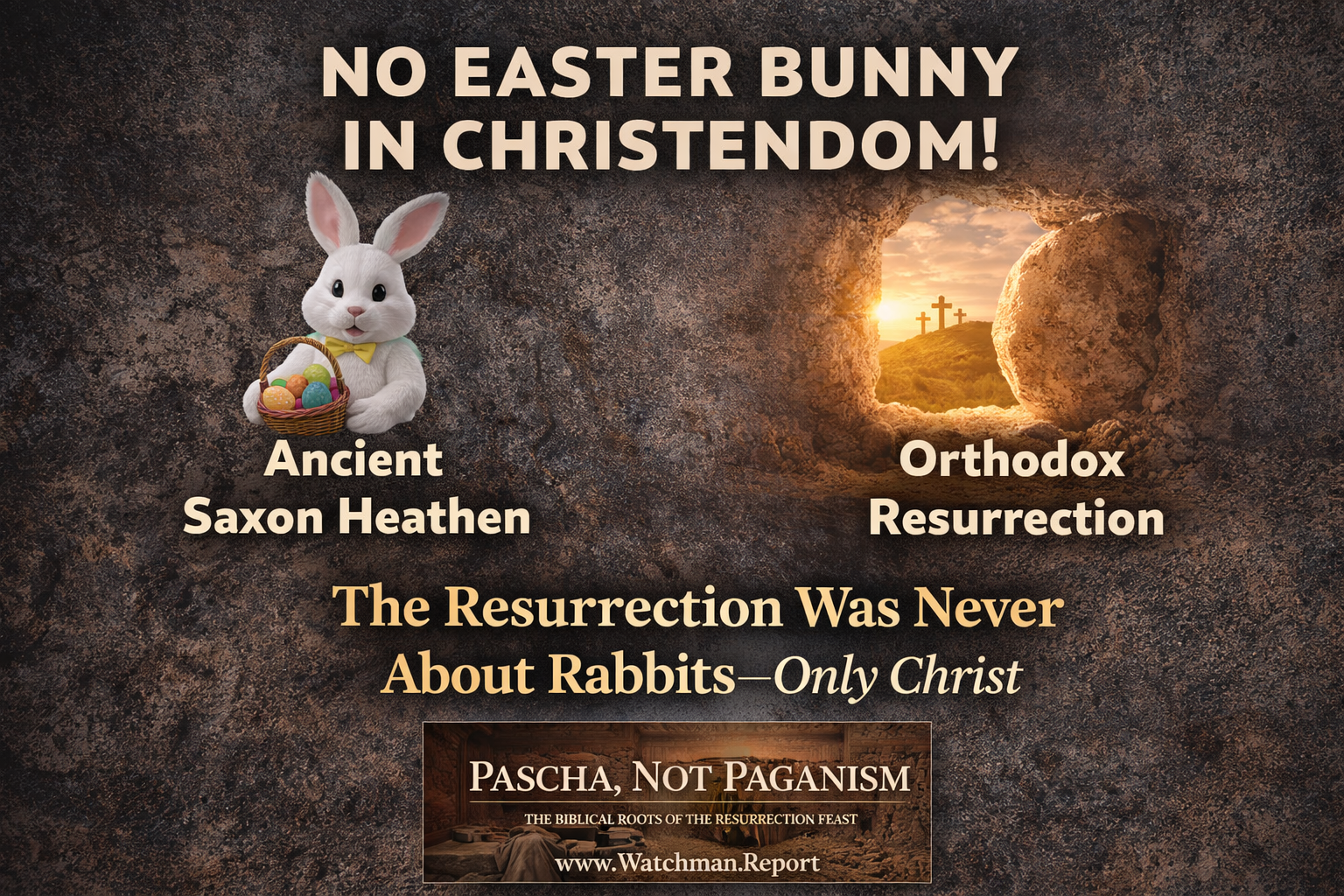
No Easter Bunny in Rome (or Most of Christianity)
This point alone exposes a major flaw in the argument.
There is:
- No Easter Bunny in Rome
- No Easter Bunny in Italy
- No Easter Bunny in Eastern Orthodoxy
- No Easter Bunny in early Christianity
The Easter Bunny is:
- A later Germanic folk tradition
- Popularized in modern Western culture, especially America
It is not:
- Part of Church teaching
- Part of early Christian practice
- Part of global Christianity
So using it as evidence against Christianity is simply misplacing a modern cultural element into ancient history.
Local Folklore vs. the Teaching of the Church
It is important to distinguish between local customs and the actual teaching of the Church.
In some parts of the Germanic world, there existed regional folklore traditions involving seasonal symbols—such as the hare (often associated with springtime activity and new life). These were part of broader cultural patterns, similar to:
- Nature folklore in Ireland (fairies, spirits)
- Seasonal customs tied to the rhythms of the land
These traditions:
- Were local and regional
- Reflected observations of nature (springtime, animal activity, renewal)
- Were not part of Christian doctrine or worship
Over time, some of these customs—particularly in German-speaking regions—became associated with the season in which Christians celebrated the Resurrection. In later centuries, these cultural elements were carried into Western societies, especially through migration.
However, a critical point must be made:
👉 The Church never taught, endorsed, or incorporated these folklore elements into its doctrine or liturgy.
There is:
- No Church teaching about an “Easter Bunny” (Osterhas)
- No liturgical reference to such symbols
- No theological meaning assigned to them
They existed alongside Christian society, not within the teaching of the Church itself.
This distinction is not unique to this case. Throughout history:
- Christian societies have coexisted with local customs
- Not every cultural element was theological
- Not every tradition was an object of worship
Scripture itself acknowledges the existence of other beliefs in the world, while commanding:
“Thou shalt have no other gods before me.” (Exodus 20:3)
The presence of local folklore does not mean the Church adopted it—it simply means that people lived within cultural environments while maintaining the worship of the one true God.
Where Eggs Really Come From
Eggs are often used as “proof” of pagan influence, but their origin is far more grounded.
Passover Context
Eggs are present in the standard Passover meal:
- Representing life
- Connected to sacrificial remembrance
- Seder texts also contain various other renditions on the symbology
This places them firmly within a Biblical non-pagan framework.
Lenten Fasting (The Most Direct Explanation)
In early Christian life:
- Eggs were often abstained from during Lent
- Chickens continued laying eggs
- Eggs accumulated over time
When Pascha arrived:
- The fast ended
- Eggs were eaten in celebration
They became:
- A symbol of joy after fasting
- A visible expression of renewal and life
Over time, Christians also saw deeper symbolism:
- The sealed shell → the tomb
- The life within → the Resurrection
This is a natural development of Lenten practices stem from a genuine Hebrew practice of fasting mandated in words of Christ—not pagan borrowing.
Fertility and Increase: A Biblical Pattern of Worship
Scripture does not treat the increase of the land—grain, oil, and wine—as something pagan, but as a direct blessing from God and a reason for worship.
“Thou visitest the earth, and waterest it… Thou crownest the year with thy goodness… the valleys also are covered over with corn; they shout for joy, they also sing.” (Psalm 65:9–13)
Here, the abundance of the land is not merely agricultural—it is liturgical. The increase itself becomes a cause for rejoicing before God.
Likewise:
“Then shall the earth yield her increase; and God, even our own God, shall bless us.” (Psalm 67:6)
This “increase” reflects covenant blessing. When God’s people walk rightly, the land responds with fruitfulness, and that fruitfulness is received with thanksgiving and praise.
Even in personal devotion:
“Thou hast put gladness in my heart, more than in the time that their corn and their wine increased.” (Psalm 4:7)
This verse shows that rejoicing in increase was already understood as a natural expression of joy—so much so that spiritual joy is compared to it.
The appointed feasts of Israel were built around this same pattern:
- Passover and Firstfruits — the beginning of harvest
- Pentecost — the fullness of harvest
These were not pagan fertility rites, but God-ordained celebrations of provision, increase, and life.
Nowhere does Scripture forbid rejoicing in such “fertility” of the land—it consistently encourages it as part of faithful worship.
The “Babylonian Origin” Claim
This claim raises more questions than it answers.
If Easter came from Babylon:
- How did it reach isolated Germanic tribes?
- Where is the historical transmission?
- Why do the claims change depending on the argument?
There is no consistent historical chain.
Instead, the claim relies on:
- Loose comparisons
- Assumptions
- Repetition without documentation
Calendar Differences Are Not Paganism
It is true that:
- Western and Eastern churches sometimes celebrate on different dates
- Pascha does not always match Jewish Passover exactly
But this is due to:
- Calendar systems
- Astronomical calculations
- Different methods of reckoning
Not pagan influence.
What Scripture Actually Teaches
Scripture brings clarity:
“Let no man therefore judge you… in respect of a holyday… which are a shadow… but the substance is Christ.” (Colossians 2:16–17)
And:
“He that regardeth the day, regardeth it unto the Lord.” (Romans 14:5–6)
Christ also affirmed fasting:
“When the bridegroom is taken away… then shall they fast.” (Matthew 9:15)
The early Church lived this out:
- Fasting
- Feasting
- Observing sacred times
But always centered on Christ.
Conclusion: A Clarification, a Return, and a Call to Faithful Assembly
For much of the Christian world, this has never been a controversy. The feast has always been known for what it truly is—Pascha, the Passover fulfilled in Christ, the Lamb who was slain and who rose again.
The modern claim that “Easter is pagan” is largely a product of recent Western confusion—mixing language with theology, confusing local customs with the doctrine of the Church, and overlooking both Scripture and the historical witness of Christianity across the world. But when these layers are stripped away, what remains is not something reinvented, but something received—handed down, observed, and centered on Christ from the beginning.
And this matters, because Scripture does not treat these things as optional or empty. The appointed times of God were given as holy convocations—assemblies:
“These are the feasts of the Lord… holy convocations, which ye shall proclaim in their seasons… throughout your generations in all your dwellings.” (Leviticus 23)
The Passover was not merely a private remembrance—it was a gathered observance, fulfilled in Christ and carried forward in the life of His Church. And so we are exhorted:
“Not forsaking the assembling of ourselves together… but exhorting one another: and so much the more, as ye see the day approaching.” (Hebrews 10:25)
The celebration of Pascha is not about adopting worldly customs—it is about the faithful assembly of the people of God, proclaiming together the death and Resurrection of Christ.
At the same time, we must not fall into another error—that of calling things unclean which God has cleansed. When Peter saw the vision of the great sheet descending from heaven, filled with all kinds of animals, the Lord declared:
“What (heathens) God hath cleansed, that call not thou common.” (Acts 10:15)
This was not only about food—it was about people. The Gentiles, or peoples who don’t have the calendar perfect yet, were once considered outside. However this Scripture tells us they are now brought near, made clean in Christ. The Gospel did not remain confined—it was readily accepted by the gentile-kindred cultures (“twelve tribes instantly received Christ” Acts 26:7) each of such tribal kindred gen-cultures (broader gentry/gentiles) required sacrifices (which they saw with the ultimate fulfilment in Christ).
And in doing so, the Church did not become pagan—it sanctified what it touched, calling all things into submission under Christ, who is:
“King of kings, and Lord of lords.” (Revelation 19:16)
So when we look at the celebration of the Resurrection, we are not looking at a borrowed pagan rite, but at the fulfillment of God’s appointed times, the gathering of His people, and the proclamation of His victory.
The feast is not about rabbits.
It is not about speculation.
It is not about reclaiming something lost.
It is about Christ.
“Christ our Passover is sacrificed for us.” (1 Corinthians 5:7)
And as Scripture reminds us:
“Let no man therefore judge you… in respect of a holyday… which are a shadow of things to come; but the substance is Christ.” (Colossians 2:16–17)
This is not a reinvention.
It is a return to understanding.
A return to Scripture.
A return to the unity of the Church.
And above all, a return to the One in whom all things find their meaning:
👉 The substance is Christ.
If this article was meaningful, and if you want to share it, you can nicely use the below text. Alternatively, these days memes are people increase exposure on social media. So you can find a handy meme to accompany it below.
BONUS MEME:
You can share this below graphic with the following text:
Many claim that “Easter is pagan”—but is that really true?
The historical Christian feast is Pascha, rooted in Passover and fulfilled in Christ—not in paganism.
This article breaks it down clearly from Scripture, history, and the life of the Church.
👉 Read here:
https://celticorthodoxy.com/2026/03/easter-not-pagan-pascha-answer/
 Ukrainian
  English
  German
  Dutch
Dutch  Polish
  Swedish
  French