
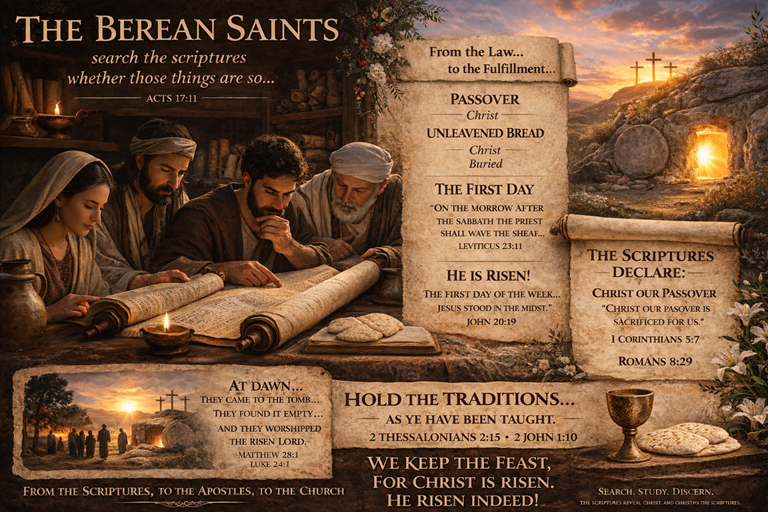
Pascha at Dawn: The Firstfruits, the Resurrection, and the Apostolic Pattern of Worship
A Living Tradition Rooted in Scripture
Before turning to the Scriptures themselves, it is helpful to begin with the living practice of the Church, because the liturgy preserves what the apostles handed down in a continuous and recognizable form.
Among Western traditions, the Book of Common Prayer provides one of the clearest and most faithful expressions of Pascha (Easter) as a sunrise celebration grounded in Scripture. On the day of Pascha (called Easter on some calendars), the ordinary morning call to worship (or Orthodox 1st canonical hour) is replaced with the Paschal proclamation:
“Christ our Passover is sacrificed for us; therefore let us keep the feast.
Not with the old leaven… but with the unleavened bread of sincerity and truth.”
(1 Corinthians 5:7–8)
This is not a later invention, nor a departure from biblical practice. Rather, it is a direct proclamation of fulfillment: the Passover finds its completion in Christ, the feast continues in Him, and the resurrection reveals the true meaning of Firstfruits. The Church is not abandoning the Hebrew foundation—it is living in its fullness.
At the same time, several churches within our broader communion—particularly those shaped by the Lutheran liturgical tradition—retain a strong and joyful proclamation of the resurrection itself: “Christ is risen! He is risen indeed!” This echoes the same confession preserved in Eastern Christianity and reflects a shared instinct across the historic Church: the resurrection is not merely remembered quietly, but openly declared. In this, there is genuine unity across traditions.
Historically, this pattern is also seen in the Sarum Missal, which represents the pre-Reformation English rite, as well as in Gallican and Celtic traditions, which emphasize the symbolism of light, dawn, and new creation. Even later Western expressions, including Lutheran sunrise services, continue this same instinct of gathering at daybreak. All of these, across centuries and regions, converge on a single truth: the resurrection of Christ was celebrated at dawn as the beginning of the new creation.
The Scriptural Foundation: Morning, Offering, and Firstfruits
When we turn to Scripture, we find that this pattern is deeply rooted in the biblical order of worship. The day, in the life of Israel, begins with morning sacrifice, prayer, and offering.
- Exodus 29:39 — “The one lamb thou shalt offer in the morning…”
- Leviticus 6:12 — the priest prepares the fire on the altar every morning
- Exodus 30:7 — incense is offered each morning as the lamps are tended
- Psalm 5:3 — “In the morning will I direct my prayer unto thee…”
This establishes a clear rhythm: the morning is the time when sacrifice is offered, when prayer ascends, and when the people of God begin their day before Him.
The same morning pattern—sacrifice, prayer, and offering—was already established in the Law, and the resurrection occurs directly within that framework, fulfilling it rather than replacing it.
Alongside this, the people were commanded to bring their firstfruits:
- Deuteronomy 26:10
“I have brought the firstfruits… and thou shalt set it before the LORD…”
These offerings were not abstract ideas, but tangible acts of worship. The people gathered the first yield of their crops, placed them in baskets, brought them to the appointed place, and set them before the Lord through the priest. This act acknowledged that all provision came from God and that the first and best belonged to Him.
Alongside this, Scripture also establishes the principle of the firstborn, particularly the male, being dedicated to the Lord and then redeemed. As it is written, “Sanctify unto me all the firstborn” (Exodus 13:2), and again, “the firstborn of man shalt thou surely redeem” (Numbers 18:15). This shows that the first increase—whether of the field, the flock, or the womb—was not treated casually, but recognized as belonging to God, either through offering or through redemption.
In a practical sense, this would have included whatever came first in abundance at the beginning of the season. In agrarian life, especially as spring begins, one of the earliest and most noticeable increases is the renewed laying of eggs. These, along with the first produce of the land, naturally formed part of the early yield that could be gathered and presented before the Lord. While later customs have taken on various cultural forms, the underlying pattern is deeply biblical: gathering the first and best of what God has provided—whether grain, fruit, or early increase—and dedicating it to Him.
Seen in this light, even later traditions such as the use of baskets at the time of the resurrection can be understood, not as foreign inventions, but as distant echoes of this older biblical practice. The form may have changed over time, but the principle remains the same: to acknowledge God as the giver of life, to honor Him with the first of all increase, and to recognize that through Him all things are redeemed.
The Appointed Day: Firstfruits on the First Day
The timing of this offering is especially important.
- Leviticus 23:11
“On the morrow after the sabbath the priest shall wave it.”
This means that the offering of Firstfruits took place on the first day of the week. It marked the beginning of the harvest and served as both a sign and a guarantee that more was to come.
When we come to the New Testament, this same language is applied directly to Christ:
- 1 Corinthians 15:20 — “Christ… the firstfruits of them that slept.”
- Romans 8:29 — “The firstborn among many brethren.”
- Romans 4:25 — “Raised again for our justification.”
In this light, Christ is not merely compared to Firstfruits—He є the Firstfruits. He is the offering presented before God, the beginning of the resurrection harvest, and the guarantee of what is to come for all who belong to Him.
At the same time, Scripture reveals another closely related pattern: the principle of the firstborn.
In the Law, the firstborn belonged to God:
- Exodus 13:2 — “Sanctify unto me all the firstborn…”
- Numbers 18:15 — “The firstborn of man shalt thou surely redeem…”
This establishes a twofold pattern within the Old Covenant. The first increase of the field was offered as firstfruits, while the firstborn—especially the male—was set apart to the Lord and then redeemed. Both practices point forward to something greater.
In Christ, these two streams come together.
He is not only the Firstfruits offered before God—He is also the Firstborn, the head of a new family. His resurrection is not simply His own victory over death, but the beginning of a new humanity.
This is why Scripture speaks of believers in this way:
- 2 Corinthians 5:17 — “If any man be in Christ, he is a new creature…”
To be “in Christ” is to be part of what He has already begun. He stands as the Firstfruits of the resurrection, and we follow in that same harvest. He is the Firstborn, and we are counted among the brethren. What was once represented through offerings and redemption in the Law is now fulfilled in Him.
In this sense, the redemption of the firstborn finds its fullest meaning in Christ. He is both the One who is given and the One who redeems. And those who belong to Him are brought into that same life—not merely under the shadow of the Law, but living in the reality to which it always pointed.
The Resurrection at Dawn
The timing of the resurrection itself confirms this pattern.
Christ had already risen before full daylight. The discovery of the empty tomb takes place in the early hours, at the very moment when the morning offerings and prayers would have been underway. In this way, the resurrection aligns perfectly with the established rhythm of Scripture: the morning sacrifice, the rising incense of prayer, and the presentation of Firstfruits all find their fulfillment in Him.
The resurrection did not introduce a new pattern of worship—it occurred within the already established rhythm of morning sacrifice, prayer, and firstfruits offering, bringing all three to their fulfillment in Christ.
Christ Appears on the First Day
The significance of the first day does not end with the resurrection itself. It is also the day on which Christ chooses to reveal Himself to His Church.
- John 20:19
“The same day at evening, being the first day… Jesus stood in the midst…” - John 20:26
“After eight days… again his disciples were within…”
These two appearances—one on the day of the resurrection and another on the following first day—establish a clear pattern. The disciples are gathered together, the doors are shut for fear, and Christ comes into their midst, bringing peace and confirming their faith. In the second appearance, Thomas is present and is invited to see and touch the wounds, removing all doubt.
Over time, this day becomes associated with gathering, fellowship, and the breaking of bread:
- Acts 20:7 — “Upon the first day of the week… to break bread…”
This does not represent the abandonment of the Sabbath, but rather the recognition that something new has taken place. The first day becomes a day of resurrection fellowship, rooted in Christ’s own actions.
The Apostolic Pattern: Doctrine, Fellowship, and Communion
This brings us back to the life of the early Church itself.
- Acts 2:42
“They continued steadfastly in the apostles’ doctrine and fellowship in the breaking of bread and in the prayers.”
This was not a casual or optional practice. The believers devoted themselves to a shared life that was structured around teaching, fellowship, communion, and prayer. These were not independent activities, but parts of a unified pattern of worship and life.
This pattern was also guarded and handed down:
- 2 Thessalonians 2:15 — “Hold the traditions…”
- 2 John 1:10 — a warning regarding those who do not bring the same doctrine
The early Church was not a collection of individuals each following their own path. It was a body that received, preserved, and lived out what had been given by the apostles.
What Is Being Missed Today
In recent years, some have attempted to return to what they believe to be a more “original” form of worship by stepping away from Pascha and from the liturgical life of the Church. In doing so, however, they often overlook the very fulfillment that the Scriptures themselves point to.
The Gospel is not only that Christ died, but that He rose again.
- 1 Corinthians 15:17 — “If Christ be not raised, your faith is vain…”
The resurrection is central. It is the moment in which death is overcome, justification is secured, and new life begins.
- 2 Corinthians 5:17 — “If any man be in Christ, he is a new creature…”
To neglect the celebration of the resurrection is not simply to omit a tradition—it is to miss the full expression of the new life that has been given in Christ, the true Firstfruits.
Pascha: Fulfillment, Not Replacement
Pascha does not replace the Hebrew Scriptures; it brings them to completion.
Passover is fulfilled in Christ’s sacrifice.
Unleavened Bread is fulfilled in His sinless body and burial.
Firstfruits is fulfilled in His resurrection.
For this reason, the Church gathers at dawn, offers prayers, proclaims the resurrection, and breaks bread in remembrance of Him. This is not departure—it is fulfillment.
A Call to Unity and Participation
This year provides a unique opportunity, as the timing allows many across Christendom to observe the resurrection together. This is not a time for division, but for unity in the truth of the Gospel.
Whether one follows the Book of Common Prayer, a Sarum or Celtic-derived liturgy, or joins in the Lutheran proclamation of the resurrection, the call is the same: to gather, to proclaim, and to remember.
Висновок
Pascha is not an optional observance, nor a later addition. It is the proclamation of the central truth of the faith: that Christ, who died for our sins, has risen again and become the Firstfruits of a new creation.
In Him, we are made new.
In Him, the harvest has begun.
In Him, the promises of God are fulfilled.
Christ is risen. He is risen indeed.
 Ukrainian
  English
  German
  Dutch
Dutch  Polish
  Swedish
  French