The Crosfigell or Cross-Vigil in Celtic Orthodoxy
Sources, Theology, and Practice
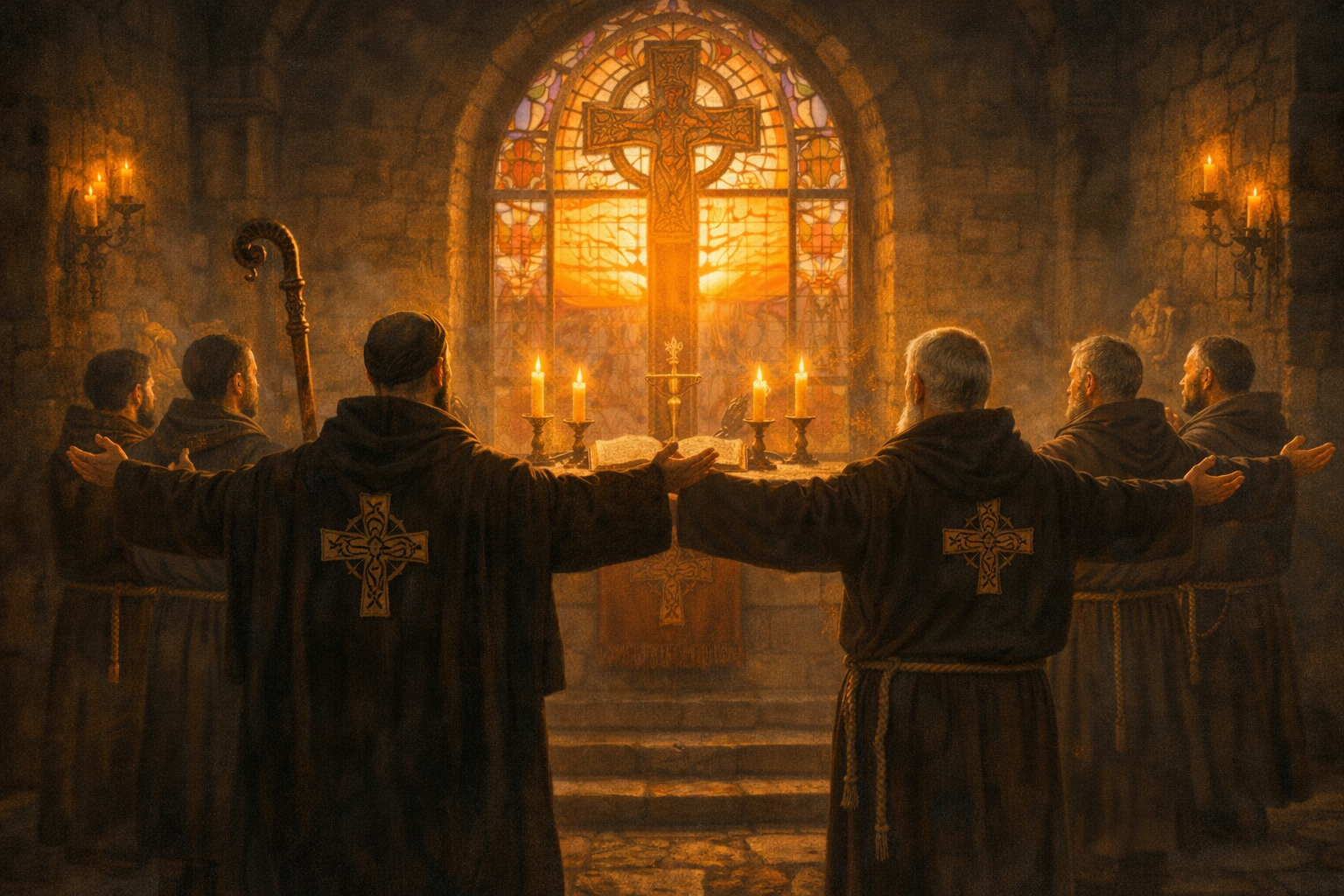
The early Irish crosfigell—usually rendered cross-vigil—is one of the most striking bodily prayers in the Celtic Christian tradition. It unites the cruciform posture with the Lord’s Prayer, Deus in adjutorium, the Gloria Patri, and the Sign of the Cross, offered directionally to the four quarters of the world, then toward earth and heaven—a full twelve-station prayer of the Kingdom of God.
This is not speculative reconstruction. It is preserved most clearly in the Tallaght recension of the Rule of the Céli Dé, where the rite is named both the “Shrine of Piety” (comrair chrabuid) and the “Breastplate of Devotion” (lúirech léire). This article gathers the principal early sources, explains their theology, and presents a historically grounded Celtic Orthodox understanding of the Cross-Vigil as a liturgical act of Christ’s victory over the world.
1. What the early texts actually say about crosfigell
1.1 The Rule of the Céli Dé (Tallaght): “Shrine of Piety” and “Breastplate of Devotion”
The key textual witness is the Rule of the Céli Dé as preserved at Tallaght under St. Máel Ruain.[1] In §6 of the Tallaght recension, the rite is laid out with exceptional clarity.
Pater sair prius & Deus in adiutorium usque festina, & da dhi láim suas fria nem & airrdhe na croise cot láim ndeiss iarum.
Similiter in cech aird sic sis & suass.
Is hi trá comrair chrabuid leosom, acht is crosfigell prius.
Lúirech léire diwo a ainm-side.[1][2]
Standard scholarly translation:
First the Pater is said, facing east.
Then “Deus in adjutorium… Domine ad adiuvandum me festina.”
This is done with both hands raised to heaven,
and then the Sign of the Cross is made with the right hand.
The same is done in each direction, likewise downward and upward.
This is what they call the Shrine of Piety,
but it is first a cross-vigil,
and its name is the Breastplate of Devotion.[1][2]
This Tallaght text is decisive:
• It defines crosfigell as the core practice
• It identifies it as lúirech léire — a spiritual breastplate
• It specifies four directions + down + up = three rounds of four = twelve stations
• It fixes the liturgical formula:
Pater → Deus in adjutorium → Gloria Patri / Sign of the Cross
This twelve-station structure is not symbolic guesswork. It is embedded in the Tallaght rubric itself and will be illustrated in the Irish-English manuscript image you will insert from pp. 6–7 of Gwynn’s Tallaght edition. Page image from the parallel version (Irish and English):

1.2 Crosfigell as cruciform orans — “Vigil of the Cross”
The term crosfigell literally means “vigil of the Cross.” Amy Remensnyder shows that it names both a posture і a liturgical action:
The Irish crosfigell denotes a crucifixion-like orans posture, arms outstretched in the form of the Cross, and is also called lúirech léire — “breastplate of devotion.”[4][9]
This confirms that the Tallaght text is not inventing a metaphor. The body itself becomes the Cross, a living icon of Christ crucified, offered to God.
1.3 Penitentials and De arreis
The Irish penitential De arreis shows how the cross-vigil functioned as a disciplined ascetical prayer. Kuno Meyer records formulas such as:
• “seven Beati in cross-vigil”
• “Beati immaculati in cross-vigil without lowering the arms”[7]
Thom and Monge Allen confirm:
Figel / crosfigell is either a period of vigil or a defined cruciform posture, performed kneeling or prostrate with arms extended as a cross, intended to discipline both body and mind.[5][8]
Thus the Cross-Vigil was never symbolic. It was embodied theology.
1.4 The Monastery of Tallaght
Tallaght preserves Máel Ruain’s own vigils:
• He recited Psalm 119 onward in cross-vigil
• He performed four nightly cross-vigils
• One evening vigil consisted of thirty Paternosters in cross-vigil
• A superior was described as raising his arms as in a cross-vigil in thanksgiving[3][6]
This shows both standing cruciform і prostrate cruciform forms were known.
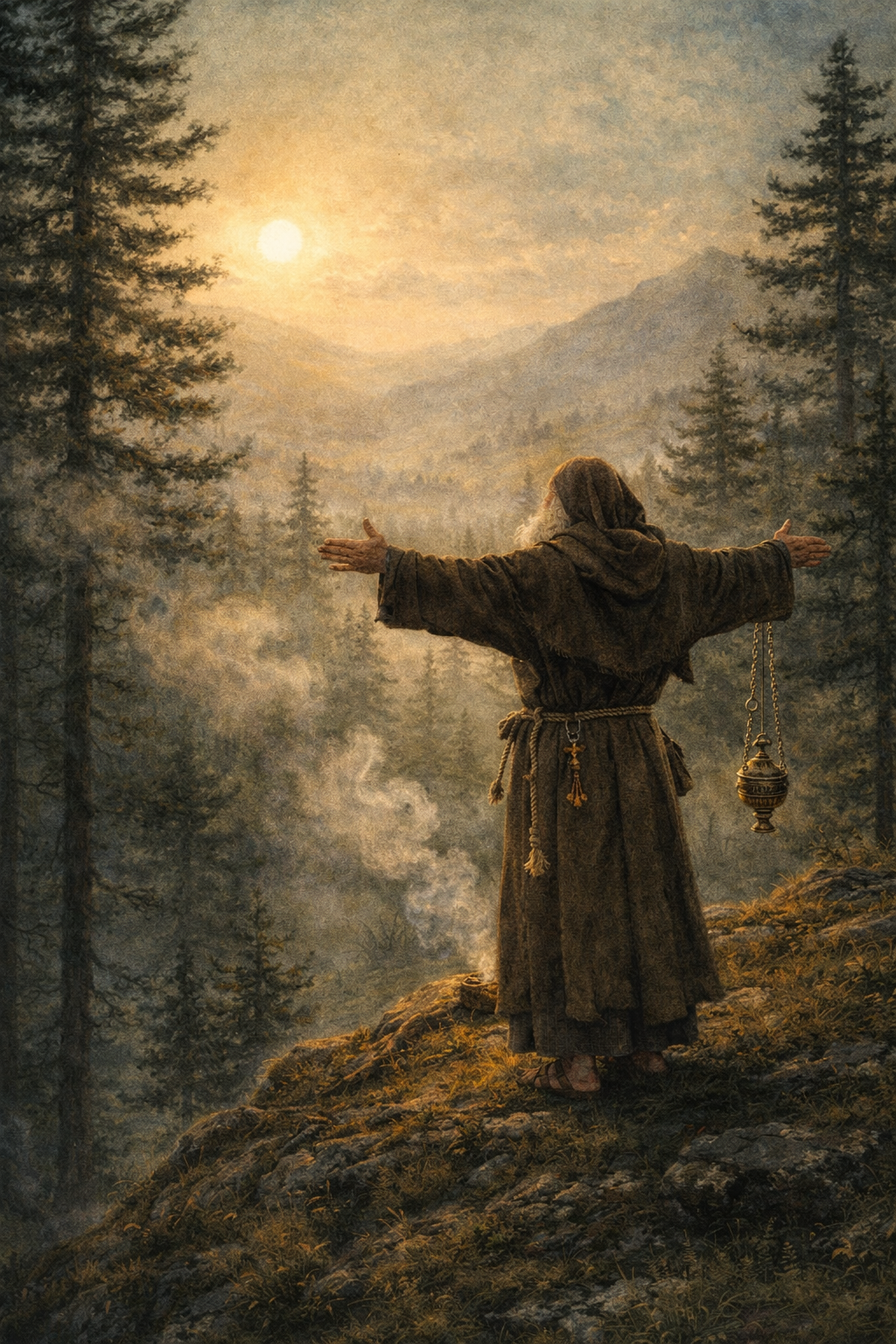
1.5 Later memory: standing cruciform prayer
Lisa Bitel and others record Irish monks:
chanting prayers while stretching their arms out rigidly in the form of a cross[6]
This posture became iconic of Irish sanctity.
2. Theological meaning of the Cross-Vigil
2.1 Conformity to Christ
The Cross-Vigil embodies Galatians 2:20 — “I am crucified with Christ.” The monk’s body becomes a living crucifix.[4][6]
2.2 Moses and spiritual warfare
Like Moses on the hill, the monk’s raised arms sustain victory (Exod 17). Irish theology understood physical endurance in prayer as spiritual warfare.[5][8]
2.3 The Twelve-Station Kingdom Rite
The Tallaght rite sanctifies:
• East, North, West, South
• Earth beneath
• Heaven above
Repeated in three rounds = twelve stations
This is a prayer for His will and Kingdom in heaven to now be done on earth.
3. The core structure of the Cross-Vigil
From Tallaght:
At each of the twelve stations:
-
Face the direction
-
Pater Noster
-
Deus in adjutorium… Domine ad adiuvandum me festina
-
Gloria Patri
-
Sign of the Cross
-
Return to cruciform orans
[1][2][3]
4. Paternosters, psalms, and the Cross-Vigil
4.1 Fixed numbers of Paternosters in Cross-Vigil
The early Irish sources do not present “thirty Paternosters in cross-vigil” as a universal obligation, but as a recognized Culdee discipline. The Monastery of Tallaght records that one of St Mael Ruain’s major evening cross-vigils consisted of thirty Paternosters (xxx pater) recited in cruciform posture.[3][8]
This is not casual prayer-counting; it is a liturgical offering of the whole body and voice together. The monk remains in the Cross while the Lord’s Prayer — the prayer of the Kingdom — is repeated until the will of God is ritually and physically inscribed upon him.
This Tallaght discipline also explains why later Western rules — including knightly and monastic orders — prescribed 14, 21, or 30 Paternosters as penitential or devotional acts. Those later rules did not invent the practice; they inherited it from the Culdee Cross-Vigil tradition.
4.2 Psalms and the Beati within the Cross-Vigil
The Irish penitential De arreis and its interpretive tradition show that Псалом 118/119 (the Beati) became the psalm of the Cross-Vigil.[7][8] Multiple penances are defined as:
• “seven Beati in cross-vigil”
• “Beati immaculati in cross-vigil without lowering the arms”
• or Beati combined with genuflexions or bodily endurance.[7]
Monge Allen demonstrates that among the Céli Dé of Tallaght and Terryglass, the Beati functioned as a penitential psalter within the Cross-Vigil, shaping both repentance and perseverance.[8]
This is deeply theological:
Псалом 118/119 is the psalm of Torah fulfilled in Christ — the law written not on tablets, but on the body and heart. To recite it in the posture of the Cross is to submit the entire person to the reign of Christ.
5. The Cross-Vigil as the Armor of Devotion
5.1 The Culdee “Breastplate” tradition
The Rule of the Céli Dé explicitly calls the Crosfigell:
“the Breastplate of Devotion (lúirech léire)”[1][2]
In early Irish Christianity, “breastplate” (lorica) did not mean metaphor — it meant spiritual armor. A lorica was a prayer that clothed the soul in Christ, protecting against spiritual attack and disorder.
This is why Irish Christianity produced entire genres of armor prayers, including:
• the Breastplate of St Patrick
• the Breastplate of Columba
• and the Culdee Breastplate of Devotion
All of them express the same spiritual logic:
Христе above, beneath, before, behind, left, and right —
the Cross sealing the whole created order.
5.2 The Cross-Vigil and St Patrick’s Breastplate
The ancient Lorica of St Patrick proclaims:
Christ with me, Christ before me, Christ behind me,
Christ in me, Christ beneath me, Christ above me,
Christ on my right, Christ on my left…
This is not abstract poetry — it mirrors the very geometry of the Crosfigell:
• East — Christ before
• West — Christ behind
• North — Christ on the left
• South — Christ on the right
• Downward — Christ beneath
• Upward — Christ above
The Culdee twelve-station Cross-Vigil gives this prayer a body.
What Patrick proclaimed with words, the Culdees enacted with arms, breath, and direction.
5.3 Martyrological memory: Oengus the Culdee
Amy G. Remensnyder confirms that the cruciform prayer posture of Irish monasticism was known by the same armor-language:
lúirech léire — the “breastplate of devotion” — preserved in the Irish martyrological and devotional tradition associated with the Félire Óengusso (Martyrology of Oengus the Culdee).[4][9]
This proves that the Cross-Vigil was not an eccentric Tallaght experiment.
It belonged to the mainstream memory of Irish sanctity, preserved in the very calendar of saints that shaped Irish spirituality for centuries.
6. The Crosfigell today: restoring the Culdee rule of the Cross
The Crosfigell is not being invented.
It is being restored.
The Orthodox Church of the Culdees stands in the apostolic and monastic succession of Tallaght, Bangor, Iona, Luxeuil, Bobbio, St Gall, and the Merovingian and Angevin Culdee monasteries of Gaul — the same Culdee world from which Chrodegang, Columbanus, and the Carolingian reforms arose.
This restoration is not antiquarian. It is місіонер.
As St Paul declared:
“I determined to know nothing among you except Jesus Christ, and Him crucified.”
(1 Cor 2:2)
The Cross is the engine of the Kingdom.
The Crosfigell is the body praying the Cross.
This practice directly embodies what Christ taught:
“Thy Kingdom come.
Thy will be done,
on earth as it is in heaven.”
The Culdee Cross-Vigil makes that petition physically real.
7. Training and liturgical restoration
Members of the Православна церква Кульдесів may receive direct instruction in the Crosfigell through Culdee workshops led by the Prior of St Andrew’s,
Rev. Dr. Stephen M. K. Brunswick, ThD, PhD,
Primate of the Orthodox Church of the Culdees.
These sessions teach:
• the Tallaght twelve-station form
• cruciform orans posture
• psalmic integration
• Kingdom theology of the Cross
so that the Crosfigell is restored not as a curiosity, or usage by our remote monastics, but as a living rule of prayer for the broader faithful.
Висновок
The Crosfigell є forgotten engine of Celtic Christianity —
the prayer by which saints stood inside the victory of Christ
and proclaimed His Kingdom
to the ends of the earth,
the depths of death,
and the heights of heaven.
The Breastplate of Devotion is being worn again.
✠
Notes and Sources
[1] Rule of the Céli Dé (Rule of the Culdees)
Primary Old Irish monastic rule of the Culdee reform movement centered at Tallaght under St. Mael Ruain (8th–9th c.). This is the earliest surviving liturgical description of the Crosfigell, where it is called both the “Shrine of Piety” (comrair chrabuid) та “Breastplate of Devotion” (lúirech léire) and where the sequence Pater → Deus in adjutorium → Sign of the Cross toward the directions is laid out.
https://celticorthodoxy.com/wp-content/uploads/2023/10/RULE-OF-THE-CELI-DE.pdf
[2] Rule of Tallaght (Hermathena XLIV, Edward Gwynn, 1927)
Parallel recension of the Tallaght Culdee rule preserved in Latin and Old Irish with English translation. This manuscript (pp. 6–7) provides the most detailed liturgical rubric of the Crosfigell as a twelve-station directional rite (four directions × downward × upward), making it the authoritative witness for how the Culdee Cross-Vigil was actually performed.
https://www.scribd.com/document/701200015/The-Rule-of-Tallaght
[3] E. J. Gwynn & W. J. Purton, The Monastery of Tallaght
Foundational historical study of Tallaght and its Culdee monks, including Mael Ruain’s own ascetical practices. Contains multiple references to cross-vigils, including the famous thirty-Paternoster cross-vigil, and defines one form of the crosfigell as “lying prostrate with his arms stretched out in the form of a cross.”
https://archive.org/download/monasteryoftalla29gwynuoft/monasteryoftalla29gwynuoft.pdf
[4] Amy G. Remensnyder, “Sacral Geographies: Saints, Shrines, and Territory in Medieval Ireland” (Brepols)
Modern scholarly synthesis explaining how crosfigell functioned as a recognized liturgical posture and why it was known as lúirech léire (“breastplate of devotion”) in the Irish devotional and martyrological tradition, including the Félire Óengusso. This is the key authority for linking the Cross-Vigil to Irish spiritual armor theology.
https://www.academia.edu/1906765
[5] Thom, The Ascetical Theology and Praxis of Sixth to Eighth Century Irish Monasticism (University of Edinburgh)
Doctoral thesis synthesizing early Irish sources on figel / crosfigell. Establishes that it was a physically demanding bodily vigil, often kneeling or prostrate, with arms extended in cruciform, used for spiritual warfare, repentance, and intercession.
https://era.ed.ac.uk/bitstream/1842/7273/1/370588_vol1.pdf
[6] Lisa M. Bitel, Isle of the Saints (Cornell University Press)
Standard historical work on early Irish monasticism. Using Tallaght sources, Bitel describes Irish monks “chanting prayers while stretching their arms out rigidly in the form of a cross,” confirming that the standing cruciform Crosfigell was a known and recognizable Culdee practice.
https://www.scribd.com/document/905532196
[7] Kuno Meyer, “An Old Irish Treatise De Arreis” (1894)
Edition and translation of the early Irish penitential De arreis (“Of Commutations”), which preserves multiple penances explicitly performed “in cross-vigil.” Includes phrases such as “seven Beati in cross-vigil” і “Beati immaculati in cross-vigil without lowering the arms.”
https://www.scribd.com/document/295854830
[8] E. Monge Allen, “Beati immaculati in via: Sin and Reconciliation among the Céli Dé of Tallaght and Terryglass”
Specialized study of Culdee penitential spirituality showing that Псалом 118/119 (the Beati) functioned as the psalm of the Cross-Vigil, frequently paired with figel / crosfigell posture in Tallaght and Terryglass.
https://researchrepository.universityofgalway.ie/bitstreams/f421d801-a704-4c95-afa7-889c2c576bb7/download
[9] Félire Óengusso (Martyrology of Oengus the Culdee) — historical background
Early ninth-century Irish martyrology produced within the Culdee movement, preserving the spiritual and liturgical vocabulary of the Irish Church. While not itself a liturgical manual, it belongs to the same devotional corpus from which lúirech léire (“breastplate of devotion”) language is preserved and interpreted by modern scholars such as Remensnyder.
https://celticorthodoxy.com/2024/03/the-life-and-works-of-st-aengus-the-culdee-hagiographus/
 Ukrainian
  English
  German
  Dutch
Dutch  Polish
  Swedish
  French