The report, titled Cuba: The Capital of 21st Century Communism, traces this campaign from Fidel Castro’s rise in 1959 through the militant New Left, the Weather Underground, American universities, political organizations, nonprofit networks, and contemporary activist movements.
The central question raised by this history is no longer merely whether communist Cuba conducted espionage against the United States. That is abundantly documented. The deeper question is whether the West has experienced a form of conquest without invasion—a gradual and largely covert occupation of its institutions, language, culture, and political consciousness.
Read the complete Department of State Cuba Report here.
What Is “Red Fascist Communism”?
The term red fascist communism describes revolutionary communist government operating through methods of totalitarian social control commonly associated with fascist systems.
Red fascist communism is Marxist-Leninist revolutionary power functioning through centralized authority, ideological conformity, political policing, surveillance, purges, intimidation, propaganda, suppression of dissent, and the conversion of social institutions into instruments of the ruling movement.
It is red because of its communist ideological lineage. It is described as fascistic because of its operational character: the supremacy of the state or revolutionary movement over the individual, the removal of meaningful institutional independence, and the demand that education, culture, labor, law, media, religion, and civil society serve a unified political purpose.
This does not mean that communist and historical fascist ideologies are identical in every respect. They have different economic theories, symbols, historical narratives, and declared constituencies. Nevertheless, their mature systems of control often display striking similarities:
- concentrated political authority;
- one acceptable ideological narrative;
- politicized courts and law enforcement;
- surveillance of the population;
- purges and loyalty examinations;
- propaganda presented as education or journalism;
- organized intimidation of political dissenters;
- the subordination of private organizations to political objectives;
- the use of manufactured crises to justify further control.
The vocabulary may promise liberation, equality, justice, or protection. The standard operating procedures produce dependency, fear, silence, and subjection.
A War Cuba Could Not Fight Conventionally
The State Department report begins with an extraordinary contention: for nearly seven decades, the Cuban regime has conducted a sustained campaign of subversion against the United States.
Cuba lacked the military capacity to defeat the United States on a conventional battlefield. According to the report, Havana therefore refined a different model of conflict—a long war based on espionage, infiltration, sabotage, proxy networks, ideological cultivation, and revolutionary infrastructure intended to turn America against itself.
This model did not draw a firm distinction between spying, propaganda, political organization, cultural exchange, militant activism, and terrorism. Each could serve the same revolutionary project.
That integrated approach is crucial to understanding the Cuban system. An intelligence officer, an ideological activist, a university contact, a solidarity committee, a nonprofit organization, a militant cell, and a politically useful public figure might occupy different positions within the same broader influence environment.
They would not necessarily possess equal knowledge. Some could be trained agents. Others might be knowing collaborators, ideological allies, “useful links,” fellow travelers, or people influenced indirectly by doctrines whose foreign origins they did not understand.
What Is a Covert Occupation?
Ordinary military occupation is visible. Foreign soldiers enter a country, seize territory, control government buildings, and openly exercise coercive power.
Covert occupation works differently.
Covert occupation is the progressive exercise of foreign or revolutionary influence over a society without conventional military conquest. It works by cultivating loyal or ideologically compatible actors within government, education, law, media, nonprofits, political organizations, labor, culture, and other institutions until portions of the host society begin advancing the outside movement’s objectives from within.
This is not “occupation” in the narrow legal meaning used in the law of armed conflict. It is an analytical term for a process of institutional and cultural penetration.
Under this model, the target’s flag can continue flying. Elections may continue. Courts, universities, media companies, foundations, and government departments retain their familiar names. Yet their assumptions, incentives, language, personnel, or policies may progressively change.
The object is not necessarily immediate command of the entire society. It is to acquire enough ideological and institutional leverage to:
- protect revolutionary networks;
- neutralize effective opposition;
- discredit the target nation’s history and legitimacy;
- redirect public anger toward designated enemies;
- shape government policy;
- mainstream previously radical doctrines;
- convert independent institutions into political instruments.
The Cuba report repeatedly describes comparable methods: cultivating ideological allies, embedding personnel within institutions, converting social organizations into revolutionary infrastructure, hollowing organizations out from within, and transforming democratic institutions into what it calls regime “beachheads.”
From Class Revolution to War Against Western Civilization
The report distinguishes Castro’s revolutionary doctrine from older Soviet communism.
Classical Marxism centered its account of history primarily upon economic classes and ownership. The Cuban revolutionary project helped shift the emphasis toward race, colonial identity, cultural grievance, national liberation, anti-Western resentment, and what became known as Third Worldism.
Under this revised doctrine, the principal enemy was no longer merely private capital. Western civilization itself increasingly became the antagonist.
Cuba presented minority populations inside the United States as internal colonies living within an imperial power. American racial conflict could therefore be integrated into an international revolutionary struggle extending from Africa, Asia, and Latin America into American cities and universities.
This was strategically valuable. Economic Marxism had difficulty producing the anticipated mass revolution within prosperous Western countries. A politics of multiplying cultural, racial, sexual, and civilizational grievances offered new revolutionary constituencies.
The new doctrine could divide society into expanding categories of oppressor and oppressed, then interpret nearly every institution, tradition, disparity, or personal conflict through that revolutionary framework.
The Weather Underground and Cuba
The report devotes considerable attention to the Venceremos Brigade and the Weather Underground.
The first Venceremos Brigade developed from a 1969 meeting involving Cuban officials and radical American students. Thousands of Americans would subsequently travel to Cuba through the Brigade, where participants networked with regime personnel and received political instruction.
According to intelligence reporting cited by the State Department, early Weather Underground organizers helped initiate and organize Brigade trips with encouragement and instructions from the Cuban government.
Several leading Weathermen traveled to Havana in July 1969 and met Cuban and Vietnamese communist officials. The report states that these encounters intensified the movement’s commitment to bringing revolutionary warfare into the United States.
The Weather Underground subsequently declared war against the United States government and bombed targets that included:
- the United States Capitol;
- the Pentagon;
- the State Department;
- police and military facilities;
- other government and corporate locations.
The report further alleges that Cuban intelligence networks maintained contact with American revolutionaries during the Weather Underground’s period of terrorism, helped fugitives travel through Soviet-bloc countries, and allowed Cuban diplomatic channels to function as a communications network between clandestine cells.
This is considerably more serious than the vague claim that American radicals simply admired Fidel Castro or Che Guevara. The report describes travel, instruction, intelligence contacts, communications assistance, ideological direction, and operational relationships.
From Revolutionary Terrorism to Mainstream Influence
Perhaps the most consequential part of the history is what happened afterward.
Many personalities and doctrines associated with the revolutionary movements of the 1960s and 1970s did not disappear. They entered universities, law firms, foundations, journalism, nonprofit organizations, labor movements, electoral politics, and government.
Bernardine Dohrn, a Weather Underground leader who traveled to Havana in 1969 and later appeared on the FBI’s Ten Most Wanted list, eventually became a law professor at Northwestern University.
Bill Ayers, another Weather Underground founder, became a professor of education at the University of Illinois at Chicago.
The State Department report states that Barack Obama’s first campaign for political office was launched in 1995 at the home of Ayers and Dohrn.
That fact does not, standing alone, prove that Obama was a Cuban intelligence asset or that he was formally recruited into the Weather Underground. The report itself does not demonstrate such a recruitment.
It does, however, illustrate the remarkable political rehabilitation and mainstreaming of figures who had belonged to a revolutionary organization that declared war upon the United States and conducted a domestic bombing campaign.
The proper question is therefore not merely, “Was this individual a spy?” A wider set of questions must be considered:
- Which ideas were normalized?
- Which revolutionary personalities were rehabilitated?
- Which institutional networks protected or promoted them?
- Which doctrines entered education, law, media, nonprofits, and government?
- How did positions once confined to the revolutionary fringe enter mainstream political life?
Universities and Long-Term Target Development
The Cuba report identifies American universities as especially attractive targets for Cuban intelligence and influence operations.
Students are often young, ambitious, ideologically open, and years away from reaching their maximum institutional value. A politically active student at an elite university may later become a diplomat, intelligence official, professor, attorney, journalist, senior civil servant, political adviser, nonprofit executive, or elected representative.
According to the report, Cuban intelligence has therefore emphasized long-term development rather than only immediate collection of secrets.
A relationship might begin through:
- academic exchange;
- political solidarity work;
- international travel;
- cultural programming;
- ideological mentorship;
- access to officials or prestigious revolutionary personalities.
The person may then be observed, cultivated, assisted, encouraged, or recruited over a period of years.
The report describes a spectrum of participants:
- The useful link: someone without classified access who can influence public opinion, political activity, or institutional decisions.
- The hybrid influence-intelligence actor: someone knowingly cooperating with Cuban officials or intelligence interests, but not necessarily operating under complete clandestine discipline.
- The intelligence agent: a trained and motivated operative with access, clandestine communications, and assigned responsibilities.
This distinction is essential. It would be irresponsible to call every socialist activist, academic traveler, racial-justice advocate, critic of American policy, or supporter of engagement with Cuba a spy.
But it would be equally irresponsible to ignore documented foreign programs simply because they involve advocacy, education, travel, cultural exchange, or nonprofit work rather than trench coats and secret documents.
Front Groups and Fellow Travelers
Front organizations allow a state or revolutionary movement to operate through bodies that appear independent.
Some may be directly controlled. Others receive support or strategic direction. Still others are ideologically aligned organizations that act largely on their own while advancing compatible policies and narratives.
The State Department report identifies the Cuban Institute of Friendship with the Peoples, known as ICAP, as a central organizing hub within Cuba’s worldwide influence network.
Through friendship societies, travel programs, activist delegations, conferences, student contacts, lobbying initiatives, and solidarity campaigns, such organizations can identify sympathetic individuals and connect them with larger political networks.
The report claims that Cuba’s influence apparatus integrates functions that Americans tend to examine separately:
- intelligence gathering;
- propaganda;
- political influence;
- recruitment;
- activist coordination;
- academic contact;
- international travel;
- material support for revolutionary movements.
When these functions are examined only one at a time, the larger system can remain hidden.
Venezuela: A Case Study in Institutional Capture
Venezuela provides one of the report’s clearest demonstrations of how covert penetration can develop into state subjugation.
Earlier Cuban attempts to export armed revolution into Venezuela failed. Hugo Chávez offered Havana a more sophisticated pathway. He could initially achieve power electorally, restructure the state constitutionally, and then open Venezuelan institutions to deep Cuban involvement.
Cuban personnel entered Venezuelan ministries, security institutions, military structures, social services, intelligence agencies, and community programs.
According to the report, Cuban advisers helped establish:
- loyalty vetting and political purges;
- expanded domestic surveillance;
- reorganized intelligence services;
- politicized military structures;
- an inward-facing apparatus of repression;
- patronage systems linking citizens’ needs to regime loyalty.
The resulting model combined ideological allies, embedded personnel, state-controlled social programs, intelligence operations, and the gradual hollowing out of existing institutions.
Venezuela therefore illustrates the relationship between external penetration and internal subjugation. The networks used to enter and influence a society become the machinery used to control that society once sufficient power has been acquired.
How Abuse Becomes Normal Across Generations
Totalitarian control does not survive through force alone. It survives by altering what a population regards as normal.
The process often unfolds gradually:
1. Intimidation
People learn that resistance can bring professional, financial, social, legal, or physical consequences.
2. Silence
Victims and witnesses become reluctant to report wrongdoing because they believe institutions will not protect them.
3. Institutional protection of abuse
Organizations protect their reputations, favored officials, political narratives, or ideological allies. Complaints are minimized, hidden, delayed, or redirected against the complainant.
4. Control of language
Coercion is renamed. Censorship becomes safety. Discrimination becomes equity. Political indoctrination becomes education. Surveillance becomes public protection. Suppression becomes preservation of democracy.
5. Generational conditioning
Children grow up without personal memory of the standards that existed before the system was normalized.
6. Internalized enforcement
Citizens begin monitoring themselves and punishing one another. At that point, the ruling ideology requires less direct force because social and institutional penalties maintain conformity.
The first generation knows it is being coerced. The next learns that resistance is dangerous. A later generation may inherit the coercion as morality, culture, or common sense.
This helps explain why covered-up abuse eventually boils over. Institutions may suppress individual complaints for years, but every concealed abuse adds pressure. When the institutional pattern finally becomes visible, the public discovers that what appeared to be isolated misconduct was systemic protection of misconduct.
The Limits of the Evidence
A serious report must distinguish documentation from inference.
The State Department report provides substantial evidence concerning:
- Cuban espionage against the United States;
- long-term recruitment and cultivation;
- relationships with revolutionary organizations;
- training of foreign militants;
- front groups and solidarity networks;
- academic and political influence operations;
- Cuban support for the Weather Underground and other militant movements;
- institutional penetration in Venezuela;
- the mainstreaming of former revolutionary personalities and ideas.
It does not prove that every modern progressive institution is controlled by Cuba, that every left-wing activist is a foreign operative, or that every policy resembling revolutionary doctrine originated through direct instructions from Havana.
Nor should personal association alone be treated as proof of intelligence recruitment.
The more credible conclusion is also more complex: Cuba developed an ecosystem in which trained agents, knowing collaborators, sympathetic contacts, fellow travelers, ideological organizations, and independently radicalized movements could advance overlapping objectives.
A mature influence operation does not require every participant to recognize that he is participating in one.
Conquest Without Invading Armies
The Cuba report challenges the assumption that a poor or militarily weak country cannot pose a profound strategic threat to a great power.
Cuba’s principal weapon was never its economy. It was its ability to organize, cultivate, train, infiltrate, inspire, connect, and endure.
The regime recognized that a civilization may be weakened without bombing its cities or occupying its territory. Its people can instead be taught to distrust their inheritance, despise their institutions, reinterpret every social relationship as oppression, and regard revolutionary restructuring as moral necessity.
Institutions may be captured incrementally. Revolutionary militants may become respected professors. Former fringe doctrines may become professional orthodoxy. Foreign influence may be laundered through apparently independent organizations. Political repression may be presented as protection of the vulnerable.
This is the meaning of covert occupation—not an army standing openly in the streets, but a revolutionary architecture operating through the institutions of the society it intends to transform.
The task before the West is not to initiate political witch hunts or accuse everyone with an unpopular opinion of treason. It is to recover the ability to recognize organized subversion, distinguish dissent from foreign influence, demand transparency from institutions, expose covert relationships, protect constitutional liberties, and refuse the normalization of political abuse.
Free societies must remain free enough to tolerate disagreement. But they must also remain vigilant enough to recognize when tolerance is deliberately exploited by movements committed to eliminating freedom itself.
Primary Source
United States Department of State, Cuba: The Capital of 21st Century Communism, July 2026.
Download and read the complete report.
Editorial note: “Red fascist communism” and “covert occupation” are analytical terms used by the author. They are not presented as formal legal classifications used by the Department of State. References to the report describe its findings and allegations; readers are encouraged to examine the report and its cited sources directly.
It’s actually much more grave than this
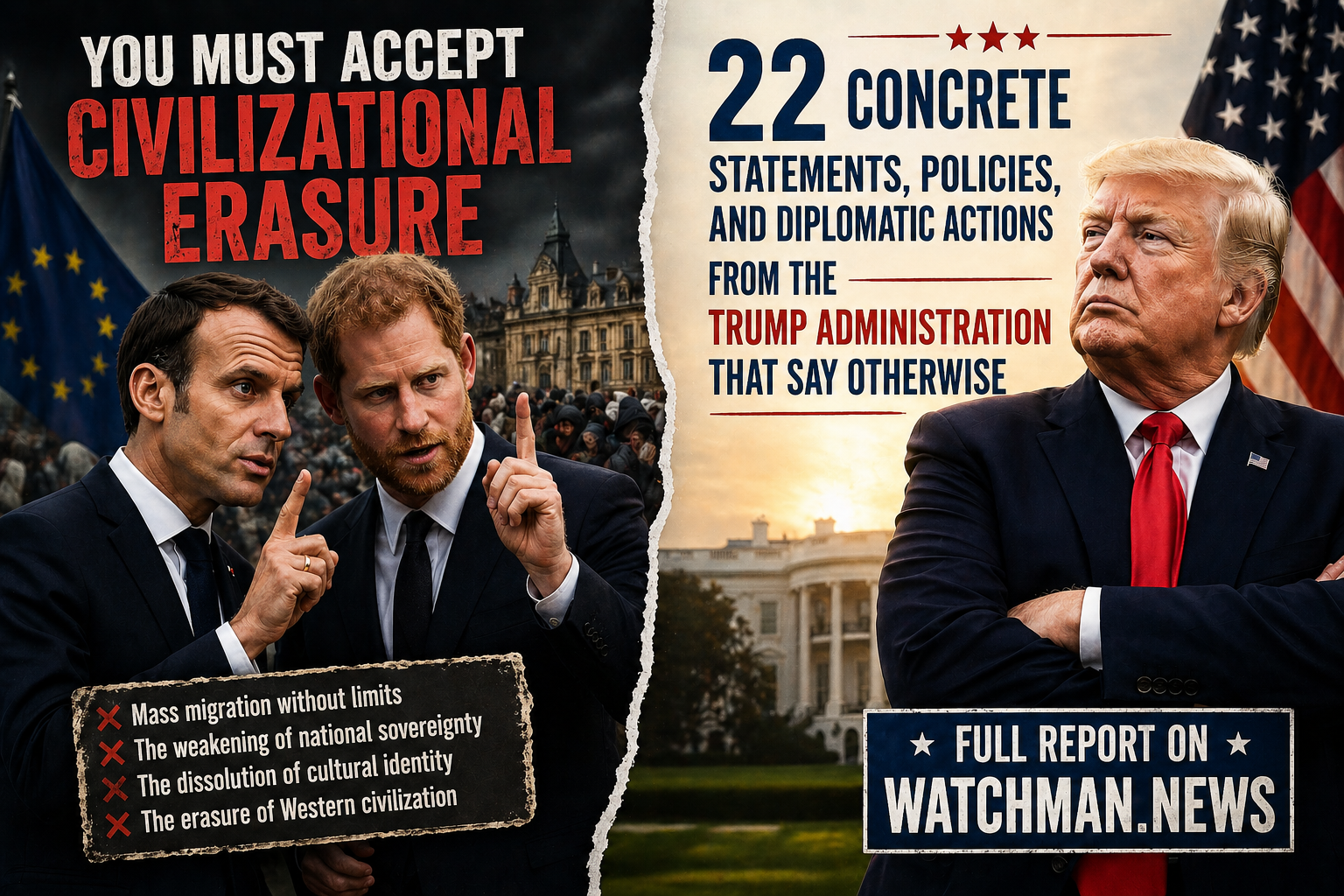
Amid rising tensions between Europe and the United States, recent statements from Emmanuel Macron have fueled debate over whether U.S. policy is undermining—or attempting to preserve—Western stability. This in-depth Watchman News analysis examines how Donald Trump’s stance on illegal migration has been widely mischaracterized, while documented policy records reveal a consistent concern for Europe’s long-term security, cultural continuity, and alliance strength. As political narratives clash with official sources, the question remains: are current policies safeguarding Europe’s future—or accelerating a trajectory some have warned could lead to civilizational erasure? Read the full report here: https://watchman.news/2026/04/eu-debating-us-over-western-stability-the-civilizational-erasure-trajectory/
THE MUST SEE “TRUMP DEFEND EUROPE POLICIES” REPORT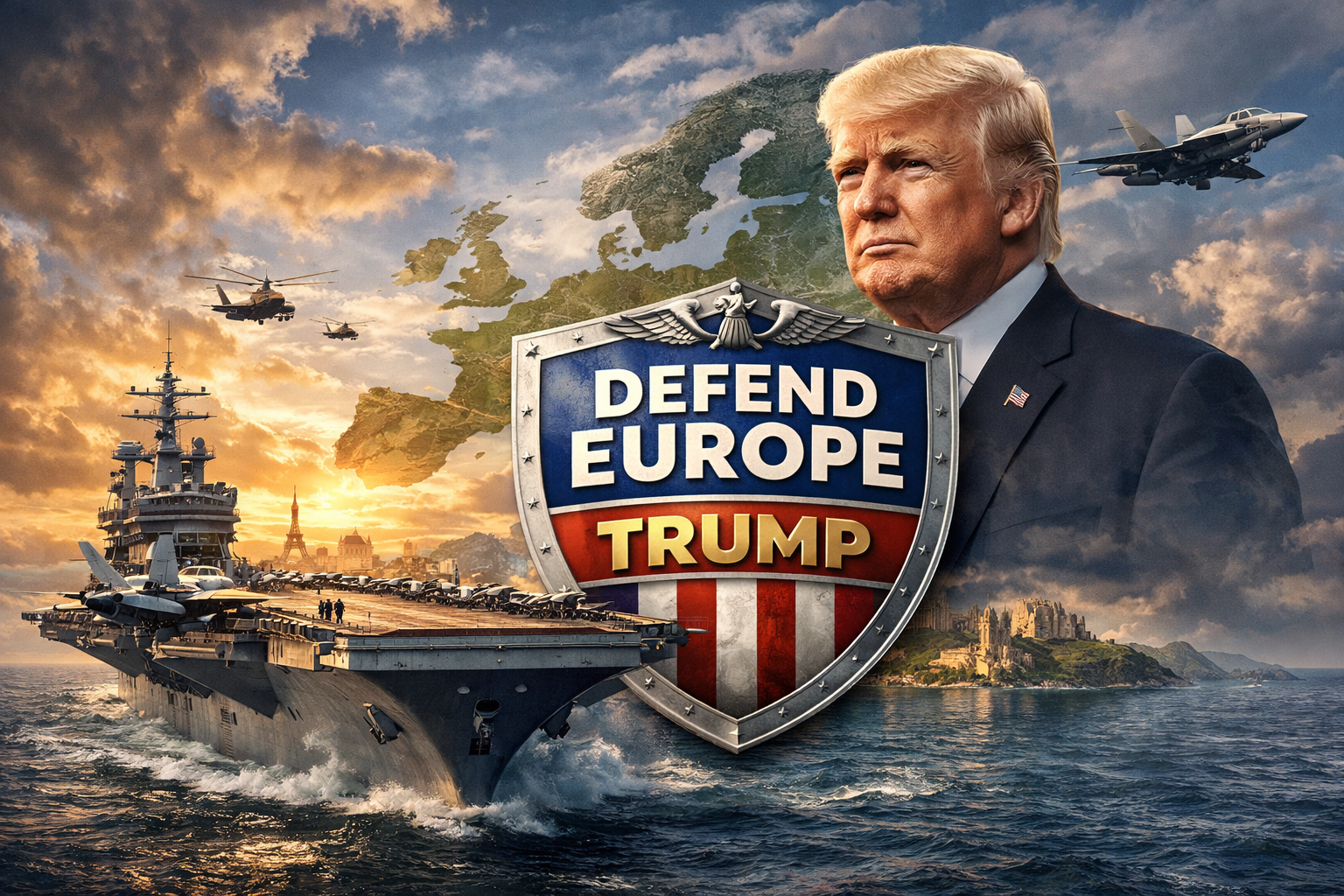
watchman.news/2026/03/defend-europe-official-trump-policies/
22 statements, policies, and diplomatic actions from the Trump administration related to migration pressures affecting Europe.![]()
![]() This collection is not opinion commentary.
This collection is not opinion commentary.![]()
![]() It is a documented record drawn from:
It is a documented record drawn from:![]()
![]() • official U.S. policy papers
• official U.S. policy papers![]() • White House statements and speeches
• White House statements and speeches![]() • diplomatic communications
• diplomatic communications![]() • major media reporting
• major media reporting