
Macron, Trump, and the Misreading of Europe’s Crisis
Political Narratives vs. Policy Reality in the Debate Over Western Stability
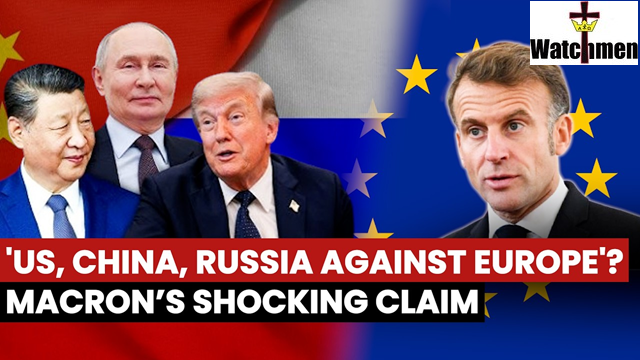
Recent remarks by Emmanuel Macron have reignited debate across Europe and the United States regarding the future of the Western alliance. In various interviews and public statements, Macron has warned that global powers—and shifting geopolitical alignments—pose risks to Europe’s stability and independence.
Among commentators, these warnings have increasingly been interpreted through a sharper lens: that figures such as Donald Trump, alongside rival powers like Vladimir Putin i Xi Jinping, represent a combined pressure against Europe.
Yet this framing, while politically potent, risks misdirecting attention away from a more immediate and documented issue—one that has been repeatedly raised in official U.S. policy discussions during the Trump administration itself.
A Narrative Built on Misinterpretation
A central tension in today’s discourse lies in how Trump’s position on immigration—particularly illegal migration—is portrayed abroad.
In many European political circles and media narratives, Trump’s stance has been simplified into a broadly “anti-immigration” posture, often interpreted as hostile to Europe’s social model. This has, in turn, shaped how leaders like Macron frame the geopolitical landscape.
But that characterization is incomplete.
Trump’s public and policy-driven positions were consistently focused on:
- illegal migration and border enforcement
- national sovereignty
- security implications of uncontrolled population flows
These distinctions matter. When blurred, they create the impression of ideological hostility where, in many cases, the underlying concern was framed as strategic and security-oriented.
What the Policy Record Actually Shows
A review of official materials from the Trump administration reveals a far more structured and consistent position than is often acknowledged in public debate.
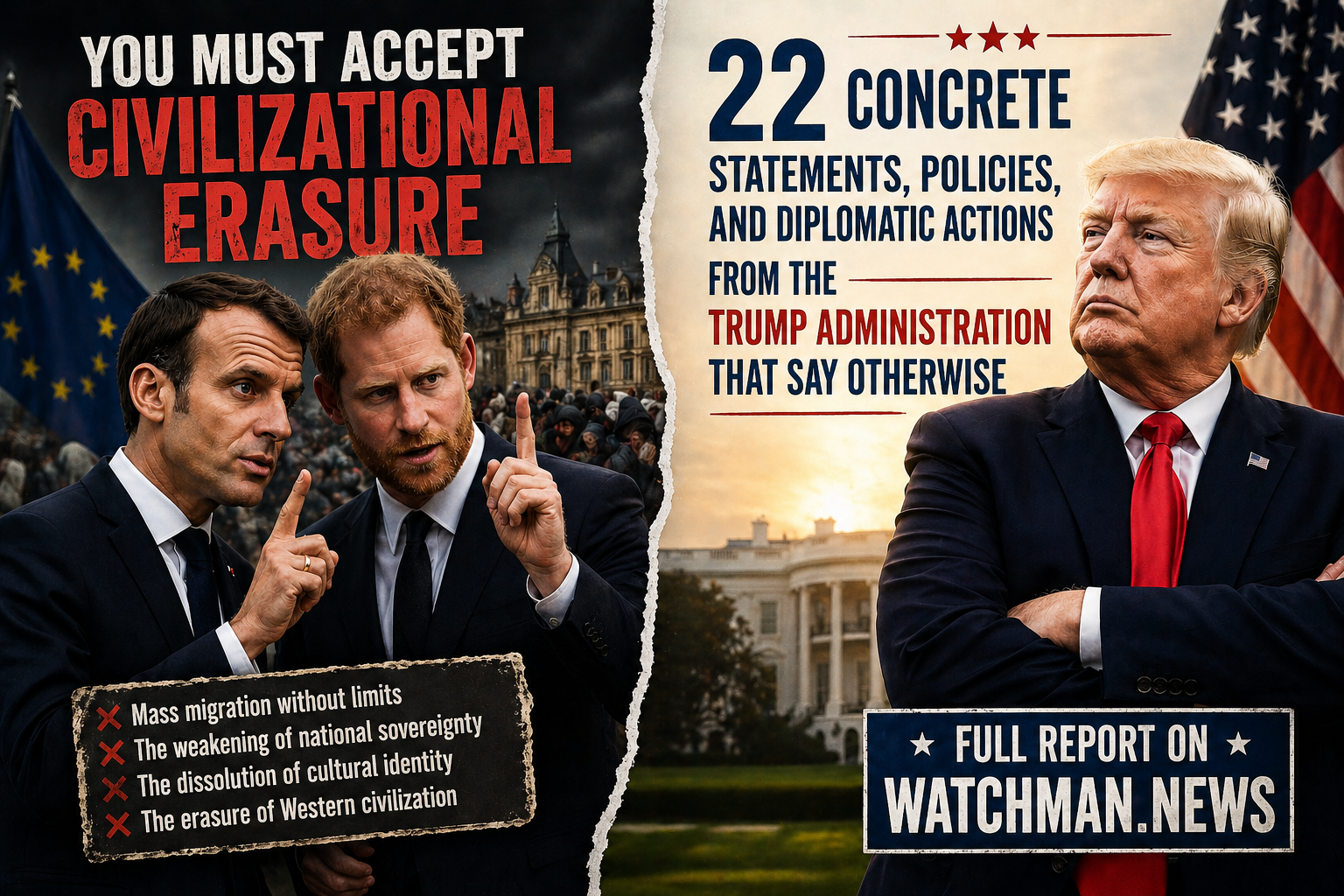
Watchman News has compiled a detailed source-based briefing documenting 22 statements, policies, and diplomatic actions related to migration pressures affecting Europe:
👉 “DEFEND EUROPE” – Official Trump Policies (22 Sources)
https://watchman.news/2026/03/defend-europe-official-trump-policies/
This collection is not commentary—it is drawn directly from:
- official U.S. strategy documents
- White House speeches and statements
- diplomatic communications
- major media reporting
Across these sources, U.S. officials repeatedly framed mass migration into Europe as:
- a security concern
- a cultural and demographic pressure
- a strategic issue affecting NATO allies
One official strategy document even warned of the potential for “civilizational erasure” if destabilizing trends were not addressed.
Europe’s Internal Reality
At the same time, political shifts within Europe itself suggest that these concerns are not confined to external observers.
Parties such as:
- National Rally
- Alternative for Germany
- Brothers of Italy
have gained significant ground in recent elections, often campaigning on:
- immigration control
- cultural identity
- national sovereignty
Whether one agrees with these platforms or not, their rise reflects growing public concern within Europe itself about long-term demographic and policy direction.
The Strategic Disconnect
This is where the current debate becomes most consequential.
If European leadership frames external warnings—particularly from the United States—as hostile or destabilizing, it risks overlooking the possibility that those warnings are, in fact, aligned with internal concerns already emerging among European populations.
In this light, Trump-era policy positions can be interpreted not as an attempt to weaken Europe, but as:
an effort—rightly or wrongly—to prevent Europe from repeating policy trajectories that have already produced long-term challenges elsewhere.
A Question of Framing, Not Just Policy
The core issue, then, is not simply policy disagreement—it is narrative framing.
- If Trump’s stance is viewed as ideological opposition, it reinforces division.
- If it is understood as a strategic warning—focused on illegal migration and systemic pressure—it opens a different conversation entirely.
That distinction has largely been lost in translation across political and media channels.
Conclusion: Competing Visions of Europe’s Future
Europe today stands at a crossroads shaped by:
- geopolitical competition
- internal political shifts
- migration pressures
- and diverging interpretations of risk
Macron’s warnings highlight one side of that equation: the need for European autonomy in a shifting world.
The Trump-era policy record highlights another: the perceived risks of unmanaged migration and long-term civilizational strain.
Between these perspectives lies a widening gap—not only in policy, but in how reality itself is being interpreted.
Read the Full Source-Based Briefing
For readers who want to examine the documented record directly:
👉 https://watchman.news/2026/03/defend-europe-official-trump-policies/
 Polish
  English
  German
  Dutch
Dutch  Swedish
  French
  Ukrainian