 Upcoming Article:
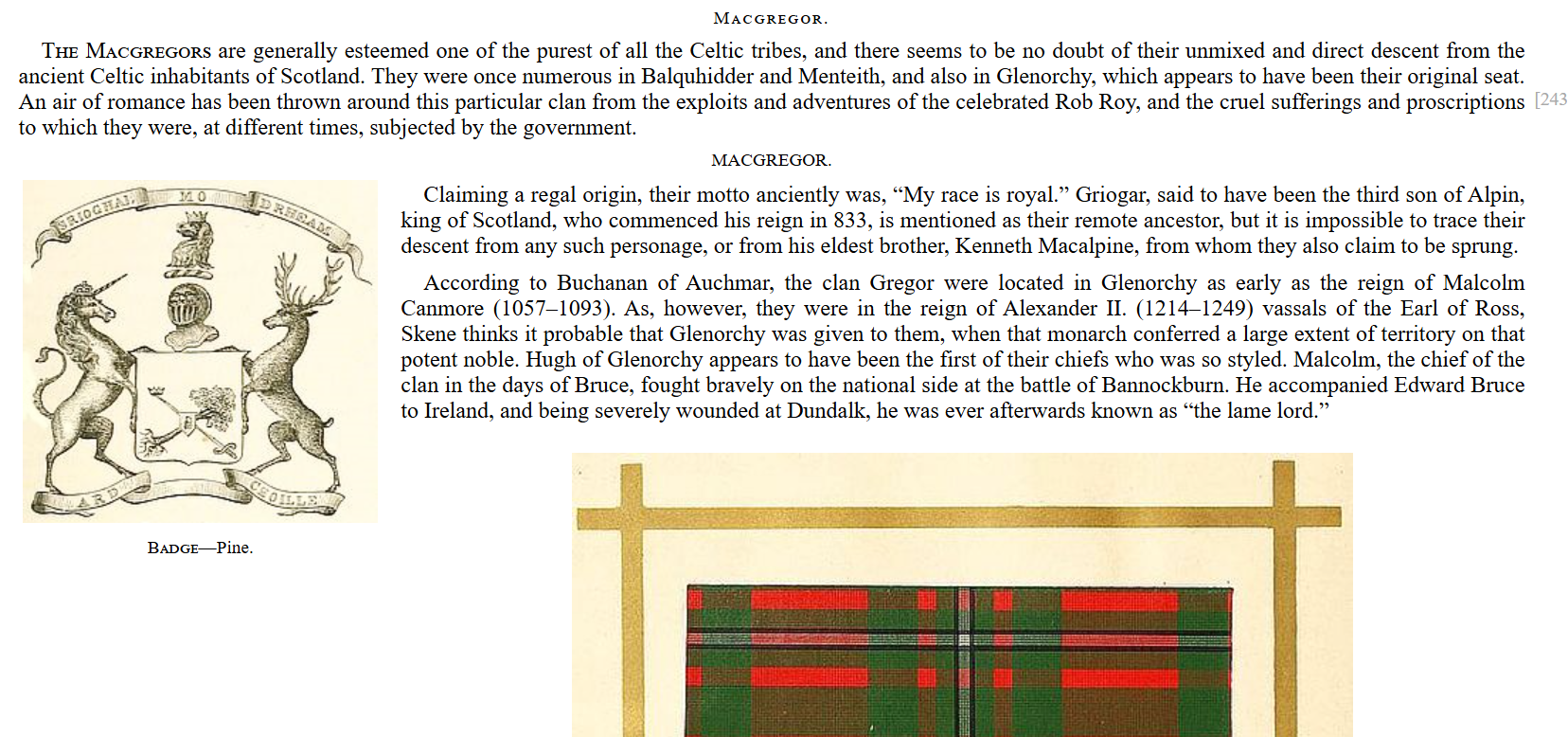
The ancient motto of Clan Gregor, “’S Rioghal Mo Dhream” — “Royal is my race,” has often been explained through the clan’s place among the Siol Alpine, those Highland kindreds traditionally said to descend from Kenneth MacAlpin. Yet older clan histories are careful: they affirm the MacGregors as one of the purest Celtic tribes of Scotland and acknowledge their ancient claim to regal origin, while also admitting that a literal descent from Alpin or Kenneth MacAlpin cannot be securely traced.
This is where the deeper question begins. If the MacGregor royal claim is real but not easily proven through the standard MacAlpin pedigree, then perhaps the clan’s memory points to an older and more complex royal inheritance: the Pictish-Moray line, the reign of Giric mac Dúngal, and the wider Gaelic royal traditions of Dál Riata and Ireland. Rather than forcing all evidence into a single simplified genealogy, this study follows the strands separately — MacGregor tradition, Siol Alpine claims, Moray history, Cenél Loairn, and the ancient Irish royal lines — to ask whether they preserve a harmonized memory of royal descent.
Introduction: “Royal Is My Race” and the Question of Origins
Clan Gregor has long carried one of the boldest mottos in Highland tradition: “’S Rioghal Mo Dhream,” commonly rendered, “Royal is my race.” This was no casual family saying. It expressed a remembered claim that the MacGregors belonged to an ancient royal stock, older than their later misfortunes, persecutions, and loss of lands.
A useful starting point is found in A History of the Scottish Highlands, Highland Clans and Highland Regiments, which places the MacGregors among the Siol Alpine, the group of clans traditionally supposed to descend from Kenneth MacAlpin. Yet the same source is careful, even cautious. It says that the validity of this “lofty pretension” had been disputed, and that the Siol Alpine clans were never truly united under one common chief. Still, it immediately identifies the MacGregors as the principal clan of that group and describes them as “one of the purest of all the Celtic tribes,” with direct descent from the ancient Celtic inhabitants of Scotland.
This gives us the central problem and the central opportunity. The MacGregor claim to royal origin was not invented out of nothing; it was deeply rooted in clan memory and repeated in Highland historical literature. But the usual explanation — descent from Alpin, Kenneth MacAlpin, or a son named Griogar — is not easy to prove in a strict documentary chain. The older writers themselves admitted this difficulty. They preserved the claim, but also acknowledged the gap.
The purpose of this study is therefore not to flatten the MacGregor tradition into a single oversimplified pedigree. Instead, it asks whether the royal memory of Clan Gregor may preserve several converging strands: the Siol Alpine tradition, the Pictish-Moray dynasty, the figure of Giric or Gregory mac Dúngal, and the deeper Irish-Scottish kindreds connected with Dál Riata and Cenél Loairn.
That approach allows us to take the clan motto seriously without pretending that every medieval genealogy is equally certain. Some evidence belongs to recorded history; some belongs to clan tradition; some belongs to royal memory; and some belongs to the older legendary framework of Irish origins. When read together, however, these traditions may preserve a more coherent picture than is usually admitted: Clan Gregor’s royal claim may not be merely MacAlpin in the narrow sense, but part of a broader Pictish, Gaelic, and Irish royal inheritance.
 Swedish
  English
  German
  Dutch
Dutch  Polish
  French
  Ukrainian