
Heavenly Participation in Early Christian Liturgy: Praise, Protection, and the Origins of Saintly Petition
Heavenly Participation in Early Christian Liturgy: Praise, Protection, and the Origins of Saintly Petition
Introduction: Recovering the Language of the Early Church
The communion of saints stands as one of the most profound and yet often simplified doctrines of the Christian faith. Scripture presents not a distant heaven, but a living reality in which the faithful are “compassed about with so great a cloud of witnesses” and have come to “the spirits of just men made perfect” (Hebrews 12:1, 23). The Church is one—both triumphant and militant—formed together as living stones in a holy Temple (Ephesians 2:21; 1 Peter 2:5).
Yet when we turn to liturgical history, an important question emerges:
How did the early Church express this heavenly participation in its actual prayers and worship?
Modern devotional language often reduces all references to the saints into a single phrase—“pray for us.” While this phrase is indeed historically attested, the earliest manuscripts reveal a more nuanced and layered reality.
This study seeks to recover that fuller picture—not to deny the communion of saints, but to understand how it was originally expressed, before later standardization simplified diverse expressions into a uniform formula.
Table of Contents
I. The Biblical Framework: Temple, Witnesses, and Living Stones
II. Bangor as the Doxological Control
III. The Irish Liber Hymnorum: Manuscripts and Tradition
IV. Colman’s Lorica: Protection and Participation
V. The Stowe Missal: A Layered Witness
VI. Dunkeld and Later Liturgical Development
VII. Comparative Table of Liturgical Modes
VIII. Broader Parallels: Eastern and Gallican Traditions
IX. Pastoral Reflection: Seeing the Saints, Not Replacing Christ
X. Final Synthesis: Recovering the Full Picture
XI. Reformation as Reaction: Martin Luther and the Question of Invocation
Conclusion
References
Appendix: Development of Direct Invocation in the Western Church
I. The Biblical Framework: Temple, Witnesses, and Living Stones
Before examining manuscripts, we must anchor ourselves in Scripture.
The New Testament does not describe the saints as inactive observers. Rather, it presents a dynamic, living assembly. Hebrews speaks of a “cloud of witnesses” surrounding the faithful—not merely remembered, but present within the life of the Church. Likewise, the believer is said to have already come to Mount Zion and to the heavenly assembly.
This language is deeply Temple-oriented. The people of God are not separate from the structure—they are the structure. Lamentations speaks of the “stones of the sanctuary” as people, while the Gospels describe the Temple as adorned with precious stones. These are not merely architectural details; they are theological patterns.
Thus, when early liturgy speaks of angels, saints, and the faithful together, it is not introducing something new—it is giving voice to this scriptural reality.
As the Apostle Paul also prays, that we might know “the riches of the glory of His inheritance in the saints” (Ephesians 1:18)—a reminder that the saints are not merely remembered figures, but the living fruit of God’s work in His people, revealing His glory within the Church.
II. Bangor as the Doxological Control (c. 680–691)
📜 Antiphonary of Bangor
The Antiphonary of Bangor provides one of the clearest windows into early Irish worship.
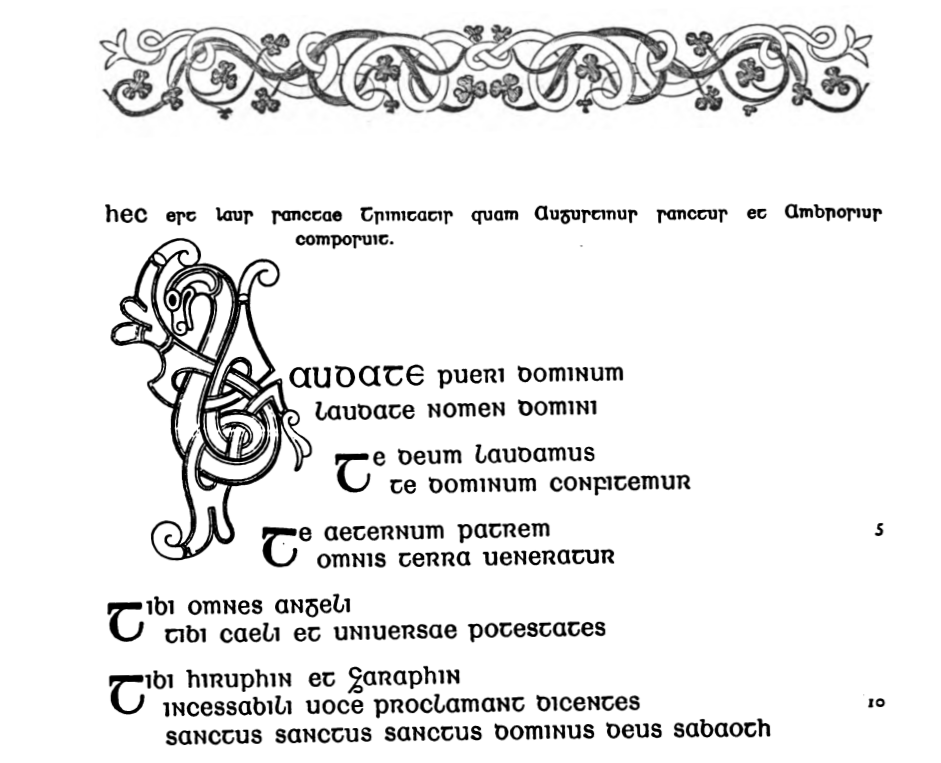
In its rendering of the Te Deum, we read:
“To Thee all angels…
The glorious company of the Apostles praise Thee…
The noble army of martyrs praises Thee…”
Here the saints are not addressed—they are described. Their role is one of praise. The Church on earth does not petition them but rather joins them.
Pastorally, this gives us a profound image: worship is not confined to earth. When the Church gathers, it stands within a cosmic liturgy, joining angels and saints already glorifying God.
Doxological Participation — the saints as fellow worshippers, not objects of petition.
III. The Irish Liber Hymnorum: Manuscripts and Living Tradition
📜 Liber Hymnorum
The Irish Liber Hymnorum survives in two principal manuscripts:
- Trinity College Dublin MS E.4.2 (11th century)
- Franciscan / UCD MS A 2 (late 11th–early 12th century)
Though these manuscripts are later copies, they preserve hymn material that is widely understood to originate in much earlier centuries of the Irish Church.
This is a critical point:
liturgical tradition is often preserved later than it originates.
Within these hymns, we encounter not a fixed or uniform formula of saint-invocation, but a varied and living expression of the communion of saints.
For example, in the hymn traditionally attributed to St. Patrick (Faeth Fiada), we find language of surrounding presence:
“Christ with me, Christ before me, Christ behind me…
Christ in the heart of everyone who thinks of me…”
Here the emphasis is not on petition directed to saints, but on divine presence permeating the life of the believer, within a world already filled with spiritual reality.
Likewise, in the great hymn Altus Prosator, attributed to St. Columba, the heavenly hosts are described in their continual praise:
- the ranks of angels
- the ordered hosts of heaven
- the created order itself
All are presented as glorifying God, forming a cosmic liturgy into which the Church participates.
Across the Liber Hymnorum, this pattern repeats:
- the saints are remembered
- their faith is proclaimed
- their place in the heavenly order is acknowledged
But they are rarely reduced to a single repeated function.
Pastorally, this is significant.
The Irish tradition preserves a stage in which the saints are not narrowly defined as objects of petition, but are understood as part of the living environment of the Church in Christ—present in praise, in memory, and in participation.
This reinforces what we have already observed:
before later standardization, the language of the Church was broader, more varied, and more closely aligned with the full scriptural vision of a unified body in heaven and on earth.
IV. Colman’s Lorica: Protection and Participation
Colman’s hymn, attributed to the 7th-century plague context, is explicitly described as a lorica—a spiritual armor.
Its language is striking:
- “may they come around us”
- “be our shield”
- “guard us”
- “come to our aid”
This is not the language of formal petition. It is the language of protection, presence, and participation.
Pastorally, this reflects a Church under pressure—facing disease and death—not constructing theology in abstraction, but invoking the reality of God’s protection.
Protective Invocation — the saints as surrounding and participating in God’s aid.
V. The Stowe Missal: A Layered Witness (8th–9th Century)
📜 Stowe Missal
The Stowe Missal preserves multiple liturgical layers.
Early layer:
“Remember, O Lord… that they may pray to the Lord our God for us.”
Later additions:
“Saint Patrick, pray for us…
All saints, pray for us.”
These occur on interpolated folios, written in a later hand. That is per the confirmations of Warren and Scudamore. The entire folio “29a and 29b being of a later hand”, as well as 30 an 31 additions of “ora pro nobis”.
👉 See detailed study:
https://celticorthodoxy.com/2026/05/stowe-missal-litany-saints-directed-petition-origins/
This reflects development—not contradiction.
God-directed intercession → Direct petitionary invocation
VI. Dunkeld and Later Liturgical Development
📜 Dunkeld Litany
Fully developed litany form:
- “pray for us”
- “intercede for us”
Earlier distinctions are now compressed into a repeated formula.
Helpful for unity—but may obscure earlier richness.
VII. Comparative Table of Liturgical Modes
| Tradition | Date | Liturgical Context | Direction | Expression / Formula |
|---|---|---|---|---|
| Bangor Antiphonary | c. 680–691 | Office / hymnody | God-directed | Saints praise God; no repetitive “ora pro nobis” formula |
| Lorica Traditions | 7th c. | Protective devotion | God-directed / protective | Saints and angels surround, guard, defend; no direct “pray for us” litany |
| Gelasian Sacramentary | 7th–8th c. tradition | Western / Gallican-Roman liturgy | Primarily God-directed | “sit pro nobis perpetuus suffragator,” “imploret,” “patrocinia”; prayers addressed to God asking saintly aid, not normally direct saint invocation |
| Greek/Latin Galba-type Litany | late 7th–early 8th c. proposed origin; later manuscript witnesses | Private/devotional preparation | Mixed / transitional | Greek εὔξαι ὑπὲρ ἡμῶν forms; Latin often abbreviated simply as “ora” or “or.” |
| Stowe (early Praeparatio) | older strata; copied 8th–9th c. | Priestly preparation before Mass | Primarily God-directed | Short saint-list framework preceding Mass; not yet the expanded later litany form |
| Stowe (later fols. 29ab–30ab) | later interpolated hand | Expanded saint-list insertion | More direct saint-address | Repeated “ora pro nobis” layer; Warren notes fol. 29ab is a later interpolated leaf |
| Corpus Irish Missal | medieval; later than Stowe | Liturgical missal witness | Abbreviated / ambiguous | After saint names preserves abbreviated “or.” rather than consistently writing “ora pro nobis” |
| Dunkeld Litany | medieval | Standardized litany tradition | Direct saint-address | Later fuller intercessory formulas such as “intercede/pray for us” |
VIII. Broader Parallels: Eastern and Gallican Traditions
When the Celtic evidence is placed alongside Eastern and wider Western traditions, a consistent pattern emerges: early liturgical language is not uniform, but develops across several recognizable modes—very similar to what we have observed in Bangor, the Lorica tradition, and Stowe.
1. Early Greek / Byzantine Liturgical Patterns
In the earliest strata of Greek liturgy, the saints are most commonly introduced within a God-directed framework, not as independent objects of prayer.
A. Commemoration within Prayer to God
In the Liturgy of St. James and early forms of the Liturgy of St. Basil, the saints are invoked in language such as:
“Remember, O Lord… the holy prophets, apostles, martyrs…”
“By their prayers and intercessions, have mercy upon us.”
Interpretation:
- The prayer is addressed to God
- The saints are referenced within that prayer
- Their intercession is acknowledged, not directly commanded
👉 This closely parallels the earlier layer of the Stowe Missal, where the saints are included in a petition directed toward God.
B. The Heavenly Liturgy Model
Eastern liturgy strongly emphasizes that earthly worship is participation in a heavenly reality.
This is expressed in texts like the Cherubic Hymn:
“We who mystically represent the Cherubim…
now lay aside all earthly care…”
Here, the faithful are not asking angels for help—they are entering into the same worship.
Similarly, Revelation imagery is reflected:
Angels and saints continually glorify God, and the Church joins that worship.
👉 This reinforces the doxological mode seen in Bangor.
C. Development of Direct Invocation
Later Byzantine practice introduces direct formulas such as:
“Most Holy Theotokos, save us.”
“Holy Apostle [Name], pray to God for us.”
These are structurally parallel to:
- Stowe (later interpolations)
- Dunkeld
- Sarum litany traditions
However, even here, there remains an important nuance:
- “save us” is often understood as participation in God’s saving work, not independent action
- “pray to God for us” maintains God as the ultimate source
2. Syriac and Early Church Orders
In texts such as the Didascalia Apostolorum and related Syriac traditions, we again see:
- strong emphasis on prayer directed to God
- acknowledgment of saints and martyrs
- but relatively less formalized direct invocation
Early Syriac liturgical forms tend to preserve:
- communal prayer
- remembrance
- continuity with the living Church
👉 This aligns closely with:
- Bangor (praise)
- early Irish prayer structure
3. Gallican and Early Western Traditions
The Bobbio Missal and related Gallican materials show a transitional stage.
Characteristics:
- prayers are overwhelmingly God-directed
- saints are:
- remembered
- included within petitions
- less emphasis on repetitive “pray for us” formulas
Only in later Western development do we see:
- the full Litany of Saints structure
- repeated vocative invocations
4.Comparative Table of Liturgical Development
| Tradition | Date (Primary Witness / Usage) | Primary Mode | Form of Address | Typical Expression | Notes |
|---|---|---|---|---|---|
| Early Eastern (St. James, Basil) | 4th–5th c. (earlier strata reflected) | God-directed intercession | To God | “Remember, O Lord…” | Saints included within prayer to God |
| Byzantine (later) | 8th–12th c. (standardized forms) | Mixed | Direct + God-directed | “Pray to God for us” / “Most Holy Theotokos, save us” | Expansion of earlier forms |
| Syriac | 3rd–5th c. (Didascalia, early liturgy) | Communal remembrance | To God | Minimal direct invocation | Emphasis on unity and continuity |
| Gallican | 6th–7th c. (Bobbio Missal, etc.) | Transitional | To God | Saints named within prayers | Bridge between early and later forms |
| Celtic (Bangor) | c. 680–691 | Doxology | Descriptive (not addressed) | Saints praise God | Pure praise model |
| Celtic (Lorica tradition) | 7th c. origin (11th c. MSS) | Protection | To God (implicit) | “Surround us,” “guard us” | Spiritual armor context |
| Stowe (early layer) | late 8th–early 9th c. | God-directed intercession | To God | “that they may pray” | Canon structure preserved |
| Stowe (later additions) | 9th c. or later hand | Direct petition | To saints | “Ora pro nobis” | Interpolated folios (29–30) |
| Dunkeld Litany | likely 9th–11th c. usage (later recorded 19th c.) | Standardized petition | To saints | “Intercede for us” | Fully developed litany form |
5. Pastoral and Theological Reflection
Across all traditions, one consistent truth emerges:
The saints are never presented as separate from God’s action, but always as participating in it.
What develops over time is not the existence of intercession, but the language used to express it.
Early liturgy tends to:
- keep prayer directed to God
- describe saints as participants
Later liturgy:
- allows direct address
- while still assuming God as the source
The danger, therefore, is not in the later forms themselves, but in reading them without awareness of their earlier context, which can lead to an oversimplified understanding of a much richer theological reality.
IX. Pastoral Reflection: Seeing the Saints, Not Replacing Christ
Much confusion arises not from belief—but from language.
Some fear invoking saints replaces Christ.
Others insist it is essential.
The early Church suggests a deeper perspective:
The saints were first seen as:
- participants
- witnesses
- fellow worshippers
When this is understood, language becomes clearer.
X. Liturgical Synthesis: Recovering the Full Range
The manuscript evidence does not present a single, uniform expression of the communion of saints.
Rather, across the earlier strata of liturgical witness, we see multiple complementary modes:
- Praise — the saints as those who continually glorify God
- Protection — the saints as surrounding and participating in divine aid
- God-directed intercession — prayer addressed to God acknowledging their intercession
- Direct petition — later, more regularized forms addressing the saints explicitly
These are not competing ideas, but distinct expressions of the same underlying reality:
the unity of the Church in heaven and on earth.
When held together, they form a fuller and more balanced liturgical language—one that reflects both Scripture and lived worship.
However, as liturgical forms became more standardized in later centuries, this range of expression was often condensed into a single repeated formula, most commonly:
“pray for us”
This simplification is not inherently incorrect. It reflects a real and enduring belief within the Church.
Yet when treated as the sole or defining expression, it can narrow what was once articulated more broadly:
- reducing praise to petition
- reducing participation to request
- and obscuring the wider scriptural vision of a living, united body
The question, therefore, is not whether later forms are valid, but whether they are being understood within the full range from which they developed.
Namely, as praying and praising together, while recognizing that those in heaven are perfected in Christ, and that their continual prayer and worship represent the fullness toward which the Church on earth aspires.
XI. Reformation as Reaction: Martin Luther and the Question of Invocation
By the time of the 16th century, the litany of saints in the Western Church had become highly standardized, often expressed through repeated formulas such as “pray for us.” This form had been in widespread use for several centuries and had come to dominate the liturgical expression of the communion of saints.
It is within this context that the reforms of Martin Luther must be understood.
Luther did not deny that the saints are alive in Christ, nor that they are part of the one Church. However, he rejected the practice of directly addressing them in liturgical prayer, removing such invocations from the litany and directing all petitions to Christ alone.
In doing so, Luther was not responding to the earliest strata of Christian worship, but to a later, more uniform expression that had, over time, become the dominant form.
From a historical perspective, this places the Reformation within the same broader pattern already observed:
- earlier traditions expressed the communion of saints in multiple ways
- later liturgical development consolidated these into more fixed formulas
- and the Reformation, in turn, reacted against that consolidation
Pastorally, this helps explain why the question remains sensitive today.
For some, the later liturgical forms represent continuity with received tradition.
For others, they appear as developments that require re-evaluation in light of Scripture.
Recognizing this shared history allows for a more constructive approach.
Rather than viewing these positions as mutually exclusive, they may be understood as emphasizing different aspects of a larger reality:
- the unity of the Church in Christ
- the continuing life of the saints
- and the primacy of God as the source of all grace
In this sense, the Reformation itself may be seen not simply as a break, but as part of an ongoing effort within the Church to clarify and renew its understanding of the faith once delivered to the saints.
Conclusion
The phrase “pray for us” is historically rooted and theologically meaningful.
Yet, when viewed in isolation, it does not fully represent the range of ways in which the Church has understood the communion of saints.
The earlier liturgical witnesses reveal something richer:
A Church that understood itself as already standing within the heavenly assembly—
surrounded by the saints,
joined with them in worship,
and participating together in the life of God.
Over time, this language was refined, structured, and in some cases simplified.
In response, movements such as the Reformation sought to recover clarity by emphasizing the direct mediation of Christ.
Both developments reflect a common concern:
that the Church remain faithful to the reality it proclaims.
For many today, the difficulty lies not in the doctrine itself, but in how it has been expressed and understood.
When the full range of earlier expression is restored, a clearer picture emerges:
- the saints are not replacements for Christ
- they are not independent sources of grace
- they are part of His Body, in whom His work has borne fruit
- the saints in heaven are perfected in Christ, and their prayer reflects the fullness toward which the Church grows
Thus, the task before the Church is not simply to choose between forms,
but to recover their proper meaning.
Not merely repeating inherited language,
but understanding it.
Not merely reacting,
but discerning.
Not merely preserving,
but renewing the faith once delivered to the saints.
References
- Antiphonary of Bangor
- Liber Hymnorum manuscripts
- Stowe Missal (Warren edition)
- Dunkeld Litany (Forbes)
- Gallican Missals
- Eastern Liturgies (St. James, Basil)
Appendix: Development of Direct Invocation in the Western Church
A natural question arising from this study is:
When did the familiar practice of directly addressing the saints—such as “pray for us”—become widespread in the Western Church?
The manuscript evidence suggests that this was not the result of a single doctrinal definition, but a gradual development of liturgical expression.
Early Foundations (1st–3rd centuries)
From the earliest period, the Church consistently held that:
- the saints are alive in Christ
- they participate in His work
- and they intercede for the faithful
At the same time, surviving liturgical texts show that prayer remained primarily:
- directed to God,
- with the saints included within that prayer or remembered as part of the heavenly assembly.
Emergence of Direct Address (3rd–5th centuries)
By the 3rd and 4th centuries, we begin to see occasional examples of direct address to saints, particularly in:
- inscriptions
- personal devotions
- early prayers (e.g., Marian texts such as Sub tuum praesidium)
These instances are typically brief and situational, and do not yet reflect a fully developed liturgical pattern.
Coexisting Liturgical Forms (5th–8th centuries)
Across Eastern, Gallican, and Celtic traditions, multiple forms appear simultaneously:
- God-directed intercession
(“Remember, O Lord… by their prayers…”) - Doxological expression
(saints described as praising God) - Protective invocation
(saints surrounding, guarding, or aiding the faithful)
At this stage, there is clear belief in saintly intercession, but no single standardized formula.
Standardization (8th–12th centuries)
Between the 8th and 12th centuries, especially in the Western Church, we see the widespread emergence of:
- structured litanies
- repeated formulas such as ora pro nobis (“pray for us”)
- extended sequences of direct saint-invocation
What had been one mode among several becomes a dominant and regularized liturgical form, as reflected in later texts such as the Dunkeld Litany and subsequent Western usage.
Clarifying Perspective
From this development, a key distinction may be observed:
The belief that the saints intercede is early and consistent.
The widespread liturgical habit of directly addressing them develops gradually and becomes standardized later.
Concluding Note
Recognizing this progression allows earlier and later forms to be understood together:
- earlier sources emphasize participation and God-directed prayer
- later sources emphasize direct invocation
Both arise from the same underlying conviction:
that the Church, in heaven and on earth, is one in Christ.