
People must realize how quickly “birth control” equals foreign replacement.
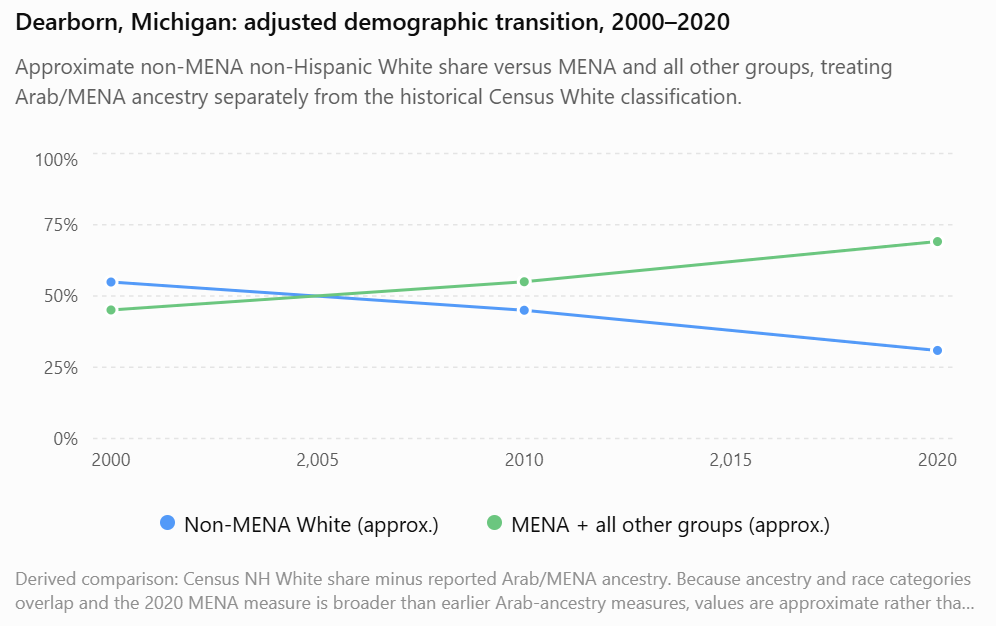
In the year 2000 Dearborn Michigan was only 29% Arab. Today it has more than doubled. See chart below.
Demographic Study: In 20 Years, Will Columbia, Missouri Join with all the rest of the non-white cities?
A comparison of Columbia’s present demographic position with American cities that passed through a similar stage of demographic change.
Columbia, Missouri is growing. Development, employment, education and new housing continue to attract residents from outside the region, while the city’s racial and ethnic composition is changing along with its population.
According to current U.S. Census data, approximately 71.7% of Columbia’s population is non-Hispanic White. In other words, approximately 28.3% of the city falls outside that category.
That number is worth studying because several growing American cities reached a similar demographic position in previous decades. What happened during the following ten or twenty years provides useful comparisons — although not a guaranteed forecast of Columbia’s future.
1. Columbia, Missouri: Where We Are Now
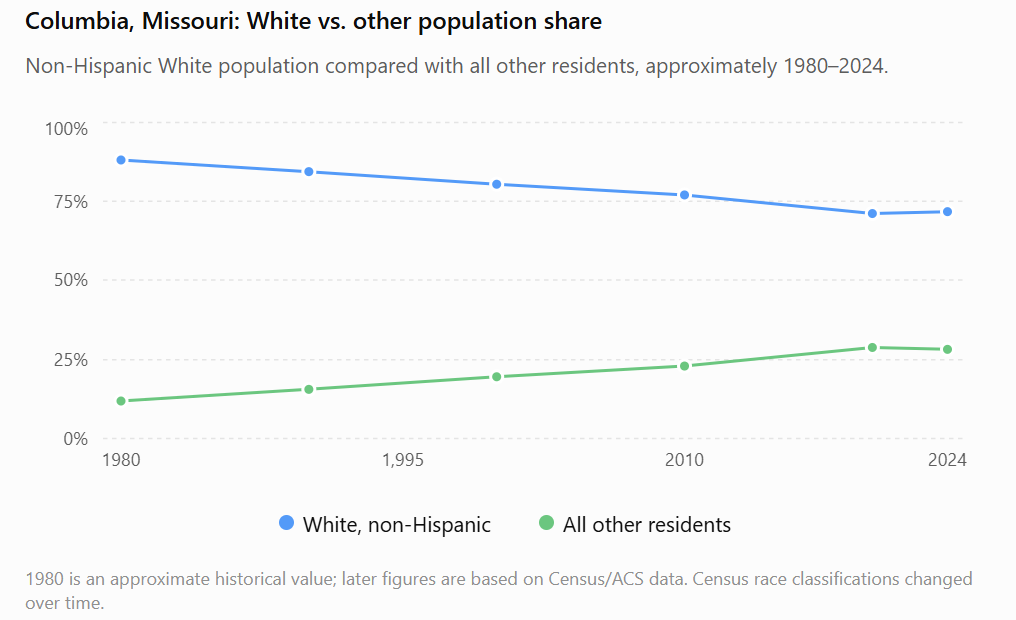
Columbia: approximately 71.7% non-Hispanic White / 28.3% other
Columbia’s change has been gradual compared with many larger metropolitan areas. Nevertheless, the long-term direction has been toward a more racially and ethnically diverse population.
The question is not whether Columbia has changed — it clearly has. The more interesting question is what cities at roughly this stage of demographic transition looked like ten and twenty years later.
Source: U.S. Census Bureau, Columbia city, Missouri QuickFacts, 2020–2024.
2. Detroit: The Large-City Historical Example
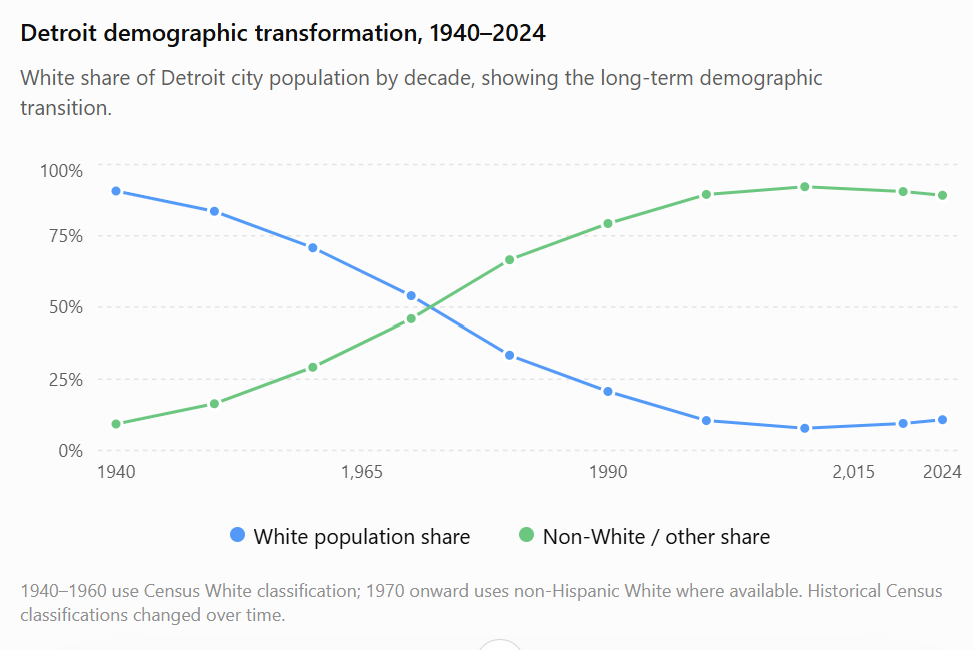
Detroit demonstrates just how dramatically a city’s demographic composition can change over several generations.
Detroit is not a direct comparison with Columbia because of its much greater historical population and its extraordinary postwar population loss.
It is useful, however, as the familiar long-term example. Detroit moved from an overwhelmingly White city in 1940 to a city in which non-Hispanic Whites represent only a small minority today.
The lesson from Detroit is therefore historical rather than predictive: urban demographic composition can change far more substantially within a lifetime than many residents assume.
The More Relevant Comparison: Cities Around Columbia’s Size
Detroit is dramatic, but Richardson, Texas and Kent, Washington provide more useful comparisons for Columbia.
Around the year 2000, both had reached roughly the demographic range Columbia occupies today.
What happened next is particularly noteworthy.
3. Richardson, Texas: The Closest Comparison
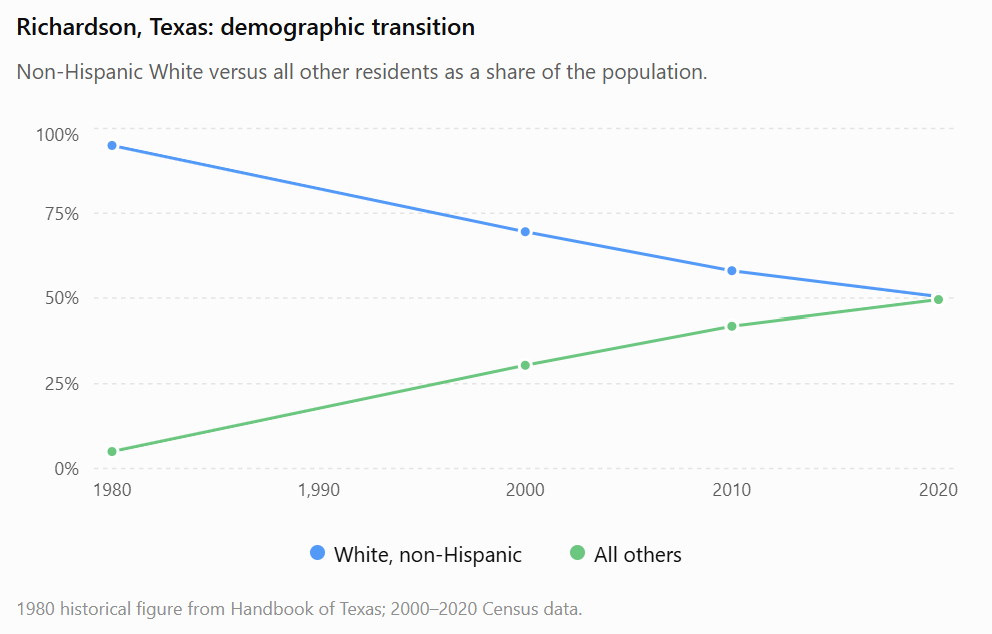
2000: 69.6% non-Hispanic White
2010: 58.1%
2020: 50.5%
Richardson is particularly interesting because its position in 2000 looked remarkably similar to Columbia’s position today.
Richardson had approximately 91,800 residents in 2000 and was 69.6% non-Hispanic White. Twenty years later, the population had increased to approximately 119,500 while the non-Hispanic White share had fallen to approximately 50.5%.
Current Census estimates place Richardson below the 50% mark.
Source: U.S. Census Bureau. Richardson population: 91,802 in 2000; 99,223 in 2010; 119,469 in 2020.
4. Kent, Washington: The Faster Transition
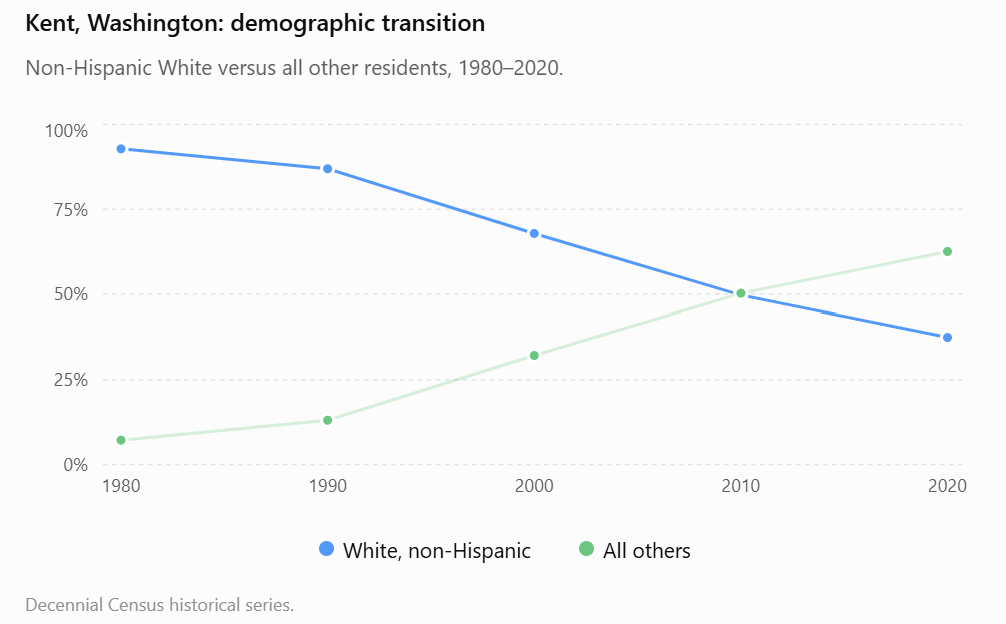
2000: 67.9% non-Hispanic White
2010: 49.7%
2020: 37.4%
Kent represents a considerably faster version of the same demographic trajectory.
In 2000, Kent was approximately 67.9% non-Hispanic White — only a few percentage points below Columbia today.
Only ten years later, that figure had fallen below 50%. By 2020 it was approximately 37.4%.
Kent’s population was also growing rather than collapsing: from approximately 79,500 in 2000 to more than 136,000 in 2020.
Source: U.S. Census Bureau decennial Census data.
5. Aurora, Illinois: A Mature Example
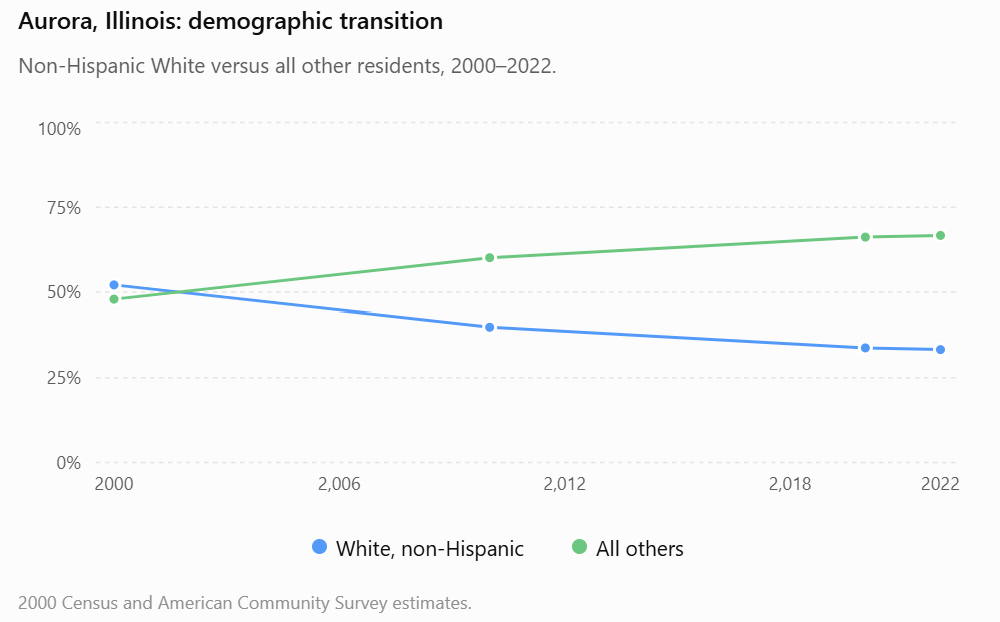
2000: 52.1% non-Hispanic White
2010: 39.9%
2020: 33.8%
Aurora had already progressed considerably farther along this demographic transition by 2000.
Its non-Hispanic White population declined from approximately 52.1% in 2000 to approximately 39.9% in 2010 and 33.8% by 2020.
Aurora therefore shows what a city can look like after the demographic crossover has already occurred.
Source: U.S. Census Bureau and Chicago Metropolitan Agency for Planning.
Columbia Today Compared With Other Cities
| City / Period | Non-Hispanic White | All Others |
|---|---|---|
| Columbia today | 71.7% | 28.3% |
| Richardson, 2000 | 69.6% | 30.4% |
| Richardson, 2020 | 50.5% | 49.5% |
| Kent, 2000 | 67.9% | 32.1% |
| Kent, 2010 | 49.7% | 50.3% |
| Kent, 2020 | 37.4% | 62.6% |
| Aurora, 2000 | 52.1% | 47.9% |
| Aurora, 2020 | 33.8% | 66.2% |
What Does This Suggest for Columbia?
Columbia is presently in a demographic range that several other growing American cities occupied roughly one or two decades before reaching a point at which non-Hispanic Whites represented approximately half — or less than half — of their populations.
Richardson went from approximately 70% to 50% in twenty years.
Kent went from approximately 68% to below 50% in only ten years.
Those histories make a substantial demographic change in Columbia over the next twenty years a plausible scenario.
They do not, however, establish an automatic demographic threshold. Columbia’s future composition will depend upon migration, births, deaths, employment, university enrollment, housing construction, economic development and other local conditions.
The significant point is simpler: Columbia is no longer at the beginning of demographic diversification. It is already approximately 28% outside the non-Hispanic White category, placing it near demographic positions previously occupied by several cities that changed substantially over the following decade or two.
Methodology Note
For modern comparisons, “White” refers to the U.S. Census category “White alone, not Hispanic or Latino.” “All others” represents the remainder of the population so that the two categories are mutually exclusive. Historical Census racial classifications have changed over time, particularly in older Detroit data, and should therefore be interpreted with appropriate caution. Comparisons between cities illustrate possible trajectories rather than deterministic forecasts.
Prepared as a demographic study for the Salem Institute of Peace Studies.