WATCHMAN REPORT: From Ukraine to the West — Is Russia Preparing for a Much Wider War?
Russia now calls the conflict a “real war.” New U.S. intelligence reportedly warns that Moscow could test NATO’s resolve as early as the fall of 2026, while Ukraine’s former Commander-in-Chief Valerii Zaluzhny warns that NATO remains roughly a decade behind Russia in adapting to the modern battlefield. Putin has separately warned that an actual confrontation with Europe would be fought without the restraints Moscow claims it has exercised in Ukraine. At the same time, Russian officials increasingly describe Ukrainian strikes as “terrorism,” while attacks on Russian and Black Sea oil infrastructure converge with the enormous energy disruption caused by the Iran war and the Strait of Hormuz crisis. The question is no longer simply how the Ukraine war ends—but what this conflict is becoming.
For more than four years, Moscow carefully insisted that its campaign in Ukraine was not technically a “war.”
It was the Special Military Operation.
That distinction has often been dismissed in the West as propaganda or semantics. Yet something important has now changed.
Kremlin spokesman Dmitry Peskov recently abandoned that distinction himself.
“There is a war going on, this is a real war.”
Peskov went further. He explained why Moscow now considers the situation different.
According to him, behind Kyiv now stand Berlin, Paris, The Hague, Oslo and Washington, whose governments assist Ukraine with satellites, intelligence infrastructure and Western weapons targeting Russian territory.
The statement was reported in early July, based upon Peskov’s interview with Russian state television. Read the report on Peskov’s “real war” statement.
The significance should not be overlooked.
For years, Moscow’s official position separated the Ukrainian people from the government in Kyiv and portrayed the conflict as a limited operation involving peoples whom Russians often describe as historically and culturally related.
Whatever one thinks about Moscow’s historical arguments, Russia and Ukraine undeniably share centuries of intertwined history, extensive linguistic and familial ties, common roots in the medieval Rus’ world, and a deep Eastern Christian heritage.
There are also millions of Russian-speaking Ukrainians, particularly in eastern and southern portions of the country.
Moscow has repeatedly cited treatment of Russian-speaking populations, political developments following 2014 and the eastward expansion of Western military influence among its grievances.
None of those arguments by themselves settle the international legal questions surrounding Russia’s invasion.
But they matter enormously when trying to understand how Russia itself views the conflict.
And that makes Moscow’s changing vocabulary particularly important.
New U.S. Intelligence Raises the Stakes
Russia’s changing rhetoric is occurring at almost exactly the same time that a significant new American intelligence assessment is raising concerns about what Moscow might do beyond Ukraine.
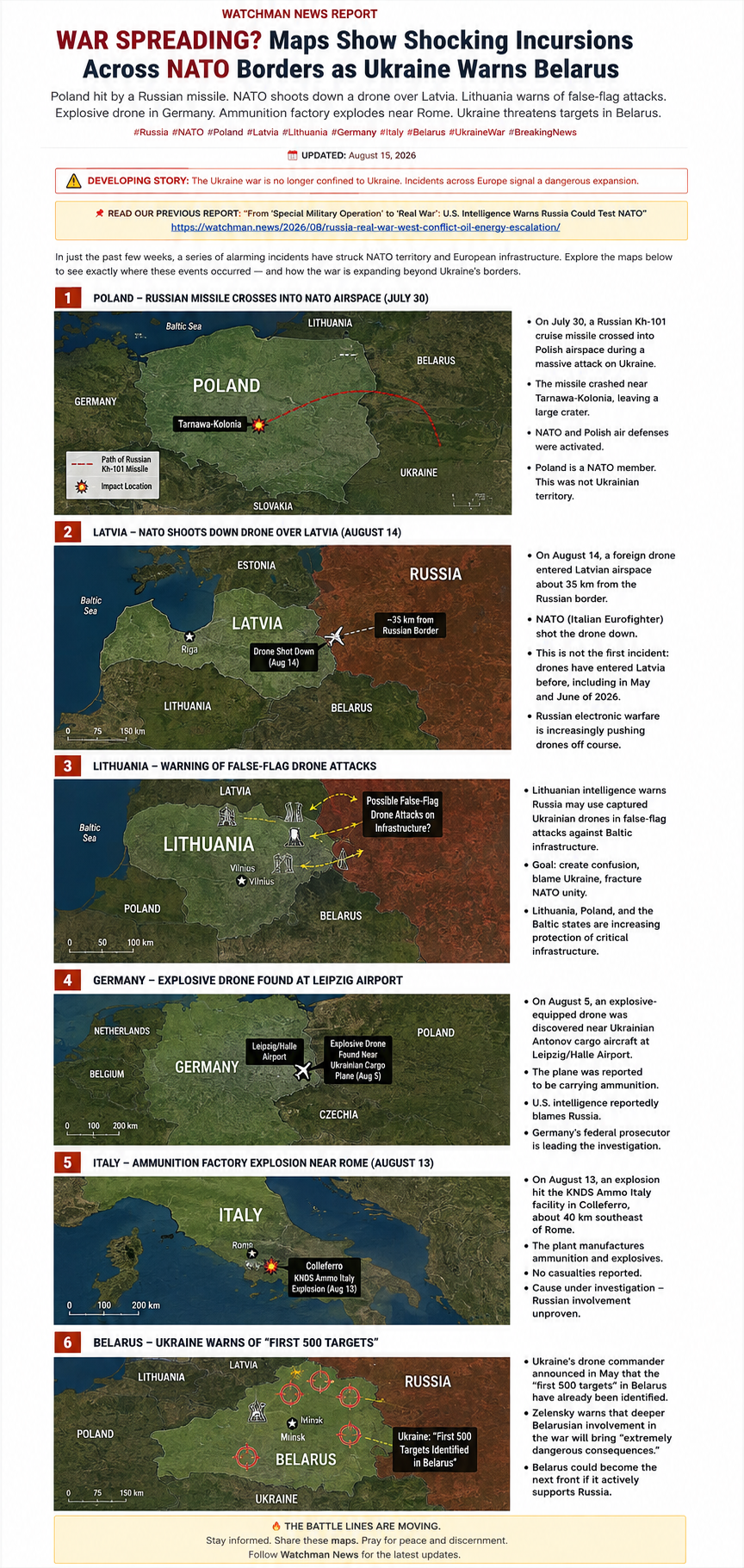
According to a recent Wall Street Journal report, U.S. intelligence agencies assess that Russia could attempt to test NATO’s resolve as early as the fall of 2026, within a broader risk window extending through 2029.
The scenarios reportedly under consideration do not necessarily involve a massive conventional invasion. They include possibilities ranging from cyberattacks and covert operations to a limited military incursion intended to test whether NATO members would actually respond collectively under Article 5.
Read the Wall Street Journal report on the U.S. intelligence assessment.
That distinction is important. The intelligence assessment does not say that Russia has definitely decided to attack NATO this fall, nor does it establish that a wider war is inevitable.
What it does indicate is that American intelligence considers some form of calculated Russian test of NATO plausible beginning as early as the coming fall.
The assessment is particularly significant because it comes amid concern about Western ammunition and missile inventories after years of support for Ukraine and the additional demands created by conflict in the Middle East.
Viewed alongside Moscow’s declaration that the confrontation has become a “real war” because Western governments stand behind Kyiv, the timing raises an obvious question:
Are Moscow and Washington independently looking at the same changing strategic landscape—and reaching increasingly dangerous conclusions about where it may lead?
Zaluzhny: Is NATO Still a Decade Behind Russia?
Adding another important dimension is a remarkable warning from Valerii Zaluzhny, Ukraine’s former Commander-in-Chief and current ambassador to the United Kingdom.
Zaluzhny recently warned that NATO is roughly a decade behind Russia on the modern battlefield, arguing that the Alliance has been too slow to absorb the lessons produced by years of rapidly evolving warfare in Ukraine.
His warning deserves particular attention because it does not come from Moscow or Russian state media. It comes from the general who commanded Ukrainian forces against Russia during some of the most consequential years of the conflict.
Read The Times report: NATO a decade behind Russia on the battlefield, Zaluzhny warns.
The concern is broader than possession of individual weapons systems. Modern war in Ukraine has become an extraordinarily rapid cycle of adaptation involving drones, electronic warfare, battlefield surveillance, countermeasures, targeting, dispersed logistics and the integration of inexpensive unmanned systems with conventional artillery and missiles.
Russia has repeatedly encountered Western and Ukrainian technologies, developed countermeasures, seen those countermeasures defeated, and adapted again.
NATO itself is now working rapidly to absorb those battlefield lessons, but Zaluzhny’s assessment suggests that institutional doctrine and procurement remain substantially behind the pace of actual warfare.
This creates an uncomfortable connection with the new U.S. intelligence warning.
If Russia could attempt to test NATO’s resolve as early as the fall of 2026, has the Alliance closed the battlefield adaptation gap that one of Ukraine’s most experienced commanders believes still exists?
It is difficult to dismiss that question when it is being raised not by a Russian propagandist, but by the Ukrainian general who spent years fighting Russia directly.
Putin Already Told Europe: Ukraine Is Not What a Real War With Russia Would Look Like
An especially revealing statement came directly from Vladimir Putin on December 2, 2025.
Putin said Russia was not seeking war with Europe.
But his description of what would happen if Europe entered a direct war with Russia was extraordinary.
He specifically contrasted such a confrontation with Russia’s conduct in Ukraine.
According to Putin, Russia was acting in Ukraine in a “surgical, careful way,” and the Ukrainian conflict was “not war in the full, modern sense of the word.”
A direct European conflict, Putin warned, would be different.
He said matters could progress so rapidly that Russia would soon have “no one left for us to negotiate with.”
Reuters reported the warning at the time. Read Reuters’ report on Putin’s warning to Europe.
The Kremlin also published Putin’s remarks through its own presidential communications. Read Putin’s December 2 remarks from the Kremlin.
Those comments take on considerably more importance now that the Kremlin spokesman himself says the “special military operation” has developed into a “real war” because Western capitals stand behind Kyiv.
Put those statements beside one another.
In December, Putin essentially said:
Ukraine is one thing. A real war against Europe would be something altogether different.
Now the Kremlin says:
This has become a real war because European governments and Washington are behind Ukraine.
At the same time, U.S. intelligence is reportedly assessing scenarios in which Moscow could test NATO’s resolve beginning as early as this fall.
That does not prove Russia is preparing to attack NATO tomorrow.
It does mean that Moscow’s conceptual boundaries are moving at precisely the moment Western intelligence agencies are examining the possibility of those boundaries moving still further.
And history teaches us to pay attention when governments begin changing the categories into which they place their enemies.
From Military Enemy to “Terrorist”
There is another change taking place simultaneously.
Russian officials are increasingly characterizing Ukrainian operations inside Russia as terrorism rather than simply acts of war.
Putin said in June that Ukrainian forces, unable to stop Russian advances, were resorting to what he called “openly terrorist methods” by striking civilian facilities, infrastructure and passenger transportation.
Peskov used similar terminology in July, describing attacks on energy and civilian infrastructure as an “obvious terrorist act” by what Moscow calls the “Kyiv regime.”
That rhetoric has become easier for Moscow to promote as Ukraine’s long-range drone campaign increasingly reaches facilities far removed from the battlefield.
One particularly striking example is Wildberries, Russia’s enormous e-commerce company.
Reuters reported on August 7 that Ukrainian drones have attacked approximately 20 Wildberries sites in less than three weeks, threatening losses for tens of thousands of merchants and bringing the economic effects of the war directly into ordinary Russian commercial life. Reuters: Ukrainian attacks on Wildberries strike at the heart of Russia Inc.
Another Wildberries logistics facility was hit in Yekaterinburg, roughly 1,400 kilometers east of Moscow. Reuters: Wildberries reports another Ukrainian drone attack.
Ukraine argues that facilities used for military logistics or supporting Russia’s war economy constitute legitimate targets.
Russia increasingly portrays attacks reaching civilian economic infrastructure as terrorism.
That disagreement could become enormously consequential.
Does Calling Ukraine “Terrorist” Cancel the Geneva Conventions?
Here an important distinction must be made.
Simply calling another government or its armed forces “terrorists” does not give Russia legal permission to ignore the Geneva Conventions.
The International Committee of the Red Cross makes clear that international humanitarian law continues to apply during armed conflict regardless of terrorism terminology. There is no legal mechanism whereby a government can simply pronounce its opponent “terrorist” and thereby make protected civilians, prisoners or other protected persons disappear from humanitarian law. ICRC: What international humanitarian law says about terrorism.
Indeed, the ICRC continues formally describing Russia and Ukraine as parties to an international armed conflict and works with both countries regarding prisoners of war and other protected persons. ICRC statement concerning protected persons in the Russia–Ukraine international armed conflict.
But that doesn’t make Russia’s terminology meaningless.
The danger is political rather than legal.
Governments historically use words such as terrorist, criminal, pirate, illegal regime and sponsor of terrorism to establish the domestic rationale for extraordinary measures.
And this raises the next question:
If Moscow believes Ukraine is conducting terrorism using Western intelligence, Western satellites and Western weapons, how long before the governments providing those capabilities are characterized not merely as Ukraine’s supporters—but as participants or sponsors of those attacks?
We should be very precise here.
Russia has not declared Germany, France, Norway, the Netherlands or the United States terrorist states.
But Moscow is now explicitly naming those countries while explaining why it believes its conflict has transformed into a broader “real war.”
That is a development worth watching.
Russia May Believe the Gloves Have Been On
This is another element often missing from Western analysis.
Whatever Western military analysts may think about the claim, Moscow itself repeatedly maintains that Russia has not employed anything resembling its maximum destructive capability in Ukraine.
Putin’s own December statement could hardly have been clearer.
He said Ukraine was being handled carefully compared with how Russia would fight an actual major-power war.
That position appears connected to Russia’s broader historical narrative.
Russian political discourse frequently depicts Russians and Ukrainians as closely related peoples whose modern political division does not erase their common cultural, linguistic and Orthodox Christian heritage.
That may help explain why Moscow continues simultaneously to devastate Ukrainian military and infrastructure targets while claiming that its ultimate quarrel is not with the Ukrainian people themselves.
One does not have to accept that claim to recognize that it is part of Russian strategic thinking.
The danger comes if Moscow eventually concludes that the distinction has disappeared.
If Russian leaders genuinely begin believing that Ukraine has ceased being a limited conflict among historically related peoples and has instead become the battlefield of an actual Western war against Russia, Moscow’s own stated rationale for restraint begins disappearing with it.
Then Came Lindsey Graham
There is another remarkable development surrounding this escalation that cannot simply be ignored, although it must be handled carefully.
Senator Lindsey Graham died suddenly on July 11 at age 71.
The official preliminary finding was an aortic dissection associated with arteriosclerotic cardiovascular disease.
There is presently no publicly established evidence that Graham was assassinated or that Russia had anything to do with his death.
That must be stated clearly.
Nevertheless, the circumstances are striking because Graham had made himself perhaps the most personally confrontational congressional adversary of Putin in Washington.
At the beginning of the war in March 2022, Graham publicly called for someone inside Russia to “take this guy out,” referring to Vladimir Putin.
The White House immediately distanced the American government from Graham’s statement, saying assassinating the leader of another country or pursuing regime change was not U.S. policy. Reuters: White House rejects Graham’s call for someone in Russia to “take this guy out”.
Graham remained one of Washington’s strongest advocates of military assistance to Ukraine and sweeping sanctions against Russia.
Then came the extraordinary chronology surrounding his death.
On Friday, July 10, Graham met Zelensky in Kyiv, where the two discussed Ukrainian air-defense requirements and Graham’s Russia sanctions legislation.
Less than two days later, Graham was dead.
Reuters reported that President Trump spoke with Graham only minutes before Graham became ill. Trump said he believed Graham suffered a heart attack and rejected speculation concerning foul play.
The preliminary medical examiner finding reported an aortic dissection caused by cardiovascular disease. Reuters: Lindsey Graham dies at 71 after meeting Zelensky in Kyiv.
Whenever a major geopolitical figure dies suddenly, particularly one who had personally advocated the removal of an adversarial foreign leader, speculation is inevitable.
But possibility is not evidence.
At present, there is no publicly demonstrated connection between Russia and Graham’s death.
The responsible observation is simply this:
One of America’s most aggressive advocates for confronting Russia—and the American senator who had publicly suggested Russians should kill Putin—died suddenly immediately after another wartime visit to Kyiv.
Whether those facts are related is unknown.
But Graham’s absence from Washington is itself strategically significant.
Ukraine Is Now Striking Russia’s Oil System Deep Inside the Country
The much more demonstrable escalation is happening in Russia’s energy sector.
Ukraine has dramatically expanded the range of its long-distance drone operations.
A Ukrainian drone strike on July 25 reached the Tyumen oil refinery in western Siberia, more than 2,000 kilometers from Ukraine, according to Russian authorities.
Russia’s domestic fuel market had already been suffering worsening pressure as Ukrainian attacks increasingly reached refinery and energy infrastructure.
The significance is obvious.
Russia finances a substantial portion of its state through the energy economy.
Oil revenues help sustain the Russian government and therefore indirectly its military operations.
Kyiv has every incentive to attack that economic lifeline.
But once wars move systematically into national energy systems, consequences become much harder to contain within national borders.
And that is precisely what is happening now.
The Black Sea Oil War Is No Longer Just Russia’s Problem
On August 7, Reuters reported a development that may ultimately prove far more consequential than another battlefield village changing hands.
Drone attacks around Russia’s Black Sea oil infrastructure caused July shipments through the Caspian Pipeline Consortium to fall more than 20% below schedule.
Approximately 400,000 barrels of oil per day were lost from the international market during July.
There is an especially important detail here.
This is not simply Russian crude.
The CPC primarily carries oil from Kazakhstan, through Russia, to the Black Sea.
Major American oil companies including Chevron and ExxonMobil operate in Kazakhstan.
The CPC normally accounts for approximately 2% of total global oil supply.
Kazakhstan’s oil production reportedly fell 14% in July amid the disruptions. Reuters: Drone attacks cut CPC oil loadings by more than one-fifth.
Russia has blamed Ukraine for attacks on tankers and accused Kyiv of deliberately destabilizing world oil markets.
Ukraine has increased attacks against Russian energy infrastructure but has not claimed responsibility for these particular CPC attacks, which predominantly affect Kazakh oil.
That distinction matters.
But so does the result:
The Ukraine war is now disrupting an international energy system extending beyond Russia and Ukraine.
And Then There Is Iran
This brings us to what may be the most important development of all.
The Russia–Ukraine war is no longer occurring in an isolated global energy environment.
The United States and Israel have been at war with Iran since February.
The Strait of Hormuz, through which roughly one-fifth of the world’s petroleum normally moves, remains severely disrupted.
The International Energy Agency has described the resulting crisis as an unprecedented global oil shock.
Before the Iran conflict, approximately 20 million barrels of petroleum per day passed through Hormuz.
Traffic subsequently fell dramatically, forcing Gulf producers to curtail production because of severely reduced ability to move crude through the waterway. International Energy Agency: The unprecedented 2026 oil shock.
And despite ongoing negotiations, Hormuz has not returned to anything resembling normal traffic.
Reuters reported August 7 that only 33 vessels crossed between Monday and Thursday, compared with the approximately 130 to 140 vessels that typically transited the strait each week before Iran closed it following the outbreak of the U.S.–Israeli conflict on February 28.
Only four vessels crossed on Thursday. Reuters: Vessel traffic through Hormuz dwindles as Iran talks continue.
Now consider what is happening simultaneously in the Black Sea.
The roughly 400,000 barrels per day lost from CPC shipments is occurring while many millions of barrels per day of normal petroleum traffic through Hormuz remain disrupted.
Together, these separate theaters are placing pressure on a meaningful share of the world’s normal petroleum flows.
This is where two wars that appeared geographically separate begin to resemble one interconnected geopolitical crisis.
“The Iran and Ukraine Wars Have Merged”
We are not the only observers noticing this.
In March, Fortune reported analysis suggesting that the Iran and Ukraine wars were effectively beginning to merge into a single conflict, as the participants, weapons systems and strategic relationships increasingly overlapped. Fortune: The Iran and Ukraine wars have begun merging into a single conflict.
University of Pittsburgh political scientist William Spaniel made a similar argument, pointing to growing interaction between the two theaters.
Russia has benefited from higher oil prices resulting from the Iran crisis.
Western air-defense resources have faced competing demands between Ukraine and the Middle East.
Russia and Iran have grown closer strategically.
Ukraine has developed highly sophisticated drone warfare capabilities that are increasingly relevant far beyond Eastern Europe.
And now attacks associated with the Ukraine war are themselves disrupting another important stream of oil at exactly the moment when the world’s most important petroleum chokepoint is already severely constrained.
The European Central Bank has separately concluded that both wars have created major energy shocks, although the Iran disruption has been substantially larger. European Central Bank: Comparing the Iran and Ukraine energy shocks.
The wars may not literally be one unified military command.
But economically and geopolitically, the walls separating them are breaking down.
A Dangerous Convergence
This is the development the Watchman believes deserves attention.
Look at the pieces together.
- Russia has shifted from insisting upon the language of a “Special Military Operation” to describing the confrontation as a “real war.”
- The Kremlin explicitly identifies Washington and major European capitals as powers standing behind Kyiv.
- New U.S. intelligence reportedly warns that Russia could attempt to test NATO’s resolve as early as the fall of 2026.
- Ukraine’s former Commander-in-Chief Valerii Zaluzhny warns that NATO remains roughly a decade behind Russia in adapting to the modern battlefield.
- Putin has warned that Russia’s claimed restraint in Ukraine should not be confused with how Moscow would fight a direct war against Europe.
- Russian officials increasingly characterize Ukrainian deep strikes as terrorist attacks.
- Ukraine is striking economic, logistics and energy targets increasingly far inside Russian territory.
- Russian oil refining and fuel infrastructure is under increasing pressure.
- Black Sea attacks have disrupted oil flows involving Kazakhstan and major Western corporations.
- The Strait of Hormuz remains severely constrained because of the Iran war.
- The Ukraine and Iran conflicts are increasingly intersecting through weapons demands, strategic alliances and global energy markets.
None of that proves World War III has begun.
None of it proves Moscow is preparing to attack NATO tomorrow.
And none of it proves every allegation made by either Russia or Ukraine concerning terrorism, civilian targets or Western participation.
But journalism should not wait until after an historic escalation to notice the warning signs that preceded it.
Russia’s vocabulary is changing.
Western intelligence assessments are changing.
Ukraine’s own former top military commander is warning about NATO’s readiness.
The geographic range of attacks is expanding.
The targets are becoming increasingly economic.
Outside states are becoming increasingly intertwined with the weapons, intelligence and logistics of the combatants.
And two of the world’s most dangerous conflicts are beginning to intersect through the one resource upon which virtually every industrialized economy remains dependent:
energy.
The question may therefore no longer be simply:
Who will win the war in Ukraine?
The more important questions may soon become:
If U.S. intelligence believes Russia could test NATO as early as this fall, is the Alliance ready for the type of war Zaluzhny says it remains years behind in adapting to?
How many countries will eventually be considered participants in the conflict?
How broadly will Moscow apply its increasingly frequent language of terrorism?
How much restraint does Russia believe it has exercised—and what happens if its leaders decide that restraint is no longer warranted?
And finally:
What happens to the world economy when the war attacking Russian and Black Sea energy infrastructure converges with a Middle Eastern war that has already severely disrupted the Strait of Hormuz?
Those are questions worth watching now—rather than explaining afterward.
— Watchman Report