
Wireless Radiation and Cancer Risk: What IARC, NIH/NTP, and International Studies Actually Show
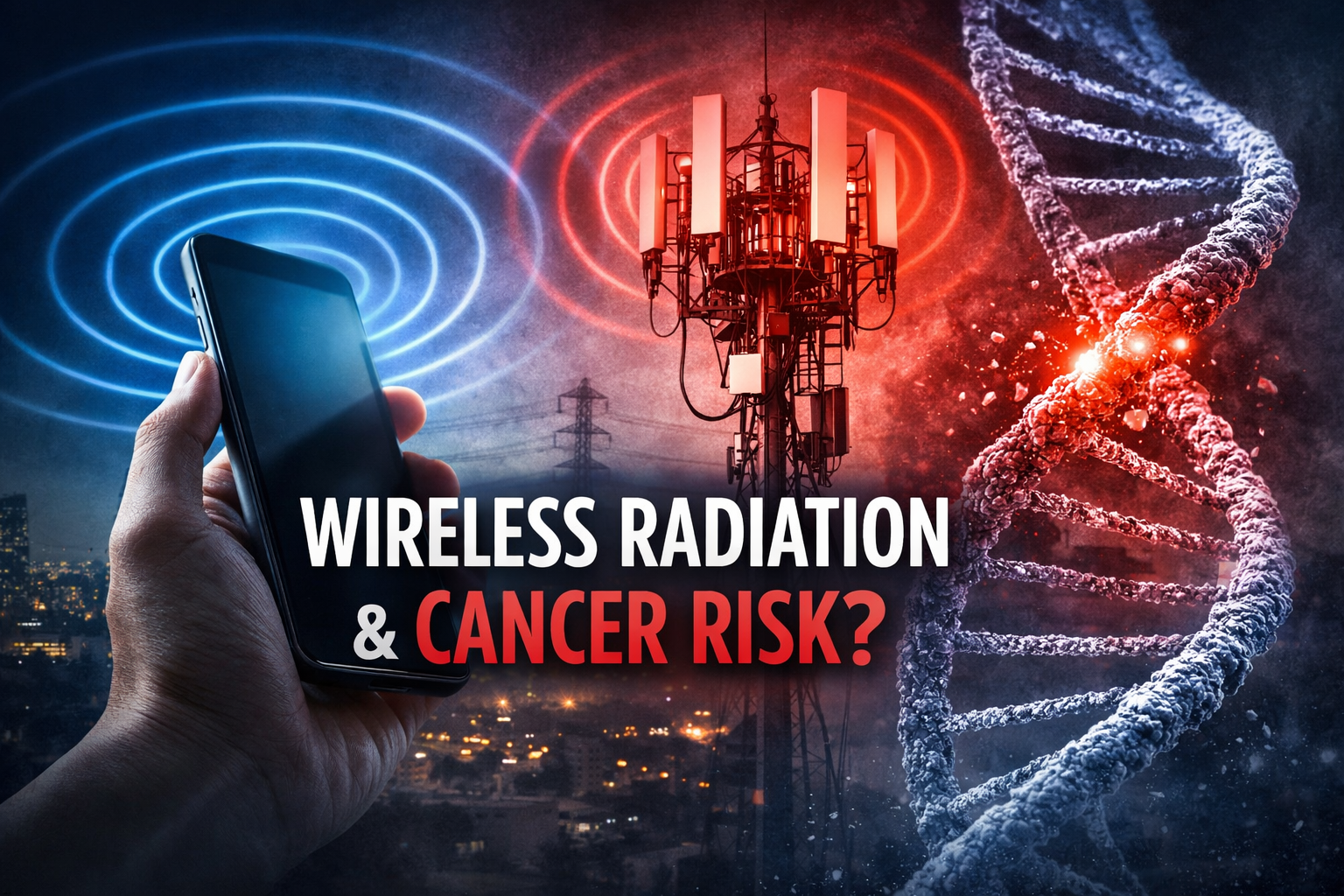
A Review of the Evidence, the Disputes, and the Policy Debate
Over the past two decades, wireless technologies have expanded dramatically. Smartphones, Wi-Fi routers, cellular towers, and now 5G infrastructure have become ubiquitous across modern life. Alongside these developments, a growing body of research has examined the biological effects of radiofrequency electromagnetic fields (RF-EMF) emitted by wireless devices.
Public debate about wireless radiation often becomes polarized. Industry groups and regulatory agencies typically emphasize existing safety standards, while some scientists and medical researchers argue that long-term biological effects may still be insufficiently studied.
Understanding this issue requires looking carefully at the major scientific milestones that shaped the discussion: the 2011 classification by the World Health Organization’s cancer research agency, the large U.S. National Toxicology Program study, und independent long-term animal studies in Europe.
This article reviews those findings and the ongoing policy debate surrounding them.
1. The 2011 WHO/IARC Classification of RF Radiation
In 2011, the International Agency for Research on Cancer (IARC)—a specialized cancer research body within the World Health Organization—convened an expert panel to evaluate the carcinogenic potential of radiofrequency electromagnetic fields.
After reviewing available evidence from epidemiological and experimental studies, the panel classified RF electromagnetic fields as:
Group 2B – “Possibly carcinogenic to humans.”
This classification placed RF radiation in the same category as substances where credible but limited evidence of cancer risk exists.
The decision followed a vote by the expert working group, which included scientists from multiple countries and disciplines.
Key factors cited by IARC included:
• Human observational studies suggesting an association between heavy mobile phone use and certain brain tumors
• Experimental animal studies indicating possible tumor development under RF exposure
• Biological mechanisms that could plausibly influence cancer risk
IARC’s classification did not conclude that RF radiation causes cancer in humans, but it determined that the evidence was sufficient to warrant caution and continued research.
Quelle:
https://www.iarc.who.int/pressrelease/iarc-classifies-radiofrequency-electromagnetic-fields-as-possibly-carcinogenic-to-humans/
PDF report:
https://www.iarc.who.int/wp-content/uploads/2018/07/pr208_E.pdf
2. Major Animal Studies After the IARC Decision
After the 2011 classification, several large-scale experimental studies were conducted to test whether radiofrequency radiation could produce biological effects under controlled laboratory conditions.
Two of the most widely cited studies were conducted independently in the United States and Italy.
3. The U.S. National Toxicology Program Study (2018)
Das U.S. National Toxicology Program (NTP) conducted one of the largest and most expensive animal studies ever performed on wireless radiation.
The research cost approximately $30 million and took over a decade to complete.
Laboratory rats were exposed to RF radiation similar to that emitted by older-generation mobile phone technologies.
The NTP concluded that there was:
“Clear evidence” of malignant schwannomas of the heart in male rats.
There was also “some evidence” of tumors in the brain (gliomas) and adrenal glands.
The study was subjected to external peer review by a panel of scientists who largely affirmed the conclusions.
Importantly, the exposures used in the experiment were higher than typical consumer exposures, and regulators note that translating animal results to human risk requires careful interpretation.
Nevertheless, the study represented the strongest experimental evidence to date that RF radiation could produce tumor development in mammals under certain conditions.
Quellen:
NIH summary
https://www.nih.gov/news-events/news-releases/high-exposure-radio-frequency-radiation-associated-cancer-male-rats
NTP research page
https://ntp.niehs.nih.gov/research/topics/cellphones
4. The Ramazzini Institute Long-Term Study
Around the same time, researchers at the Ramazzini Institute in Italy conducted a separate long-term study examining RF radiation exposure over the entire lifespan of laboratory animals.
Unlike the NTP experiment, the Ramazzini study used exposure levels designed to mimic radiofrequency emissions from cellular base stations rather than handheld devices.
The findings showed a statistically significant increase in:
• Malignant schwannomas of the heart
• Certain glial tumors in the brain
These findings were notable because they mirrored tumor types observed in the NTP study, despite being conducted by an entirely different laboratory and using different exposure conditions.
Quelle:
https://pubmed.ncbi.nlm.nih.gov/29530389/
5. Recent Systematic Reviews of Animal Evidence
More recently, researchers have conducted systematic reviews of the entire body of experimental literature examining RF radiation exposure in animals.
One such review, published in Environment International, evaluated hundreds of studies investigating cancer outcomes associated with radiofrequency electromagnetic fields.
The authors concluded that there is moderate certainty evidence of certain tumor types in experimental animals exposed to RF radiation.
At the same time, some public health agencies argue that current evidence does not yet demonstrate a clear causal risk for humans at typical exposure levels.
Quelle:
https://www.sciencedirect.com/science/article/pii/S0160412025002338
6. The Policy Debate: Safety Standards and Public Exposure
Despite ongoing scientific debate, wireless infrastructure continues to expand worldwide.
Governments and regulatory agencies generally rely on exposure limits developed by organizations such as:
• The International Commission on Non-Ionizing Radiation Protection (ICNIRP)
• The Federal Communications Commission (FCC) in the United States
These standards are primarily based on thermal effects, meaning the level of radiation required to produce measurable tissue heating.
Critics argue that non-thermal biological effects—changes in cells or tissues that occur without heating—may not be fully addressed in current guidelines.
Some scientists have therefore called for updated safety assessments or additional precautionary measures, particularly regarding children and long-term exposure.
Others maintain that the existing limits already incorporate large safety margins.
7. Legal and Regulatory Challenges
The regulatory framework surrounding wireless radiation has also been challenged in court.
In 2021, the U.S. Court of Appeals for the D.C. Circuit ruled that the Federal Communications Commission must provide a more detailed explanation of how it evaluated scientific evidence related to non-cancer health effects when maintaining existing exposure limits.
The court did not declare the standards unsafe but required the agency to address concerns raised in the administrative record.
This decision highlighted the ongoing debate over how regulators interpret evolving scientific evidence.
8. Calls for Continued Research
Many researchers agree on at least one point: long-term population exposure to wireless technologies has increased dramatically, and continued monitoring of health outcomes is important.
Scientists including epidemiologists and oncologists have suggested that the IARC classification may warrant reevaluation as new evidence accumulates.
Whether future assessments will upgrade or reaffirm the existing classification remains an open question.
9. Practical Exposure Reduction
While scientific and regulatory debates continue, individuals concerned about RF exposure often take simple precautionary steps, such as:
• Using wired internet connections where practical
• Limiting prolonged direct phone contact with the head
• Keeping wireless devices away from the body during sleep
• Reducing unnecessary background wireless transmissions
These steps do not require abandoning modern technology but can reduce personal exposure levels.
10. Health Freedom and Informed Choice
Public health policy ultimately involves balancing technological progress with long-term health considerations.
For those interested in exploring broader public health and regulatory discussions related to medical autonomy and environmental exposure, additional materials are available in the Watchman News Health Freedom Resources library.
Health Freedom Resources
https://watchman.news/2023/05/health-freedom-resources/
Fazit
Wireless technology has transformed modern society, but its biological effects remain an active area of research.
The 2011 IARC classification, the U.S. National Toxicology Program study, and the Ramazzini Institute findings all contribute important pieces to the scientific puzzle.
While regulatory agencies generally maintain that existing safety standards remain protective, some scientists continue to call for additional research and precautionary policies.
As wireless infrastructure continues expanding worldwide, understanding the evidence—and its limitations—will remain essential for policymakers, researchers, and the public alike.
Appendix A: Key Primary Sources
IARC RF Radiation Classification
https://www.iarc.who.int/pressrelease/iarc-classifies-radiofrequency-electromagnetic-fields-as-possibly-carcinogenic-to-humans/
IARC Press Release PDF
https://www.iarc.who.int/wp-content/uploads/2018/07/pr208_E.pdf
National Toxicology Program Cell Phone Study
https://ntp.niehs.nih.gov/research/topics/cellphones
NIH Summary of NTP Findings
https://www.nih.gov/news-events/news-releases/high-exposure-radio-frequency-radiation-associated-cancer-male-rats
Ramazzini Institute Study
https://pubmed.ncbi.nlm.nih.gov/29530389/
Environment International Systematic Review
https://www.sciencedirect.com/science/article/pii/S0160412025002338
FCC RF Exposure Information
https://www.fcc.gov/general/radio-frequency-safety-0
EPA RadTown Wireless Radiation Overview
https://www.epa.gov/radtown/wireless-technologies-and-radiofrequency-radiation
Appendix B: Organizations and Research Centers Studying RF Radiation
International Agency for Research on Cancer
https://www.iarc.who.int
National Institute of Environmental Health Sciences
https://www.niehs.nih.gov
National Toxicology Program
https://ntp.niehs.nih.gov
Ramazzini Institute
https://www.ramazzini.org
Radiation Research Trust
https://radiationresearch.org
Appendix C: Official Government and Regulatory Sources
The following sources provide official information from government agencies, regulatory bodies, and international health organizations regarding electromagnetic fields (EMF) and radiofrequency radiation.
United States Government Information Hubs
National Institute of Environmental Health Sciences (NIH)
Electric & Magnetic Fields overview
https://www.niehs.nih.gov/health/topics/agents/emf
Cell Phone Radiofrequency Radiation research overview
https://www.niehs.nih.gov/health/topics/agents/cellphones
Occupational Safety and Health Administration (OSHA)
Radio Frequency & Microwave Radiation health effects
https://www.osha.gov/radiofrequency-and-microwave-radiation/health-effects
Extremely Low Frequency Radiation workplace information
https://www.osha.gov/SLTC/elfradiation/
Environmental Protection Agency (EPA)
Electric & Magnetic Fields from Power Lines
https://www.epa.gov/radtown/electric-and-magnetic-fields-power-lines
Wireless Technology Radiation Overview
https://www.epa.gov/radtown/non-ionizing-radiation-wireless-technology
California Department of Public Health
Cell Phone Safety Guidance (PDF)
https://www.cdph.ca.gov/Programs/CCDPHP/DEODC/EHIB/CDPH%20document%20Library/Cell-Phone-Guidance.pdf
CDPH Press Release on Wireless Radiation Guidance
https://www.cdph.ca.gov/Programs/OPA/pages/nr17-086.aspx
U.S. Regulatory and Legal Framework
Federal Communications Commission
Radio Frequency Safety Overview
https://www.fcc.gov/general/radio-frequency-safety-0
FCC RF Exposure Limits (47 CFR §1.1310)
https://www.ecfr.gov/current/title-47/chapter-I/subchapter-A/part-1/subpart-I/section-1.1310
Alternate reference copy (Cornell Law)
https://www.law.cornell.edu/cfr/text/47/1.1310
Portable Device RF Evaluation (47 CFR §2.1093)
https://www.law.cornell.edu/cfr/text/47/2.1093
Environmental Health Trust v. FCC
FCC case summary
https://www.fcc.gov/document/dc-circuit-decision-environmental-health-trust-v-fcc
Court opinion PDF
https://docs.fcc.gov/public/attachments/DOC-374936A1.pdf
Readable HTML case page
https://law.justia.com/cases/federal/appellate-courts/cadc/20-1025/20-1025-2021-08-13.html
Medical and Professional Organization Commentary
American Academy of Pediatrics letter to the FCC
https://ehtrust.org/wp-content/uploads/AAP-Letter-To-FCC-RF-Radiation-Review-2013.pdf
AAP regulatory submission archive
https://downloads.regulations.gov/FDA-2023-N-4807-0003/attachment_11.pdf
American Medical Association Resolution 506 (2021)
https://www.ama-assn.org/system/files/2021-05/j21-506.pdf
Nursing environmental health policy reference
https://downloads.regulations.gov/DHS-2023-0048-0005/attachment_10.pdf
International Health Organizations
World Health Organization – Electromagnetic Fields
https://www.who.int/health-topics/electromagnetic-fields
WHO Non-Ionizing Radiation Program
https://www.who.int/teams/environment-climate-change-and-health/radiation-and-health/non-ionizing/emf
WHO EMF Question & Answer
https://www.who.int/news-room/questions-and-answers/item/radiation-electromagnetic-fields
WHO Environmental Health Criteria – ELF Fields
https://www.who.int/publications/i/item/9789241572385
IARC Monographs
IARC Monograph Vol. 102 – Radiofrequency Electromagnetic Fields
https://publications.iarc.who.int/_publications/media/download/5665/4a6c1fa0e4ed476c9735222ab2838b2192b7c89c.pdf
IARC Monograph Vol. 80 – Static and ELF Fields
https://www.hydroone.com/poweroutagesandsafety_/corporatehealthandsafety_/EMFs/mono80.pdf
European Scientific Reviews
European Commission EMF health effects publication
https://health.ec.europa.eu/publications/potential-health-effects-exposure-electromagnetic-fields-emf_en
SCENIHR 2015 Scientific Opinion
https://ec.europa.eu/health/scientific_committees/emerging/docs/scenihr_o_041.pdf
Insurance Industry Risk Assessment
Swiss Re SONAR 2019 Report
https://www.swissre.com/institute/research/sonar/sonar2019.html
Full SONAR Report PDF
https://www.swissre.com/dam/jcr%3A5916802c-cf6b-4c67-9d42-39cf80c4b00d/SONAR%20Publication%202019_WEB_quality.pdf
Swiss Re Press Release
https://www.swissre.com/media/press-release/nr-20190522-sonar2019.html
Exposure Standards
International Commission on Non-Ionizing Radiation Protection (ICNIRP)
https://www.icnirp.org/cms/upload/publications/ICNIRPFactSheetMvt.pdf
Additional Public Health Summaries
American Cancer Society – Cell Phones and Cancer
https://www.cancer.org/cancer/risk-prevention/radiation-exposure/cellular-phones.html
American Cancer Society – Extremely Low Frequency Radiation
https://www.cancer.org/cancer/risk-prevention/radiation-exposure/extremely-low-frequency-radiation.html
Related Watchman Resources
Health Freedom Resources Library
https://watchman.news/2023/05/health-freedom-resources/
WiFi Warnings for Women and Children — A Simple Solution
An earlier Watchman News commentary exploring concerns about wireless exposure for children and families, along with reflections on personal responsibility and faith-based approaches to health stewardship.
 German
  English
  Dutch
Dutch  Polish
  Swedish
  French
  Ukrainian