Tracing Clan Gregor from the kings of Scotland to the High Kings of Ireland
1. Introduction: “Royal Is My Race”
- The MacGregor declaration
- Siol Alpine and the problem of proof
- Framing the question of origins
2. Scots and Picts: One Royal Tradition?
- Dal Riata and Pictland
- Political vs ancestral identity
- The MacAlpin narrative
3. King Giric and the Northern Line
- Giric mac Dúngal in history
- Moray and early kingship
- Protector of the Church
4. Clan Gregor: Tradition and Identity
- The royal declaration
- Early clan memory
- Highland origins
5. The House of Moray and Cenél Loairn
- Northern Pictish dynasty
- Cenél Loairn explained
- Survival and continuity
6. Dál Riata: Scotland and Ireland United
- Migration and settlement
- Gaelic and Pictish integration
- Royal interconnections
7. The Irish Royal Framework
- The sons of Milesius
- Érimón and Éber Finn
- O’Neill and early royal lines
8. A Converging Royal Tradition
- Where the lines meet
- Reconciling historical accounts
- Memory across kingdoms
9. Conclusion: The Royal Claim Reconsidered
- Beyond MacAlpin
- A wider Celtic inheritance
- The enduring tradition
10. The Royal Line Made Simple
- From MacGregor to Giric
- From Moray to Dál Riata
- From Scotland to Irish High Kings
11. Royal Houses of Scotland in Context
- Bruce and Stewart dynasties
- Medieval kingship vs ancient lineage
- The deeper origins of royal tradition
Introduction: “Royal Is My Race” and the Question of Origins
The Traditional Declaration of Clan Gregor:
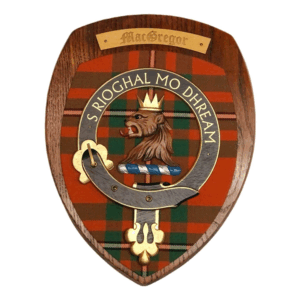
“’S Rioghal Mo Dhream” — “Royal is my race.”
This is not merely a heraldic motto preserved in later heraldry. It is a statement of identity—an inherited claim of lineage carried through centuries of upheaval, loss, and survival.
Clan Gregor has long been associated with the Siol Alpine, the group of Highland clans traditionally said to descend from Kenneth MacAlpin. This connection has often been presented as the explanation for the clan’s royal claim. Yet the historical record is more complex. Early Highland historians themselves preserved the tradition while acknowledging a difficulty: the claim to royal descent was widely affirmed, but the exact genealogical line could not be securely demonstrated.
This tension is not a weakness—it is the starting point.
If the MacGregor claim to royal origin is genuine, yet not fully explained by the standard MacAlpin pedigree, then the possibility arises that the tradition preserves something older and more layered. The early kingdom of Alba was not the product of a single line, but the convergence of multiple royal traditions: Pictish, Gaelic, Moravian, and Irish.
This study therefore does not attempt to force a single, uninterrupted genealogy where the sources do not support one. Instead, it follows the strands as they appear in the historical and traditional record: the Siol Alpine framework, the northern Pictish dynasty of Moray, the figure of Giric mac Dúngal, the Gaelic kingdom of Dál Riata, and the deeper Irish royal genealogies associated with Érimón and Éber Finn.
Some of these belong to recorded history, others to dynastic tradition, and others to the inherited memory of origin. When examined together, however, they do not contradict so much as converge. What emerges is not a single narrow pedigree, but a broader and more compelling conclusion: the royal identity preserved by Clan Gregor may reflect a continuity of inheritance rooted in the older Pictish and Gaelic order of kingship.
A useful starting point is found in A History of the Scottish Highlands…
¹ John Scott Keltie (ed.), A History of the Scottish Highlands, Highland Clans and Highland Regiments (Edinburgh: A. Fullarton & Co., 1875), Vol. II, p. 243.
2. Scots and Picts: One Royal Tradition or Two?
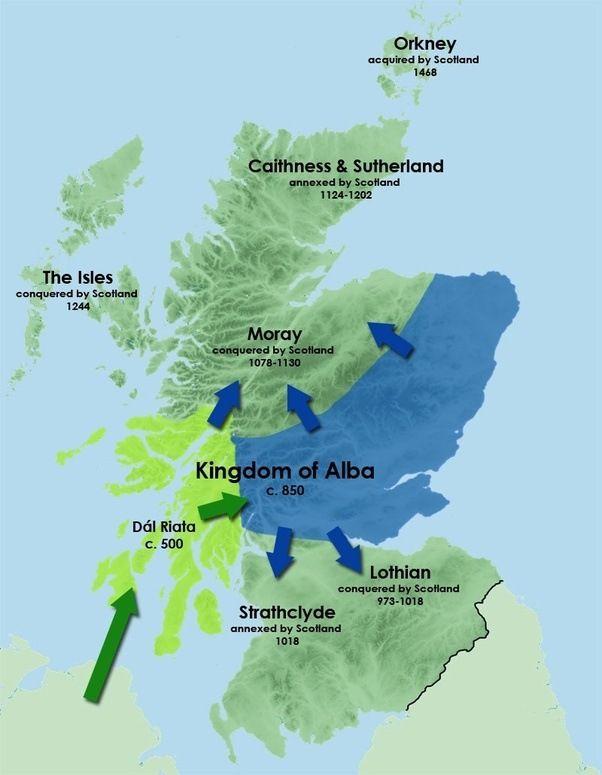
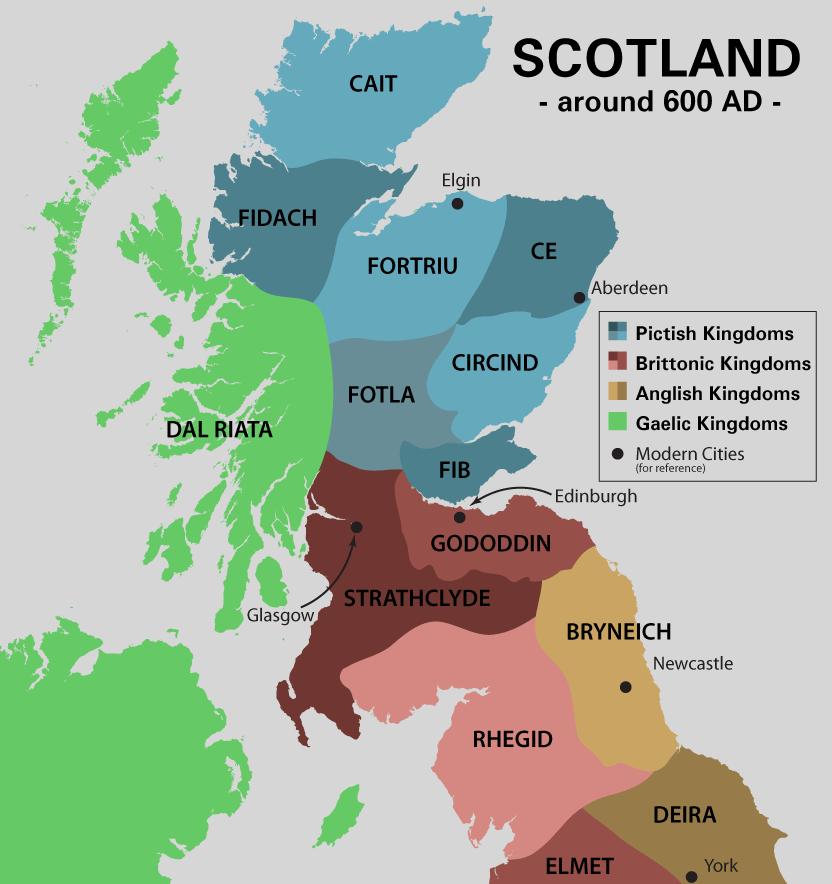
The distinction between Scots and Picts has long been presented as a dividing line in early Scottish history. In later narratives—particularly those shaped under the influence of the southern Scottish kingdom—this division became emphasized as a contrast between two separate peoples: the Gaelic Scots of Dál Riata and the indigenous Picts of northern Britain.
Yet the historical reality is more nuanced.
The kingdom of Dál Riata, rooted in both northeastern Ireland and western Scotland, represents a Gaelic-speaking political and cultural sphere. The Picts, by contrast, occupied much of northern and eastern Scotland and maintained their own systems of kingship, succession, and ecclesiastical structure. Early sources, however, do not consistently portray these groups as entirely separate in origin, but rather as neighboring and interacting branches within a broader Celtic world.
Over time, especially during the 9th and 10th centuries, these distinctions began to blur. The formation of the kingdom of Alba—traditionally associated with the rise of Kenneth MacAlpin—is often described as the unification of Scots and Picts under a single royal house. But this “unification” was not necessarily the replacement of one people by another. Instead, it appears to have been a political consolidation of already interconnected dynasties, bound by intermarriage, shared religious traditions, and overlapping territorial claims.
Later genealogical traditions tended to favor the MacAlpin line, emphasizing descent through the Scottish (Gaelic) kings of Dál Riata. In doing so, they sometimes obscured or minimized the parallel and competing royal traditions of the Picts—particularly those of the northern kingdom centered in Moray. This has had a lasting effect on how early Scottish history is understood, often giving the impression that all legitimate royal descent must pass through the MacAlpin framework.
However, this assumption deserves to be revisited.
The evidence suggests that both Pictish and Scottish royal lines may themselves have drawn from shared ancestral traditions, extending back into Ireland. The distinctions between Scot and Pict, therefore, may be less about origin and more about political identity—labels shaped by circumstance, rather than markers of entirely separate descent.
If this is the case, then the royal claims preserved in Highland clan tradition—such as those of Clan Gregor—need not be confined to a single line. Instead, they may reflect a broader inheritance, one that encompasses both the Pictish and Gaelic royal traditions that together formed the early kingdom of Alba.
² Alex Woolf, From Pictland to Alba, 789–1070 (Edinburgh University Press, 2007), pp. 1–20.
3. Giric mac Dúngal and the Northern Royal Line
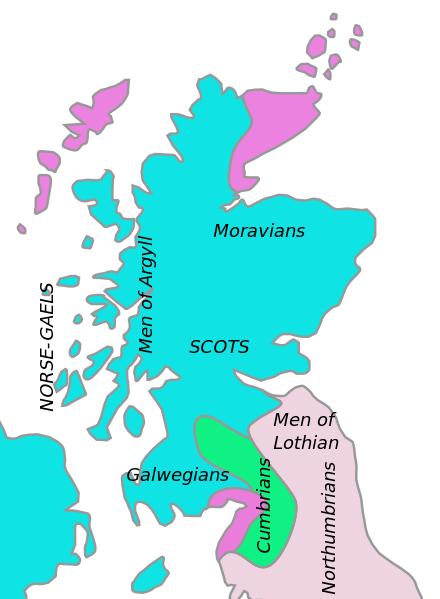
At the center of the northern royal tradition stands the figure of Giric mac Dúngal, a king of Alba whose reign is generally placed between 878 and 889. Although the surviving records concerning him are limited and sometimes contradictory, they preserve enough detail to establish his importance within the transitional period of early Scottish kingship.
Giric is consistently identified in early sources as “mac Dúngal”, indicating his descent from a figure named Dúngal. Unlike the kings of the MacAlpin line, whose genealogies were later more firmly established in Scottish tradition, Giric’s ancestry is less clearly defined. This ambiguity has led to significant scholarly discussion regarding his origins.
Modern historical analysis, particularly that of Benjamin Hudson, has suggested that Giric was not a member of the Cenél nGabráin (the line associated with Kenneth MacAlpin), but rather connected to the northern Pictish dynasty of Moray, itself linked to the kindred known as Cenél Loairn. This places Giric within a parallel royal tradition—one that existed alongside, and at times in rivalry with, the MacAlpin line.
⁴ Benjamin T. Hudson, Kings of Celtic Scotland (Westport, CT: Greenwood Press, 1994), pp. 85–95.
The importance of this distinction cannot be overstated. If Giric belonged to the Moray-based Pictish dynasty, then his reign represents not merely an episode within the MacAlpin succession, but the assertion of an alternative royal lineage within Alba—one rooted in the northern kingdom and its older structures of authority.
Giric’s reputation in later sources further underscores his significance. By the 12th century, he had come to be known as “Gregory the Great,” credited with liberating the Scottish Church from earlier constraints and extending his influence beyond Scotland. While these accounts are undoubtedly embellished, they reflect a memory of Giric as a ruler of unusual importance.
His association with the Church is particularly notable. Traditions connected with the Culdees (Céle Dé) recall Giric as a protector or patron, suggesting that his authority may have extended into ecclesiastical as well as political spheres. This aligns with the broader pattern of early Celtic kingship, in which the relationship between ruler and Church was central to legitimacy.
Taken together, these elements point to Giric as more than a marginal or obscure figure. He stands as a representative of a northern royal tradition, one that intersects with Moray, Cenél Loairn, and the wider Gaelic world. In the context of Clan Gregor’s preserved claim to royal descent, this tradition offers a compelling line of inquiry—one that may help explain how a memory of ancient kingship was maintained outside the more dominant MacAlpin narrative.
³ Chronicle of the Kings of Alba, in Marjorie O. Anderson (ed.), Kings and Kingship in Early Scotland (Edinburgh University Press, 1980).
⁴ Benjamin T. Hudson, Kings of Celtic Scotland (Westport, CT: Greenwood Press, 1994), pp. 85–95.
4. The MacGregor Claim: Tradition, Chiefs, and Identity
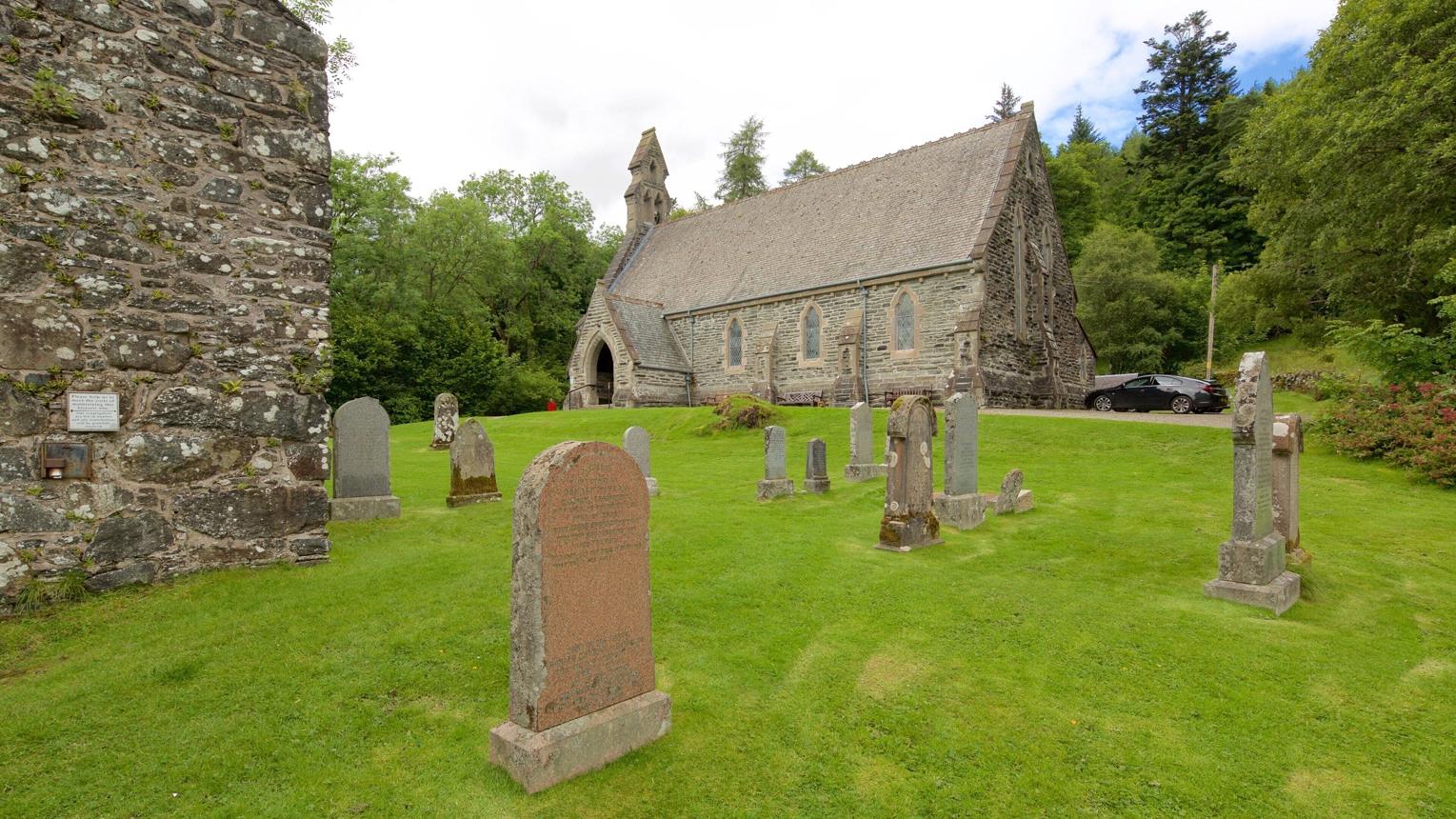
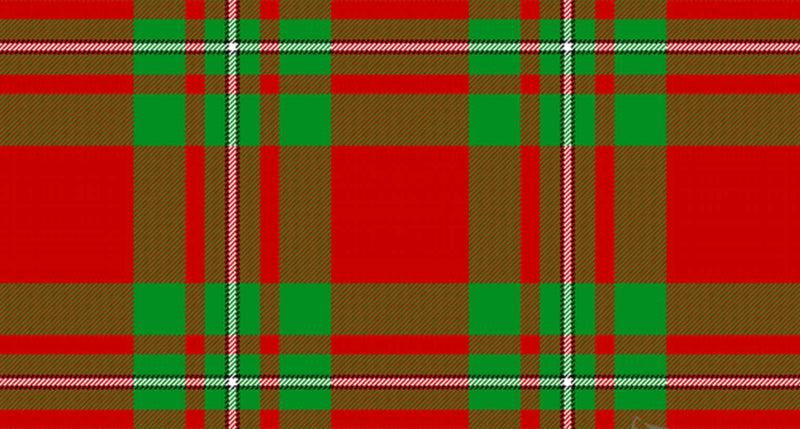
“’S Rioghal Mo Dhream” — “Royal is my race.”
This statement reflects more than pride of ancestry. It represents a persistent claim of descent from an ancient royal stock, maintained despite centuries of displacement, proscription, and fragmentation.
Historically, the MacGregors were centered in regions such as Balquhidder, Glenorchy, und Menteith, areas long associated with early Highland settlement patterns. Even as political pressures forced the clan from their lands and led to the suppression of their name, the internal cohesion of the clan remained remarkably strong. This continuity of identity is itself evidence of a deeply rooted tradition.
Early Highland histories placed the MacGregors among the Siol Alpine, the grouping of clans traditionally linked to Kenneth MacAlpin. At the same time, those same sources acknowledged a limitation: while the royal origin of the clan was widely affirmed, the exact genealogical path through the MacAlpin line could not be definitively demonstrated.
This duality—certainty of royal descent, uncertainty of precise lineage—is central to understanding the MacGregor claim.
In some genealogical traditions, the clan traces its origin to a figure named Gregor (Griogar), said to have been connected to the MacAlpin family, sometimes described as a younger son or collateral relative. Yet even early historians admitted that such a descent could not be clearly traced in surviving records. Rather than weakening the tradition, this suggests that the preserved memory of royal origin may extend beyond the simplified genealogies later constructed to explain it.
The lived history of the MacGregors reinforces this interpretation. Few clans endured such sustained legal persecution, including the banning of their name and the forced adoption of aliases. Yet through these trials, the clan maintained a strong internal identity, bound not only by kinship but by a shared understanding of origin.
This resilience points to something deeper than a convenient claim. It suggests the preservation of a genuine ancestral tradition, one that may have been only partially captured in later genealogical reconstructions.
If the MacGregor identity carries an authentic memory of royal descent, then the task is not merely to fit it into the MacAlpin framework, but to examine the broader historical context in which multiple royal lines—Pictish, Gaelic, and Moravian—interacted and overlapped. It is within that wider context that the MacGregor claim finds its most compelling explanation.
⁵ William F. Skene, The Highlanders of Scotland (London, 1837), pp. 292–300.
5. The House of Moray and Cenél Loairn
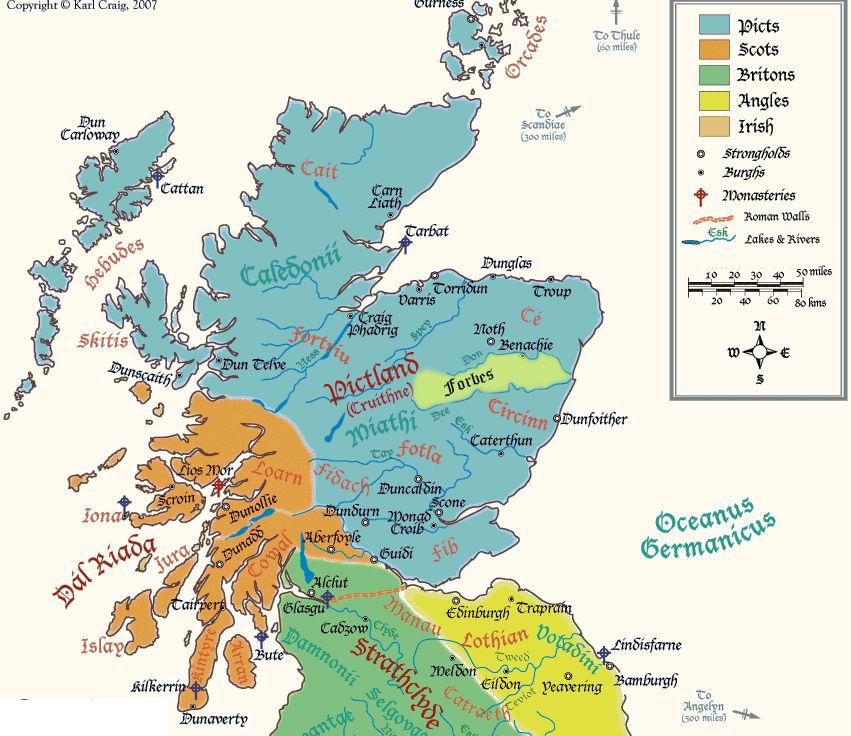
To understand the deeper framework behind the MacGregor claim, it is necessary to turn to the northern kingdom of Moray, one of the most important centers of power in early medieval Scotland.
Moray, associated with the earlier Pictish kingdom of Fortriu, maintained a distinct political identity even as the kingdom of Alba was forming. Far from being absorbed immediately into a unified Scottish monarchy, Moray preserved its own ruling dynasties, traditions of succession, and regional authority for several centuries.
Central to this northern tradition is the kindred known as Cenél Loairn, one of the principal branches of the early Gaelic kingdom of Dál Riata. While Dál Riata is often associated with the western seaboard and its Irish connections, its internal divisions—particularly between Cenél nGabráin and Cenél Loairn—reflect a more complex structure of overlapping dynasties.
The Cenél Loairn line has been linked by modern scholarship to the ruling families of Moray, suggesting that the northern Pictish dynasty was not isolated, but connected to the broader Gaelic world. This connection provides a critical bridge between Pictish and Irish royal traditions.
Within this context, figures such as Macbeth und Lulach emerge not as anomalies, but as representatives of a continuing Moray-based royal line. Their reigns demonstrate that the northern dynasty remained a viable contender for the kingship of Scotland well into the 11th century.
The position of Giric mac Dúngal within this framework becomes especially significant. If, as proposed by scholars such as Benjamin Hudson, Giric belonged to this northern, Cenél Loairn-connected dynasty, then his reign represents an earlier assertion of Moray-based royal authority within Alba.
This interpretation helps to explain why later traditions surrounding Giric differ from those of the MacAlpin kings. Rather than being fully integrated into the dominant southern narrative, Giric appears as a figure whose legacy was preserved in alternative strands of tradition—particularly those connected with the north and with ecclesiastical communities such as the Culdees.
The importance of Moray, therefore, lies not only in its political history, but in its role as a conduit of continuity. It represents a line of kingship that was neither wholly Pictish nor wholly Scottish in the later sense, but part of a broader network of Gaelic and Celtic royal traditions extending into Ireland.
It is within this network that the MacGregor claim can be more fully understood. If the clan’s preserved memory of royal descent does not align neatly with the MacAlpin line, it may instead reflect an inheritance connected to this northern dynasty—one rooted in Moray, linked to Cenél Loairn, and ultimately tied into the wider Irish royal framework.
⁶ Alex Woolf, From Pictland to Alba, pp. 200–220.
6. Dál Riata: The Bridge Between Ireland and Scotland
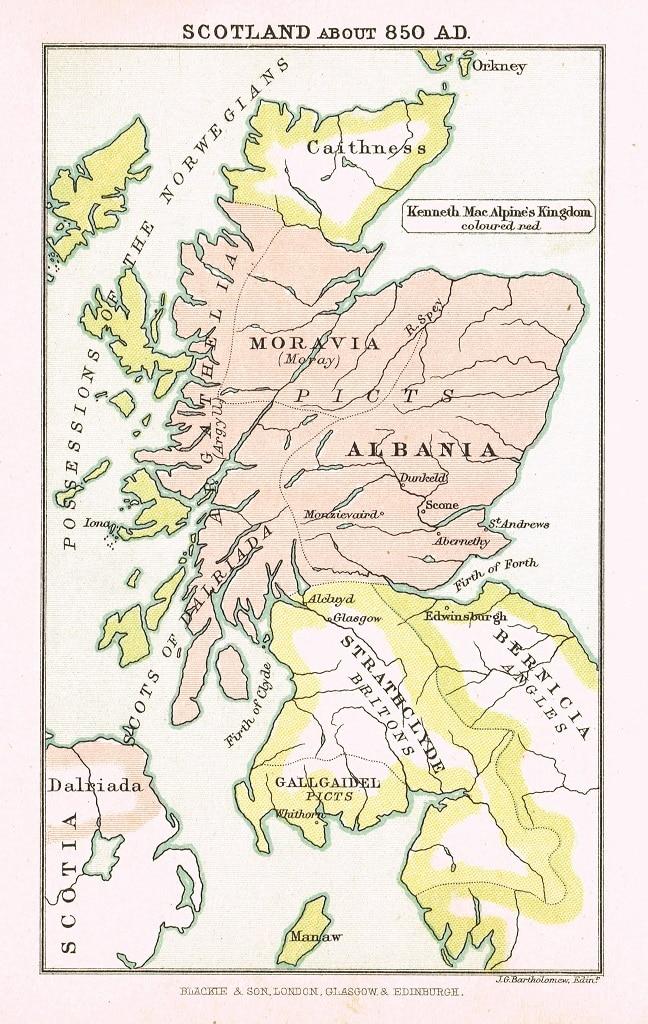
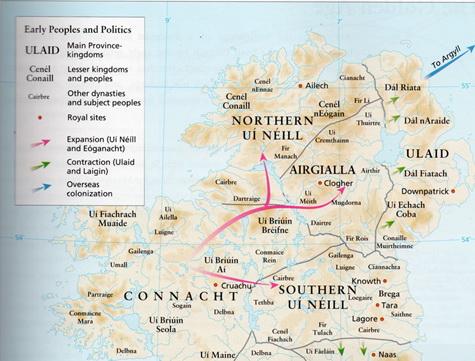
The kingdom of Dál Riata occupies a central place in the formation of early Scotland, serving as the most visible bridge between Ireland and the western Highlands. Far from being confined to a single landmass, Dál Riata existed as a maritime kingdom, spanning the narrow sea between northeastern Ireland and western Scotland.
From at least the late fifth century, Gaelic-speaking groups associated with Dál Riata established themselves along the coast of Argyll and the surrounding regions. This movement did not occur in isolation. It brought with it systems of kingship, language, and ecclesiastical tradition that would play a defining role in the shaping of Alba.
Dál Riata itself was not a unified or monolithic kingdom. It was composed of several kindreds, most notably Cenél nGabráin und Cenél Loairn, each maintaining its own lines of leadership and territorial influence. The former is more commonly associated with the later MacAlpin kings, while the latter—Cenél Loairn—has been linked to the northern dynasties centered in Moray.
This internal structure is critical. It demonstrates that the royal traditions of early Scotland did not originate from a single line, but from multiple interconnected dynasties, each drawing upon shared cultural and ancestral frameworks rooted in Ireland.
Through Dál Riata, the distinction between “Irish” and “Scottish” royal lines becomes increasingly difficult to maintain. Kings, nobles, and clerics moved across the narrow sea, intermarried, and shared traditions of legitimacy. The influence of Iona and the Columban Church further reinforced these connections, embedding Irish ecclesiastical patterns within the developing kingdom of Alba.
Within this context, the emergence of the MacAlpin dynasty can be seen not as the introduction of an entirely new ruling house, but as the ascendancy of one branch within an already interconnected system. At the same time, other branches—particularly those associated with Cenél Loairn and the Moray region—continued to assert their own claims to authority.
Dál Riata therefore stands as the essential framework through which the royal traditions of Ireland and Scotland converged. It provides the historical foundation for understanding how a clan such as the MacGregors could preserve a memory of royal descent that is not confined to a single Scottish lineage, but reflects a broader inheritance extending across the Irish Sea.
⁷ Ewan Campbell, “Were the Scots Irish?” in Antiquity 75 (2001): 285–292.
7. The Irish Royal Framework: Érimón and Éber Finn
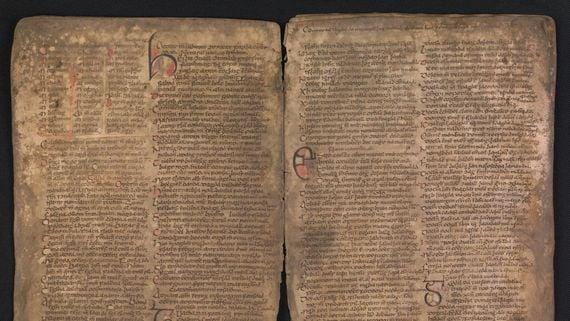
At the center of this framework stands the figure of Milesius (Míl Espáine), the legendary ancestor of the Gaels. According to Irish tradition, his sons divided the sovereignty of Ireland, establishing lines of descent that would shape the genealogical identity of the island for centuries.
Two of these lines are of particular importance:
- The line of Érimón, associated with the northern half of Ireland and later linked to powerful dynasties such as the O’Neills
- The line of Éber Finn, associated with the southern regions and connected, in later tradition, to branches that extended into Dál Riata and Scotland
These divisions are not to be read as modern historical fact in the strict sense, but neither are they arbitrary inventions. They represent a structured memory of origin, used by medieval scholars and chroniclers to organize the relationships between ruling families and to situate them within a coherent narrative of descent.
Within this framework, the royal lines of Ireland, Dál Riata, and ultimately Scotland are presented as branches of a common ancestral tradition. This is particularly relevant in the case of Cenél Loairn and related kindreds, whose presence in western Scotland reflects the extension of Irish royal structures across the sea.
The genealogies themselves become more historically grounded as they approach the early medieval period, particularly from the fifth century onward, when figures associated with Dál Riata and the early kings of Scotland begin to appear in both Irish and Scottish sources. Prior to this, the lines serve primarily as a record of dynastic identity and continuity, rather than a strictly verifiable chronology.
For the purposes of this study, the importance of the Milesian framework lies not in proving each individual link, but in understanding the context it provides. It demonstrates that the royal traditions preserved in Scotland—whether associated with the MacAlpin line, the Moray dynasty, or clans such as the MacGregors—were part of a wider Gaelic system of kingship that traced its origins to Ireland.
When viewed in this light, the convergence of traditions explored in the preceding sections becomes more coherent. The MacGregor claim to royal descent, the Moray connection, the Cenél Loairn lineage, and the Dál Riata bridge all fit within a broader framework in which Irish, Pictish, and Scottish identities were not separate origins, but interwoven expressions of a shared royal heritage.
⁸ Annals of the Four Masters, ed. John O’Donovan (Dublin, 1856).
⁹ John O’Hart, Irish Pedigrees (Dublin, 1892), Introduction (note: represents traditional genealogical compilations rather than strictly critical history).
8. Harmonizing the Traditions: Pict, Scot, and Irish Royal Memory
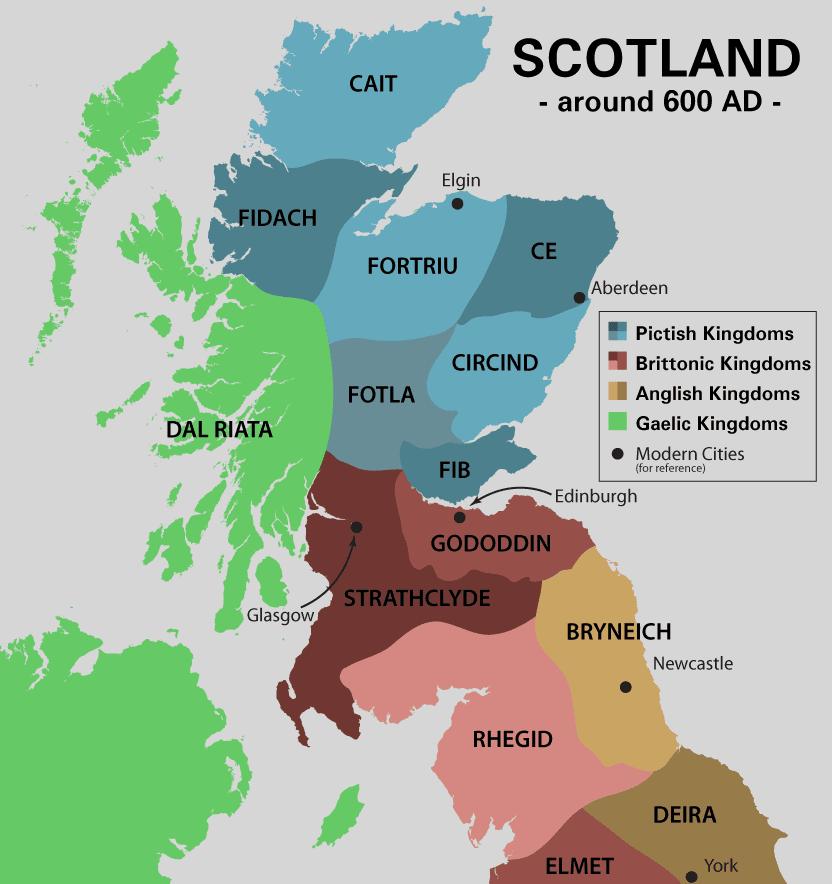
At first glance, the traditions examined in this study can appear contradictory. The MacGregor claim has been linked to the Siol Alpine and the line of Kenneth MacAlpin. At the same time, historical analysis points toward a connection with the northern Pictish dynasty of Moray, associated with Cenél Loairn. Beyond this, the broader genealogical framework of Ireland traces royal lines back through the divisions of Érimón and Éber Finn, ultimately rooted in the Milesian tradition.
Taken separately, these strands seem difficult to reconcile. Yet when considered within the historical context of early medieval Scotland and Ireland, they begin to align.
The formation of the kingdom of Alba did not erase earlier identities; it brought them into relationship. Pictish, Gaelic, and Irish traditions coexisted and interacted, often recorded differently depending on the political or regional perspective of the source. A genealogy written in a southern Scottish context might emphasize MacAlpin descent, while one reflecting northern traditions might preserve the memory of Moray. Irish genealogies, in turn, placed both within a wider ancestral framework that extended beyond Scotland entirely.
In this light, the variations in tradition do not necessarily represent competing falsehoods, but partial reflections of a more complex reality.
The concept that best describes this is not a single linear descent, but a converging royal memory. Different records preserve different aspects of lineage, shaped by the priorities of their compilers—whether political legitimacy, regional identity, or continuity with older traditions. When these are brought together, they reveal not contradiction, but depth.
The MacGregor tradition fits naturally within this model. Its association with Siol Alpine reflects one layer of historical memory; its potential connection to the Moray and Cenél Loairn dynasties reflects another; and its resonance with the wider Irish genealogical structure provides yet a broader context.
Rather than diminishing the claim, this convergence strengthens it. It suggests that the royal identity preserved by Clan Gregor is not dependent on a single narrow pedigree, but is rooted in a shared inheritance across the Pictish, Gaelic, and Irish worlds.
In this way, the enduring declaration “’S Rioghal Mo Dhream” can be understood not as an isolated boast, but as the preserved expression of a tradition that spans multiple strands of early Celtic kingship.
¹⁰ Compare genealogical variations across Irish and Scottish traditions in Hudson, Kings of Celtic Scotland.
9. Conclusion: The Royal Claim Reconsidered
The royal claim of Clan Gregor has often been viewed through a limited lens, framed primarily in relation to the MacAlpin dynasty and the later development of the Scottish monarchy. While this perspective preserves an important part of the tradition, it does not fully account for the complexity of early Scottish and Irish royal history.
This study has taken a broader approach.
By examining the relationship between Scots and Picts, the role of Giric mac Dúngal, the continuity of the Moray dynasty, the structure of Cenél Loairn, and the bridging function of Dál Riata, a wider framework emerges—one in which multiple royal traditions intersect. When placed alongside the Irish genealogical system, these connections reveal a network of inheritance that extends beyond the confines of a single dynasty.
Within this framework, the MacGregor claim to royal descent appears not as an isolated or unsupported assertion, but as part of a coherent historical and traditional continuum. The difficulty in tracing a single, uninterrupted line through the MacAlpin genealogy does not invalidate the claim; rather, it points to a deeper and more distributed inheritance, one preserved across multiple strands of tradition.
The strength of the MacGregor identity lies precisely in this continuity. Despite centuries of adversity—loss of lands, legal proscription, and fragmentation—the clan retained a clear and consistent understanding of its origin. That memory was not erased, even when formal records were incomplete or contested.
In this sense, the declaration “’S Rioghal Mo Dhream” — “Royal is my race” stands not merely as a statement of pride, but as a reflection of a long-standing and resilient tradition of royal association. When viewed in the broader context of Pictish, Gaelic, and Irish history, it becomes clear that this claim is not confined to a single lineage, but belongs to a wider heritage of early Celtic kingship.
The MacGregor story, therefore, is not only the story of one clan. It is part of a larger narrative—the convergence of ancient traditions that shaped the formation of Scotland itself.
10. The Royal Line Made Simple: From MacGregor to the High Kings of Ireland
For many readers, the question remains: how do all of these traditions connect in a way that can be clearly understood?
Stripped of complexity, the preserved tradition can be expressed simply:
- Clan Gregor maintains a claim of descent from an early royal figure, often associated with Giric mac Dúngal, a king of Alba in the 9th century
- Giric is understood by modern scholarship to be connected to the northern Pictish dynasty of Moray, rather than the southern MacAlpin line
- That northern dynasty is associated with Cenél Loairn, a branch of the Gaelic kingdom of Dál Riata
- Dál Riata itself forms a historical bridge between Scotland and Ireland
- And within Irish tradition, these royal lines are situated within the broader framework of the High Kings of Ireland, including the line later associated with the O’Neills
Presented in this way, the tradition becomes clear:
MacGregor → Giric → Moray (Pictish Kings) → Dál Riata → Irish High Kings
This does not represent a single uninterrupted documentary pedigree in the modern sense. Rather, it reflects a converging tradition of royal descent, preserved across Scottish and Irish sources.
What is often missing is not the tradition itself, but its clear expression.
When understood in this way, the declaration:
“’S Rioghal Mo Dhream” — “Royal is my race”
ceases to be an abstract claim, and instead becomes a concise statement of a lineage that spans the royal traditions of both Scotland and Ireland.
11. Royal Houses of Scotland and the Question of Origins
The later royal houses of Scotland, including those of Robert the Bruce und das House of Stuart, are well known and well documented. Their legitimacy rests on medieval succession, noble recognition, and their rule over the kingdom of Scotland.
These lines, however, belong to a later phase of Scottish history.
Both the Bruce and Stewart dynasties ultimately trace their authority through the kings of Alba, commonly associated with the line of Kenneth MacAlpin. Yet the formation of Alba itself was not the beginning of kingship in Scotland, but the continuation of earlier Pictish and Gaelic traditions.
It is within this earlier framework that the tradition of Clan Gregor becomes particularly significant.
Rather than focusing solely on the later institutional monarchy, the MacGregor tradition points toward the older royal landscape of northern Scotland, especially the figure of Giric mac Dúngal and the dynasty associated with Moray. When considered alongside the connections to Dál Riata and the Irish royal genealogies, this tradition reflects a broader and earlier context of kingship.
In this sense, the difference is not one of contradiction, but of perspective.
The Bruce and Stewart lines represent the established monarchy of medieval Scotland. The MacGregor tradition, by contrast, may preserve memory of the earlier royal foundations from which that monarchy emerged.
📖 Further Study
Those wishing to explore the deeper Irish genealogical traditions that underlie early Scottish royal lines may consult the companion article:
 German
  English
  Dutch
Dutch  Polish
  Swedish
  French
  Ukrainian