
The Gothic Road to Jerusalem
Raymond IV of Gothia, the House of Barcelona, and the Forgotten Visigothic Heritage of the First Crusade
For centuries, historians have acknowledged that many noble houses of northeastern Spain and southern France preserved traditions connecting themselves to the Visigothic past. Yet these traditions are often studied separately: Visigothic history is separated from Crusader history, and Crusader history is separated from later dynastic and Templar memory.
This study proposes that a more complete picture emerges when these traditions are examined together. Through the figures of King Wamba, Guifré el Pilós, Raymond IV of Gothia, and the early Kingdom of Jerusalem, we may observe a continuous historical memory stretching from Visigothic Hispania to the Crusader East.
Whether every genealogical link can be demonstrated beyond dispute remains a matter for scholarly discussion. What is beyond dispute is that medieval rulers themselves believed these connections mattered, preserved them in chronicles, and used them to explain their place within Christian civilization.
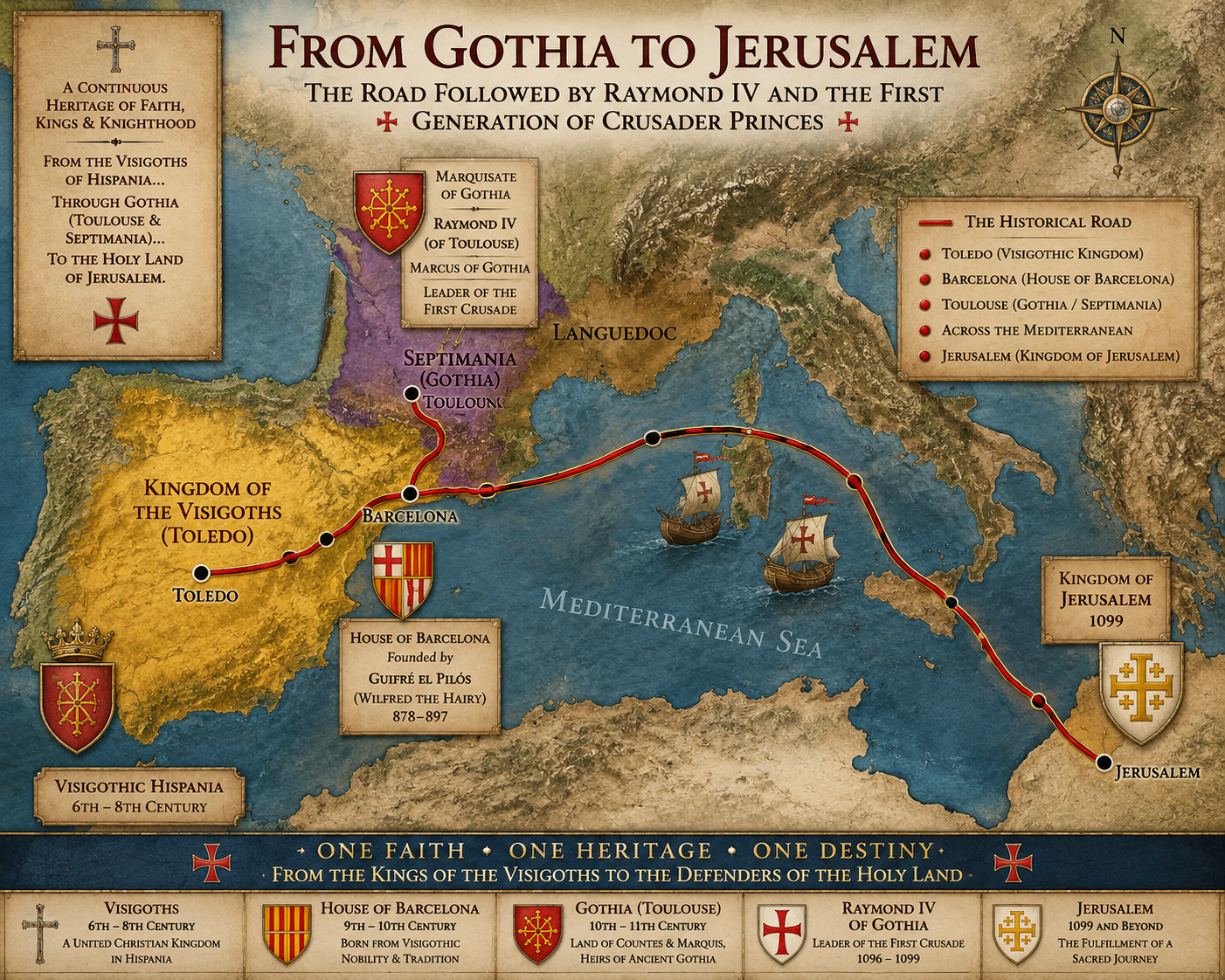
The Three-Part Line of Inquiry
- The line from Raymond IV of Gothia and Toulouse to Guifré el Pilós / Wilfred the Hairy, founder of the House of Barcelona.
- The traditional line from Wilfred the Hairy to King Wamba of the Visigoths.
- The older Gothic royal context from King Wamba toward the earlier Visigothic kings, including Alaric I.
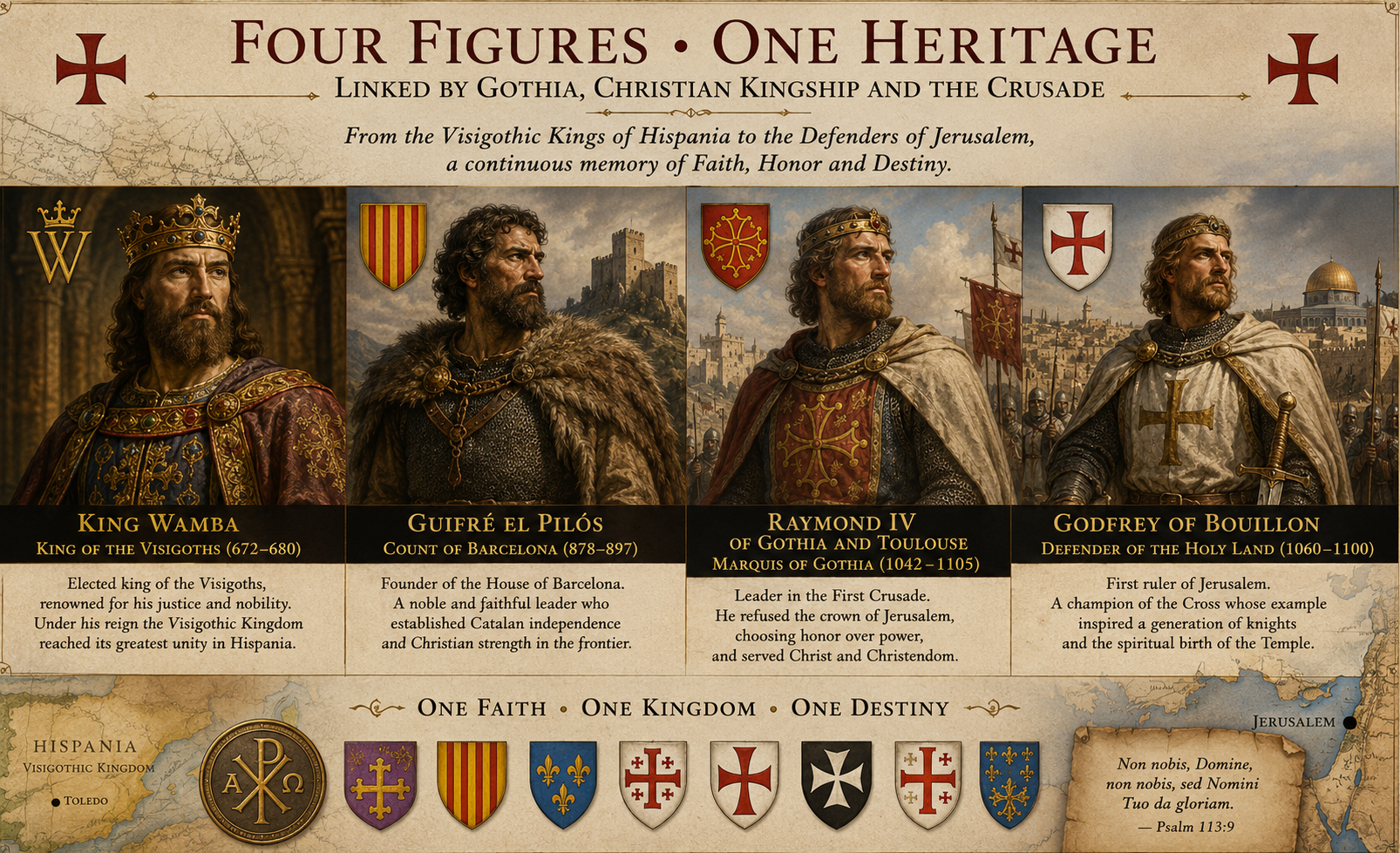
Kingdom of the Visigoths
The Visigothic Kingdom formed one of the great Christian kingdoms of the early medieval West. Its memory remained especially strong in Hispania, Septimania, Gothia, Toulouse, Barcelona, and the lands that later shaped Aragon and Catalonia.

Raymond IV of Gothia and Toulouse
Raymond IV, also known as Raymond of Saint-Gilles, was Count of Toulouse, Marquis of Provence, and a leading prince of the First Crusade. He commanded one of the largest Crusader armies and was among the senior princes present in the campaign toward Jerusalem.
The significance of Raymond IV lies not merely in his military role, but in the title and regional memory attached to him: Gothia, including Septimania, Languedoc, and Toulouse. This places him at the intersection of French, Spanish, Visigothic, and Crusader history.
Genealogical Descent Toward Wilfred the Hairy
- Raymond IV / Raymond of Saint-Gilles — Count of Toulouse and Marquis of Provence.
- Pons of Toulouse — father of Raymond IV.
- William III Taillefer — grandfather of Raymond IV.
- Raymond III Pons — great-grandfather of Raymond IV.
- Pons II of Toulouse — earlier Count of Toulouse.
- Raymond II of Toulouse — earlier Count of Toulouse.
- Raymond I of Toulouse — Count of Toulouse in the 9th century.
- Berno of Septimania — associated with Septimania.
- Guilhem I of Razès — linked to Razès.
- Bello of Razès — early noble ancestor in the Razès tradition.
- Bertrand of Razès — earlier ancestral figure.
- Wilfred the Hairy / Guifré el Pilós — Count of Barcelona, Girona, Ausona, Urgell, Cerdanya, and Besalú; founder of the House of Barcelona.
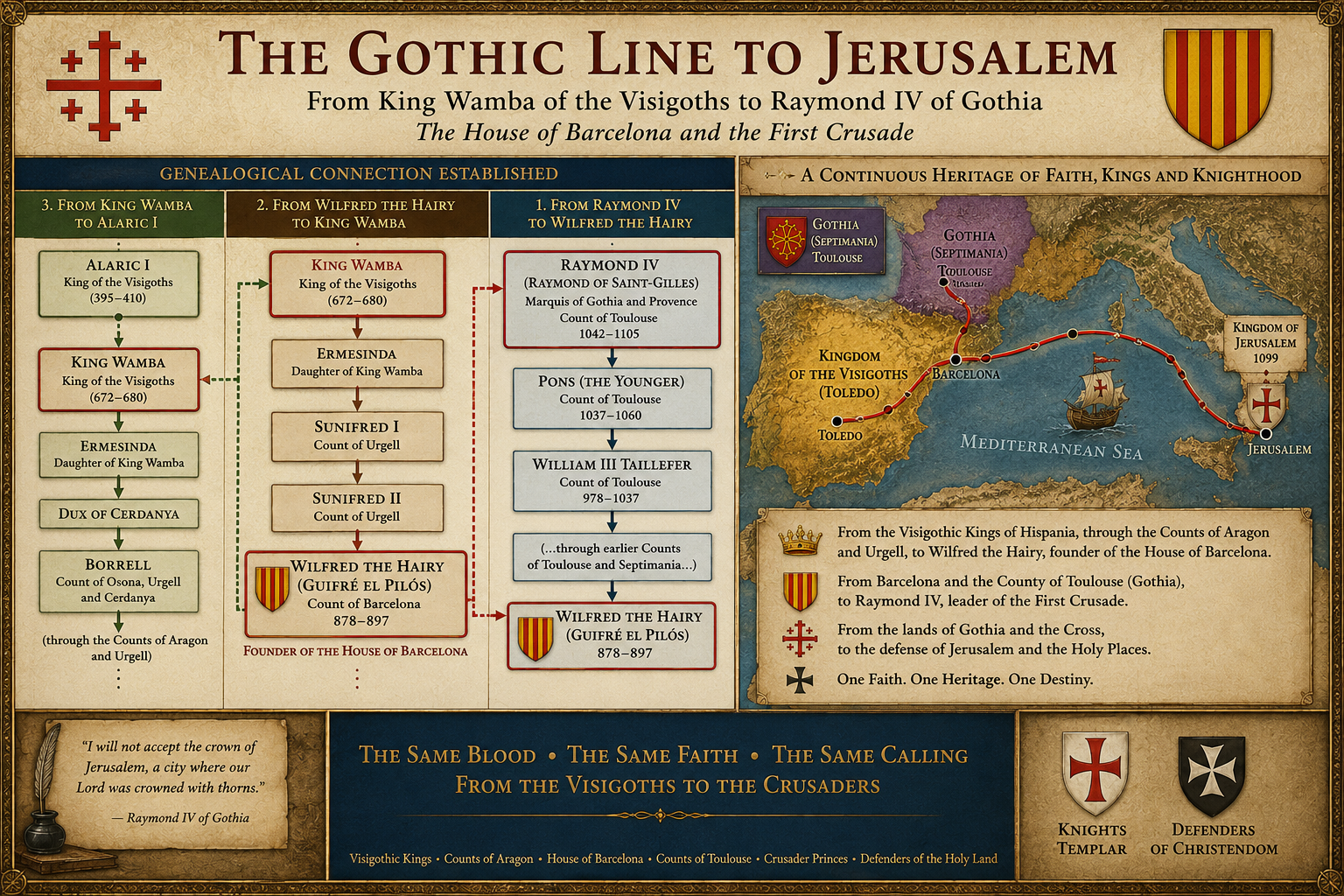
From Wilfred the Hairy to King Wamba
A traditional account associated with the Llibre dels Fets, the Book of Deeds connected with King James I of Aragon, preserves a memory linking the House of Barcelona to King Wamba of the Visigoths. This is especially important because it shows how later medieval rulers themselves understood the prestige of Visigothic descent.
- King Wamba, King of the Visigoths, ruled 672–680.
- Ermesinda, daughter of King Wamba, married the Count/Dux of Cerdanya.
- Borrell, Count of Osona, Urgell, and Cerdanya.
- Galindo Belascotenes, first Count of Aragon.
- Galindo Aznarez, Count of Aragon.
- Aznar Galíndez, Count of Aragon.
- Galindo Aznárez, Count of Aragon.
- Azinar Sunifred I, Count of Urgell.
- Sunifred II of Urgell.
- Wilfred the Hairy / Guifré el Pilós, founder of the House of Barcelona.
King Wamba and the Gothic Royal Memory
King Wamba was widely remembered as one of the most noble and capable figures of the Visigothic world. His election to kingship, preserved in the History of King Wamba by Julian, Bishop of Toledo, reflects the older Gothic principle that kingship was tied not merely to blood, but to recognized nobility, ability, and the election of the best among the people.
Anderson’s genealogical tables are useful here because they preserve older attempts to chart Gothic royal and noble lines, even where later genealogical connections become difficult or disputed.


The Crusader and Templar Question
The earliest years after the capture of Jerusalem remain important for understanding how the first generation of Crusader princes, holy warriors, and later Templar traditions developed. A text attributed to Simon de St. Bertin, written circa 1135–1137, records that during the reign of Godfrey, certain men vowed themselves to God’s Temple, renouncing the world, living communally, and taking up arms only for the defense of the land when necessity demanded.
“While he [Godfrey] was reigning magnificently, some had decided not to return to the shadows of the world after suffering such dangers for God’s sake. On the advice of the princes of God’s army they vowed themselves to God’s Temple under this rule: they would renounce the world, give up personal goods, free themselves to pursue purity, and lead a communal life wearing a poor habit, only using arms to defend the land against the attacks of the insurgent pagans when necessity demanded.”
This passage does not settle every question about formal Templar origins. However, it is a valuable witness to the early spiritual atmosphere in which the later Templar vocation emerged: poverty, discipline, communal life, purity, and defense of the Holy Land.
Raymond IV and the Refusal of Jerusalem
Raymond IV is especially powerful as a historical figure because he reportedly refused the crown of Jerusalem, not wishing to be crowned king where Christ had worn the crown of thorns. Whether interpreted politically, spiritually, or symbolically, the episode helped preserve Raymond as a model of senior crusading authority joined to humility before the Holy Places.
For Spanish, French, and Templar audiences, this matters greatly. Raymond IV stands at the crossing point of Gothia, Toulouse, Septimania, Barcelona traditions, the First Crusade, and the sacred memory of Jerusalem.
The Princes of the First Crusade and the Earliest Templar Tradition
One of the most intriguing questions surrounding the origins of the Knights Templar is whether the commonly repeated narrative beginning with Hugh de Payens in 1118 represents the actual beginning of the movement, or merely the formal organization of an already existing tradition.
An important early witness is Simon de Saint-Bertin, writing circa 1135–1137, who describes events immediately following the capture of Jerusalem in 1099. According to his account, while Godfrey of Bouillon was ruling Jerusalem:
“On the advice of the princes of God’s army they vowed themselves to God’s Temple under this rule: they would renounce the world, give up personal goods, free themselves to pursue purity, and lead a communal life wearing a poor habit, only using arms to defend the land against the attacks of the insurgent pagans when necessity demanded.”
This testimony is remarkable because it places the origins of a Temple-centered religious-military fraternity within the lifetime of the First Crusade itself, nearly two decades before the traditional date associated with Hugh de Payens and the later formal organization of the Order.
The text does not identify a single founder. Instead, it attributes the initiative to the collective advice of the “princes of God’s army.” Among these princes, Raymond IV of Gothia and Toulouse occupies a unique position. He was the eldest and most senior leader of the First Crusade, commanded one of the largest crusading contingents, played a decisive role in the conquest of Jerusalem, and remained in the Holy Land after many others departed.
For this reason, Raymond IV emerges as a plausible candidate for influence in the earliest formation of the Temple movement described by Simon de Saint-Bertin. While the evidence does not permit a definitive claim that he alone founded the later Order of the Temple, it strongly suggests that the earliest Temple-oriented fraternity arose under the patronage, guidance, or encouragement of the leading crusader princes among whom Raymond was pre-eminent.
Viewed in this light, the formal recognition of the Templars in 1129 and the later Papal endorsement of 1139 may represent not the birth of the movement, but rather the institutionalization of a tradition whose roots reach back to the immediate aftermath of the First Crusade and the generation of Raymond IV himself.
Why This Study Matters
This article is not presented as the final word on every genealogical connection. Rather, it is offered as a constructive historical synthesis. It asks whether older Visigothic, Catalan, Occitan, Aragonese, and Crusader traditions should be read together rather than apart.
If so, then the road from Gothia to Jerusalem is not merely a military road. It is a civilizational memory: a path of Christian kingship, noble service, pilgrimage, sacrifice, and the preservation of sacred inheritance.
One Faith • One Heritage • One Sacred Memory
From the Visigothic kings of Hispania, through the House of Barcelona and the princes of Gothia, to the defenders of Jerusalem, this tradition invites renewed study by all who love Christian history, noble service, and the sacred memory of the Holy Land.
Related Studies
- Brunswick Continuing Knights Templar House of the Original Angevin Royals’ branch, with full royal protections of the Templar, including fons honorum
- Goths’ Viking Royalty, Parallel Empire and Cultural Heritage
- Wolfenbüttel-Brunswick Commandery Knights Templar Archive
- Brunswick Grand Commandery of the Knights Templar BrunswickTemplar.org
Non Nobis Domine. Robur et Honestas.