
WATCHMAN NEWS REPORT | AUGUST 15, 2026
NATO Airspace Breached Again:
Is the Ukraine War Spilling Into Europe?
A Russian cruise missile entered Poland. NATO has now shot down another
drone over Latvia. Baltic intelligence services are warning about possible
false-flag attacks. An explosive-equipped drone appeared beside Ukrainian
cargo aircraft in Germany. An ammunition factory exploded near Rome.
And Ukraine has openly warned Belarus that hundreds of potential targets
have already been identified.
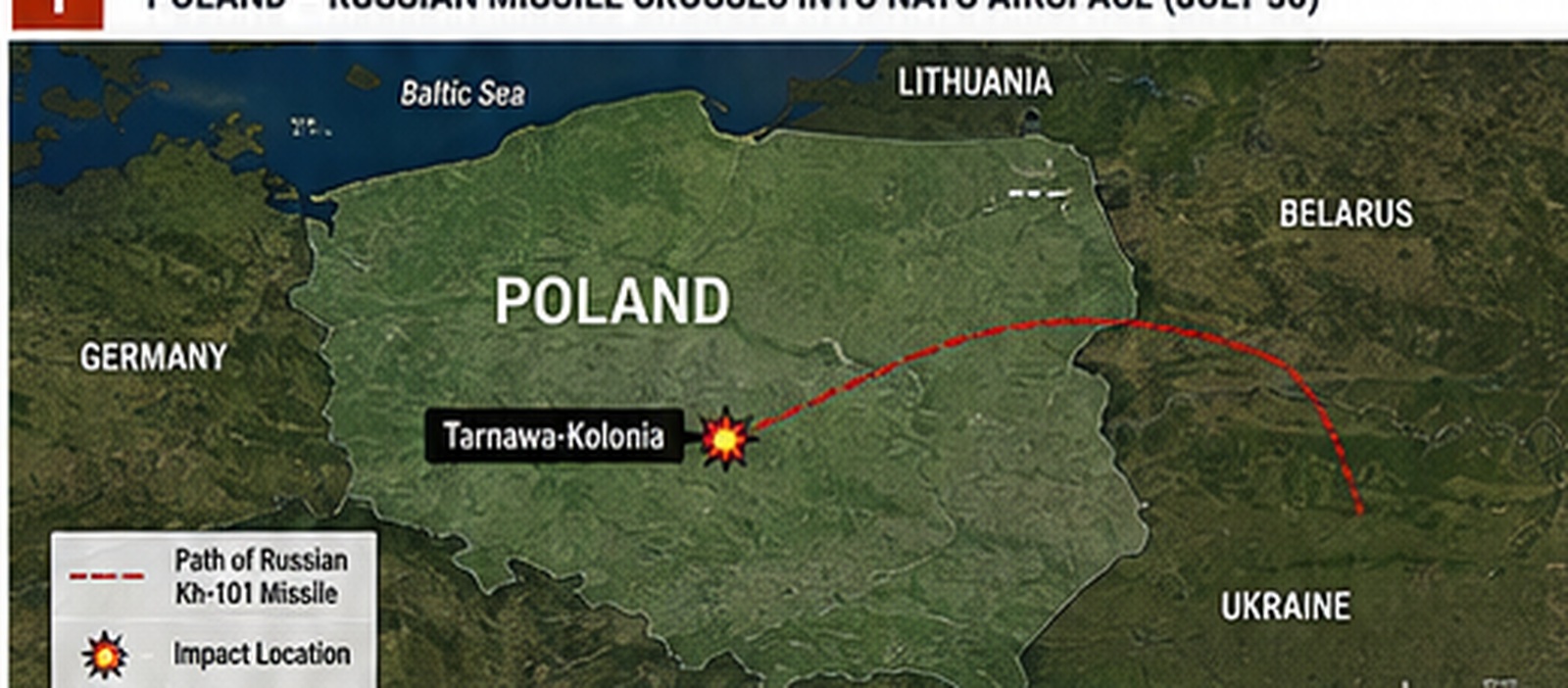
POLAND: The July 30 incident was later confirmed by Polish
authorities to involve a Russian Kh-101 cruise missile that crossed into
Polish territory during a large Russian attack on Ukraine.
Only a little more than a week ago, Watchman News
published a major report examining a disturbing change in the nature of
the Russia-Ukraine conflict.
Russia had begun openly speaking of the confrontation as a
“real war” involving not merely Kyiv, but Western governments
standing behind Ukraine.
At the same time, a reported U.S. intelligence assessment warned that
Moscow could potentially attempt a limited test of NATO’s resolve within
a broader risk period beginning as early as the fall of 2026.
READ THE PREVIOUS WATCHMAN REPORT: From “Special Military Operation” to “Real War”:Is Russia Preparing for a Wider Conflict with the West?
That report emphasized something particularly important:
“The geographic range of attacks is expanding.”
The events since then raise an obvious question:
Are we now beginning to watch that expansion happen in real time?
A Russian Kh-101 Crosses Into Poland
On July 30, 2026, during a major Russian missile and drone
attack against Ukraine, a cruise missile entered southeastern Poland.
After examining the wreckage, Warsaw formally identified the projectile as
a Russian Kh-101 cruise missile.
The missile came down near Tarnawa-Kolonia in Poland’s
Lublin region.
Polish Prime Minister Donald Tusk said Polish forces had been prepared to
shoot the missile down if it had continued deeper into the country.
There were no casualties.
The projectile was identified by Poland as a Russian Kh-101 missile.
Poland is a NATO member. The missile entered Polish territory during a
Russian attack against Ukraine.
There is an important distinction, however.
Polish officials did not establish that Russia had intentionally selected
Poland itself as the missile’s target.
That means the incident should not be represented as a confirmed Russian
attack upon NATO.
But intention is only one component of escalation.
A Russian weapon from the Ukraine war physically crossed onto the territory
of a NATO member.
Major wars do not expand only because governments consciously decide to
launch invasions.
They can also expand through error, electronic warfare, navigation
failure, malfunction, retaliation, or a government’s belief that something
presented as accidental was actually intentional.
For NATO’s eastern members, that danger is no longer theoretical.
SOURCE: Reuters — Poland summons Russian ambassador after Kh-101 missile incident
NATO Shoots Down a Drone Inside Latvian Airspace
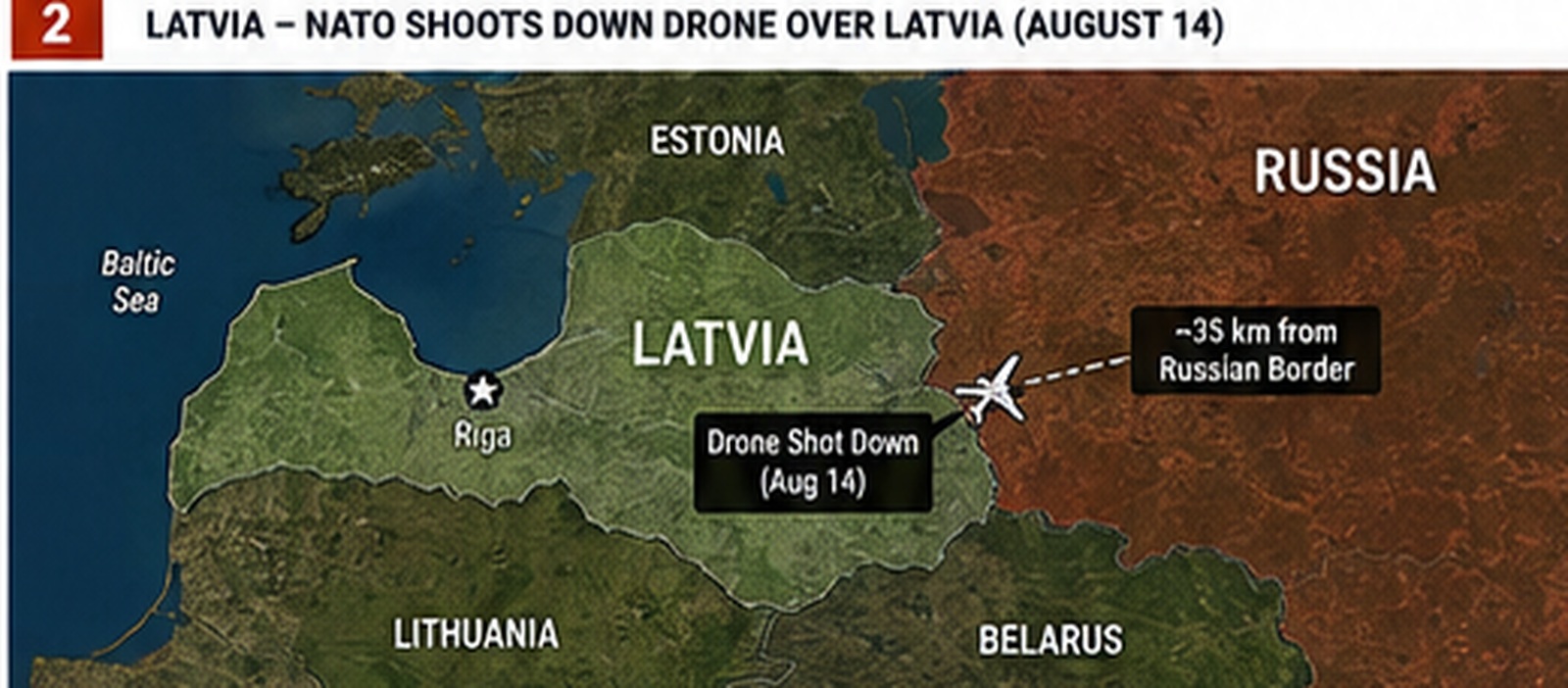
Then came August 14.
A drone entered Latvian airspace near the town of
Rugaji, approximately 35 kilometers from the Russian border.
NATO responded immediately.
Two Italian Eurofighters operating from Lithuania and two Turkish F-16s
operating from Estonia were scrambled.
One of the Italian Eurofighters identified the drone and
shot it down.
As of August 15, Latvian and NATO authorities had not publicly established
the origin of the drone. It should therefore not presently be described
as a confirmed Russian drone.
The wider context nevertheless matters.
The Baltic states have experienced repeated drone incursions during 2026.
Latvian military officials have argued that Russian electronic warfare
activities are contributing to Ukrainian unmanned aircraft straying from
their intended courses.
A Romanian F-16 had already shot down a Ukrainian drone over Estonia in May,
and a French Rafale destroyed another over Latvia in June.
NATO aircraft are now physically shooting down drones produced by the
Russia-Ukraine battlefield after those aircraft enter Alliance airspace.
That is not the same thing as NATO entering the Ukraine war.
But it is another example of the war refusing to remain neatly contained
within Ukraine’s borders.
SOURCE: Reuters — Italian NATO fighter shoots down drone in Latvian airspace
Baltic Intelligence Is Preparing for Something More Deliberate
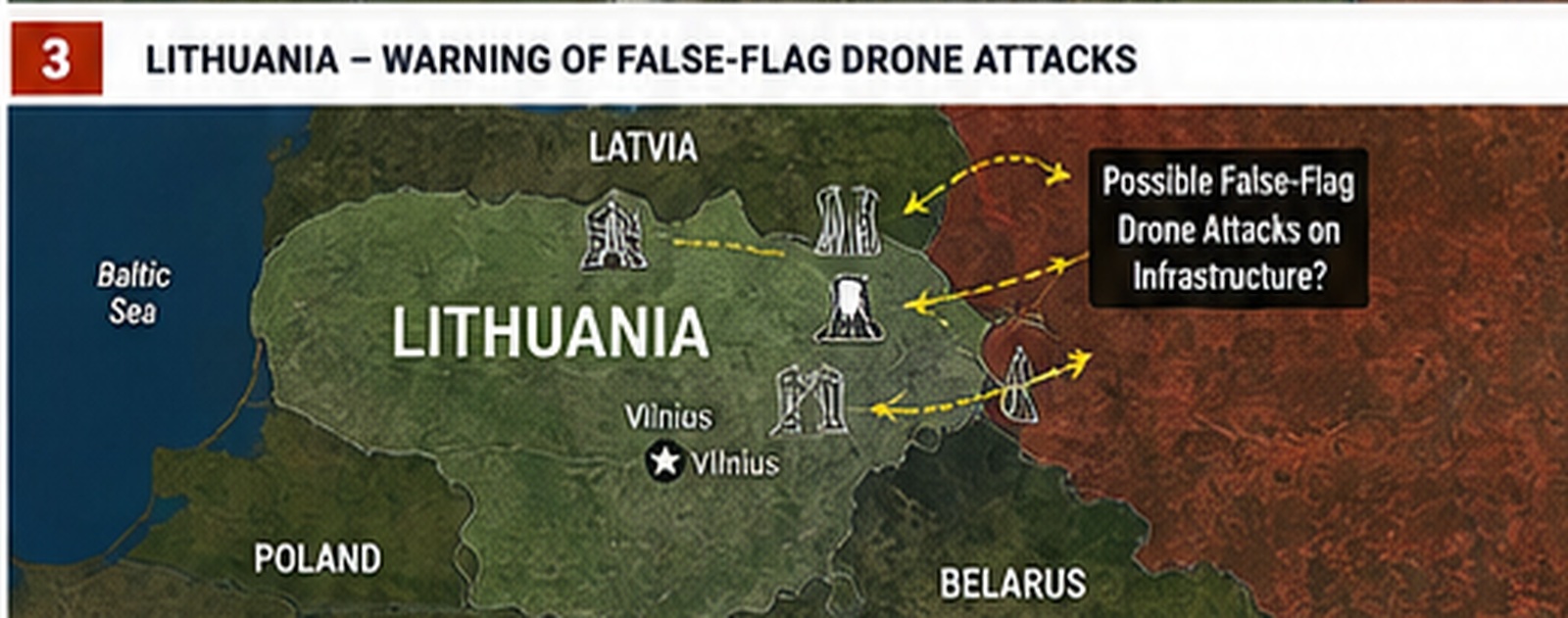
The concern in Lithuania and neighboring NATO states now extends beyond
accidental drone incursions.
Lithuanian officials say intelligence assessments indicate that Russia
could potentially use captured Ukrainian drones in a false-flag
operation.
The objective, according to officials familiar with those assessments,
could be to strike infrastructure either inside Russia or NATO territory
using Ukrainian-manufactured aircraft.
That would create immediate confusion over responsibility.
Who launched the drone?
Was Ukraine responsible?
Was Russia responsible?
Was it an accident?
Was it sabotage?
In a military alliance, uncertainty over attribution can itself become a
weapon.
Poland, Lithuania, Latvia and Estonia have consequently increased security
around critical infrastructure, including energy installations, pipelines,
gas facilities, dams and electrical links.
Lithuania has deployed military personnel to reinforce security around
several strategic facilities.
WHAT THIS DOES NOT MEAN:
No such Russian false-flag attack has been publicly established.
The intelligence assessment concerns a possible operation.
Russia rejects the accusation and has characterized Western warnings about
covert Russian action as attempts to justify increased militarization.
That distinction is essential.
But the fact that NATO governments are now physically guarding infrastructure
against this scenario demonstrates how seriously the danger is being taken.
SOURCES: Reuters — Lithuania says Russia could use Ukrainian drones against Baltic region
Reuters — Poland and Baltics shield infrastructure amid false-flag fears
This Was Not Merely a Drone Watching an Airport
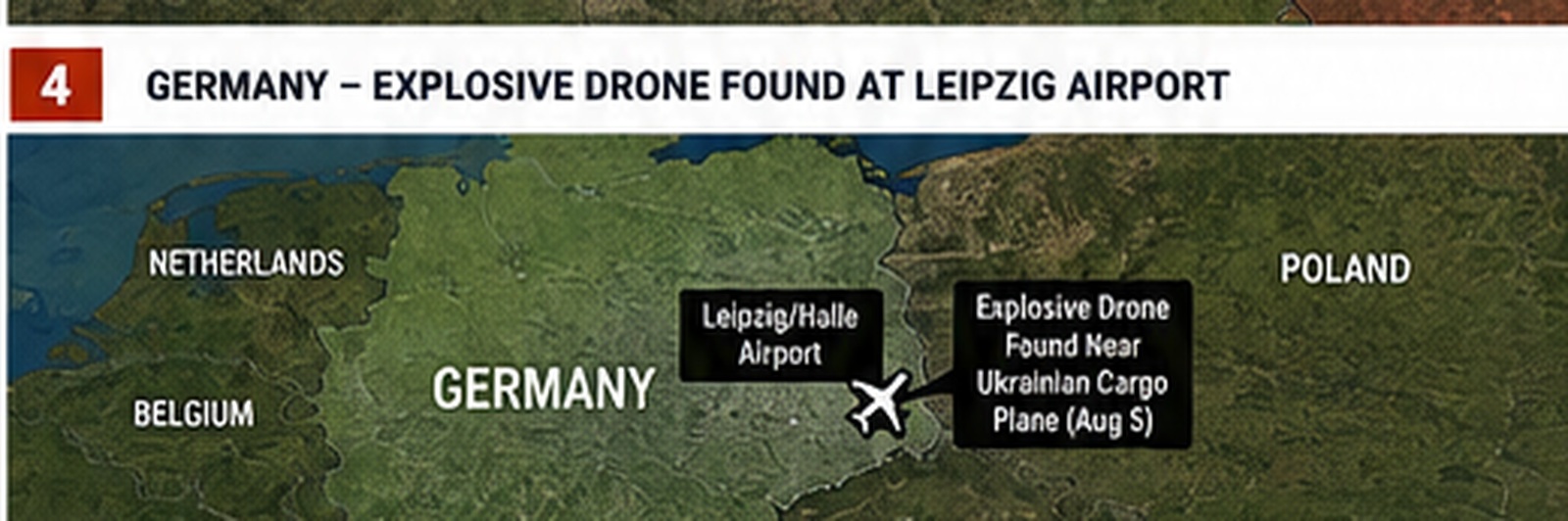
The incident at Leipzig/Halle Airport raises the level of
concern considerably.
German investigators found a drone inside the airport’s secured area near
the south runway on the night of August 4-5.
It was not simply carrying a camera.
German federal prosecutors later said:
“The drone had been equipped with professional explosives and a detonator.”
Bomb disposal specialists removed the detonator.
The drone was discovered in the vicinity of Ukrainian Antonov cargo aircraft,
which have used Leipzig/Halle as an operating base since Russia’s full-scale
invasion.
German media subsequently reported that an aircraft near the drone had been
carrying ammunition.
Germany’s federal prosecutor took control of the investigation.
THE ATTRIBUTION QUESTION:
German investigators have not publicly announced a final attribution to
Russia.
However, subsequent American reporting citing U.S. intelligence officials
said American intelligence believes Russia was behind the explosive-drone
operation.
German Interior Minister Alexander Dobrindt described the incident as part
of a professional hybrid-threat scenario.
There is another disturbing connection.
German reporting indicated that DNA evidence recovered in the investigation
may be linked to evidence associated with a 2024 incendiary-device case
being prosecuted in Lithuania, where alleged Russian intelligence connections
have already been investigated.
If the Russian attribution is eventually established, an explosive device
connected to a Russian operation will have reached a major European logistics
hub supporting Ukraine — inside Germany.
That would represent a far different category of escalation from a missile
accidentally crossing a frontier.
SOURCES:Reuters — Explosive drone discovered at Leipzig/Halle Airport
Reuters — German federal prosecutor takes over explosive drone investigation
The Guardian — U.S. intelligence reportedly believes Russia was behind Leipzig drone bomb
Then Came the Massive Blast Near Rome
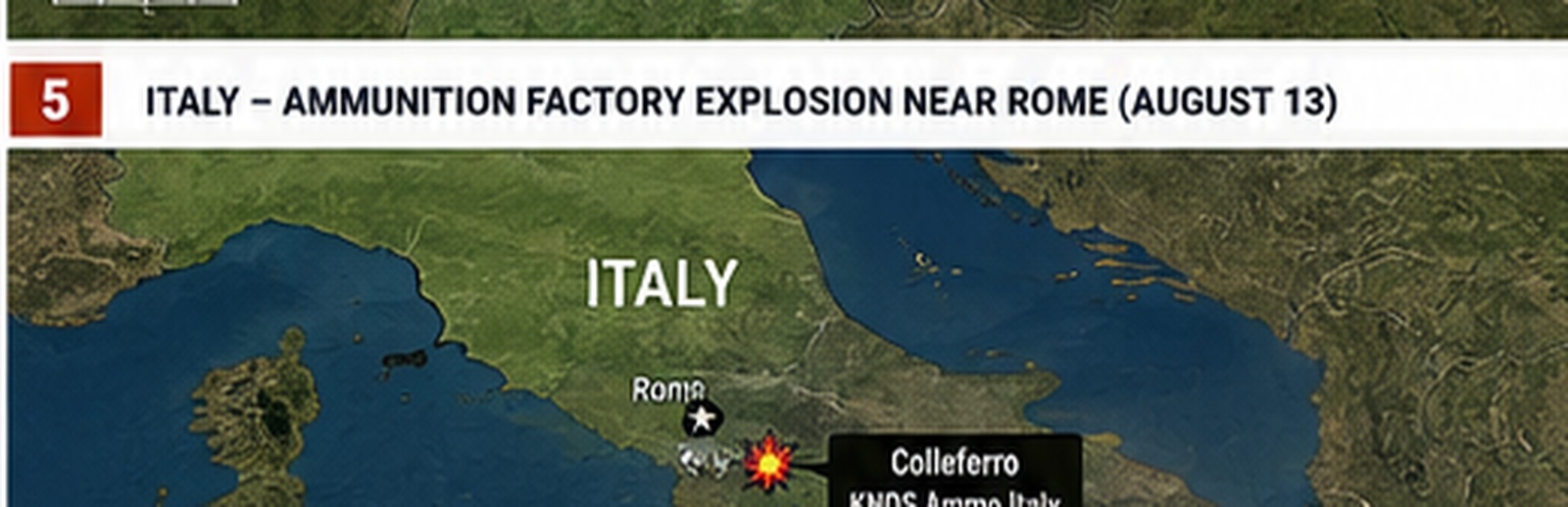
On August 13, a powerful explosion struck the
KNDS Ammo Italy munitions facility at Colleferro,
southeast of Rome.
The blast was powerful enough to be heard kilometers away and produced a
towering cloud visible across the surrounding area.
Firefighters and police were already responding to a fire when the explosion
occurred.
According to initial reports, the blast originated in or around the
facility’s powder-pressing department.
Remarkably, no injuries were reported.
All 24 workers believed to have been at the facility were accounted for.
WHAT IS KNOWN:
KNDS Ammo Italy manufactures ammunition and defense-related products.
Police and prosecutors are investigating the cause.
As of this report, there is no publicly established evidence that
Russia caused the explosion.
That qualification cannot be buried.
An industrial fire or accident remains a completely plausible explanation.
Watchman News is therefore not reporting that Russia blew
up the Italian ammunition factory.
But context matters.
European governments are simultaneously investigating sabotage networks,
explosive drones, covert activity around military facilities and potential
attacks against Ukraine-related logistics.
Europe has reached the point where a major explosion at an ammunition factory
naturally raises a national-security question that investigators must now
rule in or rule out.
The answer may prove mundane.
It may not.
What matters journalistically is maintaining the distinction between
what happened and what has not yet been proven.
SOURCES:Reuters — Large explosion rips through Italian munitions factory
Associated Press — Huge explosion at KNDS ammunition factory near Rome
Ukraine Says It Has Already Identified Hundreds of Potential Targets
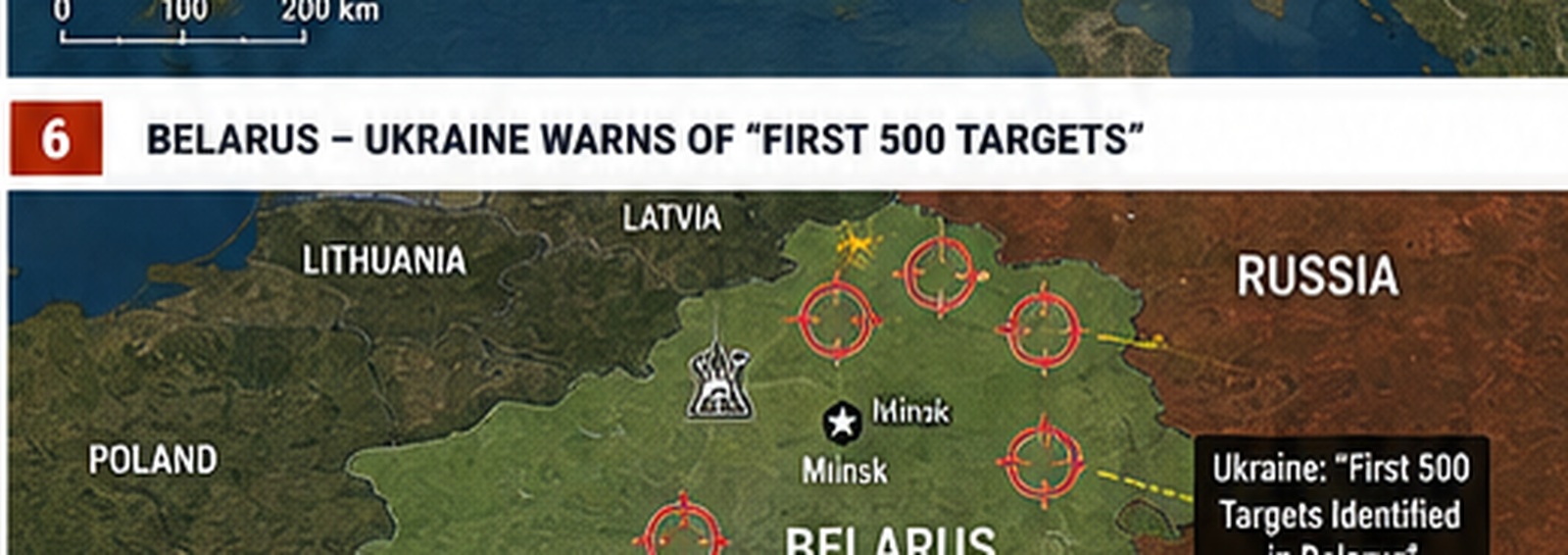
Escalation is not moving in only one direction.
Ukraine itself has issued increasingly explicit warnings to Belarus.
In May, the commander of Ukraine’s Unmanned Systems Forces,
Robert “Madyar” Brovdi, warned Belarusian leader Alexander
Lukashenko against becoming more deeply involved in Russia’s war.
Brovdi said Ukrainian forces had already identified approximately
500 potential targets inside Belarus.
Ukraine was openly signaling that Belarusian territory would not necessarily
remain beyond the reach of its drone forces if Minsk became a more direct
participant in the war.
Then the warning moved from a military commander to the Ukrainian president.
President Volodymyr Zelensky said Ukraine had identified Russian equipment
inside Belarus that Kyiv says assists attacks against Ukrainian territory.
Ukraine specifically identified signal-relay stations in the Belarusian
regions of Gomel and Brest.
Zelensky gave Belarus approximately one week to remove or
disable the equipment.
His warning was explicit:
“If he doesn’t do it, we’ll do it.”
The Kremlin responded by accusing Kyiv of threatening Belarusian sovereignty.
Belarus has not committed its own army to combat against Ukraine.
Nevertheless, Russian forces used Belarusian territory as a major launchpad
during the opening phase of the 2022 invasion, while military cooperation
between Moscow and Minsk has continued.
WHY THIS MATTERS:
If Ukraine eventually begins conducting deliberate strikes against military
or dual-use infrastructure inside Belarus, another internationally recognized
state will have become an active geographic theater of the war.
That could force decisions not only in Minsk and Kyiv, but also in Moscow.
Russia and Belarus are deeply integrated militarily and politically.
A Ukrainian strike inside Belarus could therefore create an entirely new
escalation pathway.
SOURCES:Euronews — Ukraine drone commander says 500 potential Belarus targets identified
Reuters — Zelensky gives Belarus one week to remove equipment used in attacks
Reuters — Kremlin accuses Ukraine of threatening Belarusian sovereignty
Do Not Look at These Incidents Only One at a Time
POLAND:
A confirmed Russian Kh-101 cruise missile enters NATO territory.
LATVIA:
NATO fighters shoot down another drone inside Alliance airspace.
Its origin remains under investigation.
LITHUANIA:
Intelligence services warn that captured Ukrainian drones could potentially
be used in Russian false-flag operations against critical infrastructure.
GERMANY:
An explosive-equipped drone is discovered beside Ukrainian cargo aircraft
at Leipzig/Halle Airport. U.S. intelligence reportedly suspects Russia.
ITALY:
A major European ammunition plant explodes outside Rome.
The cause remains under investigation and Russian involvement has not been
established.
BELARUS:
Ukraine says hundreds of potential targets have already been identified,
while its president warns that equipment supporting Russian attacks must
be removed.
These events do not all have the same cause.
That is important.
Some involve a confirmed Russian weapon.
Some involve drones whose exact origin has not yet been established.
Some concern intelligence warnings about operations that may never occur.
One involves an explosive device where Russian attribution is increasingly
suspected but has not yet been formally declared by Germany.
Another may ultimately prove to have been nothing more than a terrible
industrial accident.
The common denominator is not proven Russian responsibility for every event.
The common denominator is the increasing difficulty of keeping the war
geographically contained.
This Did Not Begin This Week
The events covered in this report should not be interpreted in isolation.
Our earlier Watchman investigation documented a larger strategic change
already underway.
Russia had begun describing its confrontation with Ukraine and the West as
a “real war.”
The Kremlin was explicitly naming European capitals and Washington as powers
standing behind Kyiv.
U.S. intelligence was reportedly considering scenarios in which Moscow might
eventually test NATO’s resolve with something short of a massive conventional
invasion.
Ukraine, meanwhile, was extending its own strikes dramatically deeper into
Russian territory.
The original report asked:
“How many countries will eventually be considered participants in the conflict?”
FULL BACKGROUND REPORT:
That broader process has been underway for some time.
What is changing now is the frequency with which the weapons, drones,
sabotage concerns and retaliatory threats associated with the war are
touching territory outside Ukraine itself.
How Does a Regional War Become a European War?
It does not necessarily begin when one head of state appears on television
and declares:
“Today we begin a wider European war.”
History is often less orderly than that.
A missile crosses a border.
A drone enters another country’s airspace.
Then another drone.
An explosive device appears at an airport.
Critical infrastructure receives additional military protection.
An unexplained ammunition-factory explosion triggers a sabotage investigation.
A neighboring government announces that hundreds of targets across another
border have already been identified.
Each incident can remain below the threshold of general war.
Each government may have powerful reasons not to escalate.
Each side may insist that it remains in control.
Until one incident produces a response that produces another response —
and the threshold suddenly disappears.
Not Every Incursion Means Article 5 — But Every Incident Tests Decision-Making
It is important not to sensationalize NATO’s collective-defense mechanism.
A missile accidentally entering NATO territory does not automatically mean
that NATO must declare war.
Nor does an unidentified drone automatically constitute a deliberate armed
attack by Russia.
NATO governments must determine what occurred, who was responsible, whether
the action was deliberate, and what response is proportionate.
That is precisely why ambiguous warfare can be so dangerous.
The most destabilizing incident may be one serious enough to demand a response,
but ambiguous enough that the allies disagree over what actually happened.
That is why Lithuania’s false-flag warning deserves attention.
The strategic value of such an operation would not necessarily lie in the
amount of physical destruction.
It could lie in the argument that followed.
Was Russia responsible?
Was Ukraine responsible?
Was it an accident?
Does Article 5 apply?
Should NATO respond militarily?
Would Washington support that response?
Would every European government?
Those questions could be almost as strategically valuable to an adversary
as the drone itself.
The Battle Lines Are Moving
None of the evidence presented here proves that World War III has begun.
It does not prove that Russia has decided to invade NATO.
It does not prove that every unidentified drone over Europe is Russian.
It does not prove that the Italian ammunition-factory explosion was sabotage.
And it certainly does not mean every alarming incident should be forced into
a single conspiracy theory.
That would obscure what is actually happening.
The more defensible warning is also the more important one:
the geographic boundaries of the Ukraine war are becoming increasingly
porous.
Weapons are crossing borders.
NATO aircraft are firing on drones over Alliance territory.
European governments are guarding infrastructure against suspected hybrid
operations.
An explosive drone has appeared at one of Europe’s major Ukraine-related
cargo hubs.
Ukraine is openly establishing conditions under which targets inside Belarus
may become subject to attack.
And all of this is occurring while the political language surrounding the
war is itself becoming broader.
The previous Watchman Report asked whether the conflict was changing from a
limited Russia-Ukraine war into something involving Russia and the West more
directly.
This week’s incidents do not answer that question conclusively.
But they make it harder to dismiss.
How many borders can the weapons of this war cross before somebody decides
that the war itself has crossed the border with them?
That is the question worth watching now —
rather than explaining afterward.
— WATCHMAN NEWS REPORT
WATCH THE BORDERS. WATCH THE ESCALATION.
Share this report with readers following NATO, Russia, Ukraine,
Belarus and the developing security situation in Europe.
EDITOR’S NOTE:
This report distinguishes confirmed events from intelligence assessments,
reported suspicions and incidents still under investigation.
Where attribution has not been established, Watchman News does not present
it as established fact.
This report may be updated as investigations in Germany, Italy, Latvia and
elsewhere produce additional evidence.