
Special Human Ecology Report
Deportation, Demographic Collapse & the Weaponization of Children
How Soviet and Russian population engineering continues to destabilize Europe’s human ecosystem
By Watchman News
January 2026
I. Why Deportation Is Not a “Historical Footnote”
For most Western audiences, the word deportation evokes distant images of Stalin, gulags, or long-past horrors of the Second World War. Yet for large portions of Eastern Europe, deportation is not history — it is a living system of governance that continues today.
From ethnic Germans in Ukraine, to Crimean Tatars, to Poles, Balts, Koreans, Chechens, and now Ukrainian children, Moscow has repeatedly used forced population transfers to erase identity, break resistance, and permanently alter who belongs to the land.
This is not simply repression. It is demographic engineering — the deliberate manipulation of the human ecosystem of entire regions.
And it is happening again.
II. Ethnic Germans Were Native to Ukraine — Not Foreigners
Contrary to widespread misconception, ethnic Germans were not wartime invaders in Ukraine. They were indigenous settlers whose presence predated modern Russia itself.
Ukrainian historians now confirm that German communities existed on Ukrainian lands as early as the 10th century, during the era of Kyivan Rus and the Galician-Volhynian Kingdom. But the largest wave of German settlement occurred in the 18th century, when Germans fleeing war and religious persecution in Central Europe accepted invitations from the Russian Empire to colonize and develop southern Ukraine.
These Germans built entire towns, farms, and industrial centers. By the early 20th century, Ukraine contained fully German districts, including:
• German-majority districts in Volhynia
• German cities in Odesa Oblast
• German colonies in Zaporizhzhia
• German settlements in Kherson
These were not minorities sprinkled among others. They were self-contained, multi-generational communities, with their own churches, schools, and economies.
Pre-war Ukraine contained approximately 1.8 million ethnic Germans, according to historical census data, USSR official deportations etc.
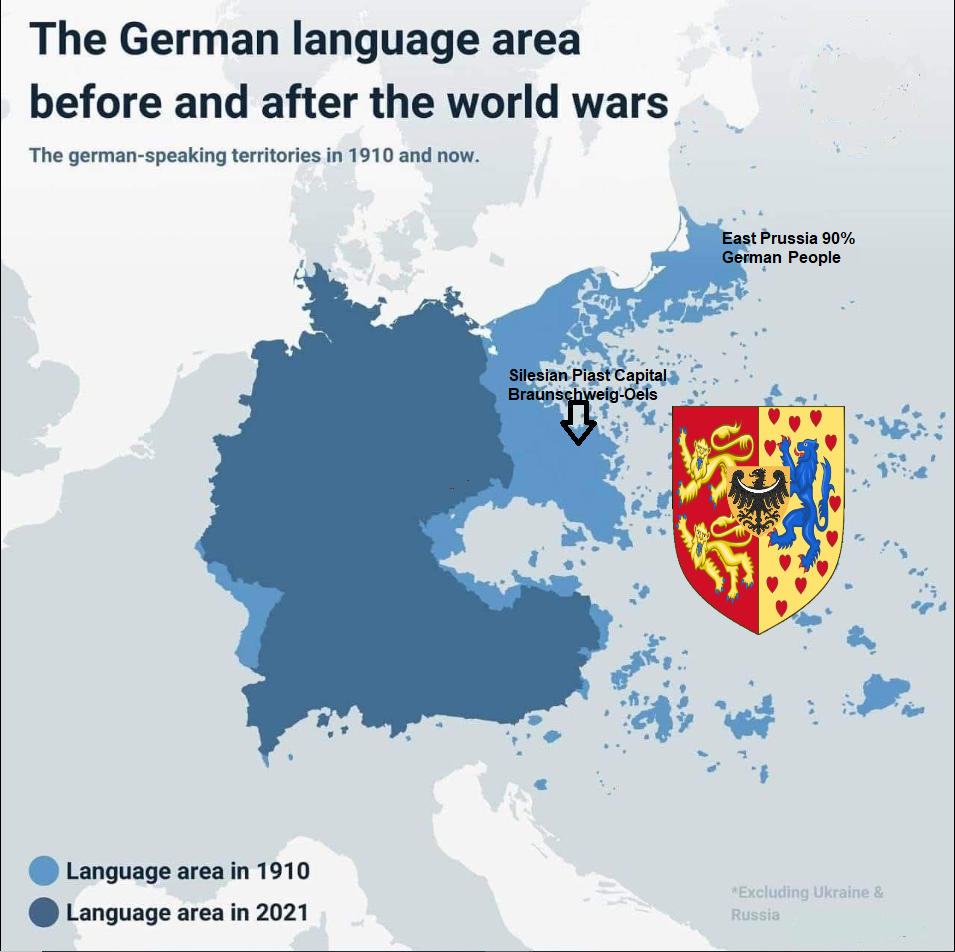
A visual representation of this reality is preserved in the 1910 census maps showing extensive German-speaking regions across southern and eastern Ukraine.
III. How Moscow Criminalized an Entire People
The destruction of these communities did not begin with Hitler. It began earlier.
During the 1930s, German engineers and farmers — many of whom had helped industrialize Ukraine — were increasingly accused of being “foreign spies” and “kulaks.” The narrative of suspicion was already being built.
When Nazi Germany invaded the USSR in 1941, the Soviet regime used the war as pretext to enact something far broader: collective punishment.
All ethnic Germans — regardless of personal beliefs, loyalty, or history — were declared Nazi collaborators.
Ukrainian historians now confirm that in 1941:
• Entire German towns were emptied
• Families were deported to forced labor camps
• Men, women, and children were sent eastward under guard
This was not justice. It was ethnic punishment.
Even after Stalin’s death, the repression continued.
A special Soviet decree forbade ethnic Germans from returning to their homes until 1974 — nearly 30 years after the war had ended.
The land was taken. The churches abandoned. The cemeteries left to decay.
Ukraine lost one of its most productive, stable, and deeply rooted populations — not through war, but through administrative erasure.
IV. The Kremlin Is Doing It Again — But Worse
What happened to the Germans is now happening to Ukrainians — particularly to their children.
According to Ukrainian historian Vladyslav Havrylov, modern Russian deportation policy is more advanced and more dangerous than its Soviet predecessor.
During 2022 and 2023, Russian authorities deported Ukrainian children to:
• Rostov Oblast
• Voronezh Oblast
• Belgorod Oblast
• Belarus
There, they were placed into “temporary accommodation centers,” which were in fact pre-planned indoctrination hubs.
Once inside Russia, deportation is only the first stage.
The next stage is reprogramming.
Children are placed into:
• Russian state education systems
• Russian nationalist curricula
• Paramilitary youth organizations such as:
– Yunarmiya
– Movement of the First
– Orly Rossii
These are not cultural clubs. They are militarization pipelines designed to convert kidnapped children into future soldiers for the Russian state.
As Havrylov explains, this is no longer merely deportation — it is biological and psychological capture.
V. How Many Children Have Been Taken?
The official Ukrainian government registry (Children of War) confirms:
• 19,546 Ukrainian children have been identified as deported
• Only 1,605 have been returned
These are only the documented cases.
Independent Western researchers estimate far higher numbers:
• Yale University: ~35,000
• European researchers: 200,000–300,000 possible cases
• 1.6 million Ukrainian children currently live under occupation
Russia refuses to release full lists.
This means thousands of children may never be found.
VI. Why Deportation Creates Permanent Instability
Deportation is not temporary displacement. It is ecological collapse.
When Moscow removes one population and replaces it with another — whether Germans in Ukraine, Ukrainians in Donbas, or Russians in Mariupol — it permanently breaks:
• Property continuity
• Cultural inheritance
• Social trust
• Family lineage
• Language ecology
The result is not peace. It is generational instability.
Occupied cities like Mariupol are now being filled with migrants from Dagestan, Tuva, Buryatia, and Mordovia — people who have no historical roots to the land and no loyalty to its future.
This is the same strategy used in Kaliningrad (former East Prussia), where a 100% German population was erased and replaced after 1945.
The result was not integration — it was cultural sterilization.
VII. The Forgotten German Question
Pre-war East Prussia (now Kaliningrad) had nearly three million Germans. It was not legally annexed until after Germany’s defeat. It was emptied under the same “denazification” banner used against Germans in Ukraine.
More on this history can be found here:
https://watchman.news/2025/02/the-forgotten-german-land-why-kaliningrad-must-be-restored-to-its-rightful-sovereign/
These deportations created millions of displaced German families who never received restitution.
The destruction of German Ukraine and German East Prussia was not a war necessity. It was post-war ethnic engineering.
VIII. Why This Still Matters
Russia now claims it is “denazifying” Ukraine.
But history reveals what that word really means in Moscow’s vocabulary:
It means erasing whoever stands in the way of imperial control.
Germans were called Nazis.
Ukrainians are called Nazis.
Baltic peoples were called fascists.
Chechens were called extremists.
The label changes. The machinery does not.
IX. A Different Future Is Possible
Ukraine will soon receive hundreds of billions in Western reconstruction funding under US-backed security guarantees.
This creates a historic opportunity.
Instead of repeating Soviet-style demographic erasure, Ukraine could:
• Restore property rights to displaced families
• Rebuild destroyed towns as multi-ethnic zones
• Invite German-Ukrainian descendants to return
• Offer land grants to young families
• Create protected cultural districts
This is not removal. It is restoration.
Entire regions of southern and eastern Ukraine have been bombed into emptiness. They are depopulated. No one is being displaced — there is nothing left to displace.
Repopulation through voluntary return is healing, not conquest.
X. Why This Is Human Ecology
This is not geopolitics. This is human ecology — the science of how populations, identity, and environment interact.
Deportation creates:
• Trauma cycles
• Crime waves
• Demographic collapse
• Cultural self-hatred
• Fertility decline
• Intergenerational instability
The NTA International Department of Human Ecology has issued a professional report analyzing these effects:
https://ntawellness.com/reports/HE-2026-01.pdf
It documents how forced population engineering destabilizes entire civilizations.
XI. The Moral Test of Our Time
Western leaders speak of democracy and human rights — but forced deportation remains one of the least confronted crimes.
The truth is simple:
If Germany’s destruction through deportation was unjust,
then Ukraine’s destruction through deportation is unjust.
If Crimean Tatars deserve return,
so do Germans.
If Ukrainian children must be returned,
so must Ukrainian Germans.
Human dignity is not selective.
XII. Conclusion: A Chance to Break the Cycle
Russia’s war is not only about territory. It is about who belongs.
Ukraine now has the chance to do something radically different:
To rebuild not just cities — but communities.
To prove that Europe has moved beyond population engineering.
And to finally heal the wounds opened by deportations that never truly ended.
Eindnoten
-
Vladyslav Gavrylov interview, History Without Myths, 2024
-
Children of War Registry, Government of Ukraine
-
Yale University Humanitarian Research Lab
-
NTA International Department of Human Ecology & Wellness
https://ntawellness.com/reports/HE-2026-01.pdf - Vladyslav Gavrylov interview, How Russians used DEPORTATIONS to DESTRUCT THE IDENTITY of peoples https://www.youtube.com/watch?v=WH3OStRe0vM
-
Watchman News archives on Kaliningrad and German displacement
https://watchman.news/2025/02/the-forgotten-german-land-why-kaliningrad-must-be-restored-to-its-rightful-sovereign/
 Dutch
Dutch  English
  German
  Polish
  Swedish
  French
  Ukrainian